Showing posts with label Federation of Indian Rationalist Associations. Show all posts

Thursday, 29 August 2013

Who Killed Narendra Dabholkar?


Ram Puniyani


The brutal killing of Dr. Narendra Dabholkar (20th August 2013) is a big jolt to the social movement against blind faith and superstitions. During last few decades the tendency for promotion of rational thought parallel to social change came up as Popular Science movement. In Maharashtra it took shape in the form of a movement, Andh Shraddha Nirmoolan Samiti (Committee for Eradication of Blind faith), where it became a powerful campaign for popular awareness, under the leadership of Dr. Narendra Dabholkar. There were those who were uncomfortable due to Dr. Dabholkar’s work against blind faith and superstitions and so he started getting threats to his life. Before his death he got several threats, one of which said, they will give him the same fate as that of Gandhi. After his killing Sanatan Prabhat, a Hindutva ideology paper, which constantly spew poison against him, commented that ‘one gets what one deserves’.

The practitioners and supporters of blind faith surely know that their art is a hoax, were sure that their blind magic can’t kill the pioneer of a rationalist movement, so they did hire assassins to kill Dabholkar. He was recipient of regular abuses from the Hindutva organization, Hindu Janjagruti Samiti, on their web posted claims that they have exposed anti Hindu conspiracy. In their publications they put across abuses for him in gay abandon, one of which read, ‘Dabholkar’s group” should permanently make their faces black for their misdeeds against Hindu religion.”


As such Dabholakar was not against religion or faith. He strongly condemned the practices of blind faith and superstitions, promoted and practiced by Babas and their ilk, who proactively practiced and propagated retrograde practices.  Some of these practices like and Karni, Bhanamati are the ones’ in which magical rites are performed in the name of supernatural power. Some other practices are like offering of ash, talisman, charms etc. for the purpose of exorcism and to drive out evil spirits or ghosts. These Godmen and their types claim to be in possession of supernatural powers and advertise this claim. Many a times they claim to be reincarnation of a particular Saint or God, and this way they cheat the gullible and God-fearing simple folks. They do perform so called black magic and spread fear in society. The act which Dabholkar was campaigning for, which the Government adopted after his assassination, makes such practices as an offence under this act. Just a reminder that when this act was first brought up for discussion BJP-Shiv Sean combine strongly opposed the same. He was critical of these irrational practices, and for this he was labeled to be anti Hindu.

Apart from these upholders of politics in the name of Hindu religion other conservatives were also against the activities carried out by his organization. Faith is a complicated phenomenon, true it is needed by a section of society. Faith in supernatural power, faith in institution built around the names of prophets and individuals operating in the name of some religion or God have to some extent provided an emotional support to many in this cruel World with gross deprivations and inequalities. Recognizing this weakness of humans many a religio-entrepreneurs have systematically converted the faith into blind faith, a series of rituals, acts, which are deliberately used to exploit the gullible.

The battle between these two tendencies is old enough. Reason on one side and faith on the other. Reason believes in questioning the existing beliefs and to keep going beyond the prevalent knowledge. Faith, particularly the one constructed around the ‘institutions of religion’ begins with unquestioning subservience to the prevalent norms, beliefs and rituals. Many individuals who go in to establish their enterprises around these rituals, claim to be having divine powers. Incidentally, most of the founders of religions, the prophets, had questioning mind and they questioned the existing norms, values and practices. It is precisely for this that many of them were tormented and punished by the powers that ruled. The clergy, which built institutions around the names of these prophets or supernatural powers, developed rituals in the names of these prophets. The clergy and their practices were most static. Such tendency promotes status quo not only of knowledge but also of social situations and relations.  Clergy promoted the social status quo and so demanded unquestioning loyalty to their interpretation of religion and social norms as dictated by them.

There are many incidents in the history, where those who came up with rational thought were not only killed but sometimes harassed to no end. We know the fate of Charvak in India, who questioned the supernatural authorities of Vedas, he was condemned, and his writings were burnt. In Europe, Copernicus and Galileo’s plight at the hand of clergy is another chapter, while the scientists like Bruno, Servatus who argued that diseases are due to Worldly reasons and not due to the wrath of God, were burnt alive by the machinations of clergy. The idea here was very simple, if people start understanding that the diseases are due to bacteria or other etiological factors, the earlier practices of pleasing God through the clergy for healing will come to a halt and clergy’s social power will decline.

In India as the secularization process, the land reforms plus reduction of the hold of clergy remained incomplete, the power of clergy in social field continued. Indian Constitution talks of promotion of scientific temper and people like Nehru kept promoting the inculcation of this scientific temper. Meanwhile the political tendencies operating in the name of religion, kept opposing scientific, rational thinking and kept uncritically glorifying the ancient past, ancient practices cultivated by the clergy to exploit the gullible society, society in the grip of uncertainty and deprivation.

India did witness the rational movements to promote the scientific temper, but its impact in the society remained marginal. With the rise of communal politics from the decade of 1980, the blind faith took a massive leap with hoards of Babas and acharyas, setting up their religious enterprises, enterprises which probably turned out to be most profitable by any standard. One hopes that the business schools are able to calculate the returns on the investments in such enterprises some day. In addition many such Babas extracted the additional bonus of physical pleasures of another kind, the way currently Asaram Bapu is being accused of and so many of them have had their fill. In a crass manner many of the small and high level players also incorporated magical tricks like producing ash and gold from nowhere as their trademark of divine powers. It is these tricks which were being exposed by Dabholkar’s groups. 

The practitioners of blind faith and these hoards of five-seven star babas, get their legitimacy and appreciation from leaders of different hues. While those coming from RSS stable are firmly with them at all the levels, even politicians from other tendencies also personally support and follow these tricksters, Babas, Godmen and their whole tribe. The communalists stand to support them ideologically the way Sanatan Sanstha, while abusing Dabholkar also talked of his work being ‘anti Hindu’! A similar trickster, Benny Hynn did public performances for faith healing, and there is no dearth of the ‘Baba Bangali’ series indulging in such trade.

It took Dabholkar’s sacrifice for Mahrashtra Government to pass and bill against blind faith for which Daholkar was struggling from decades. He had collected data that it is women who are the biggest victims of those practicing black magic. He had been talking of taking on the highly rewarding trade of gems and their magic powers, in due course. Alas, that was not to be! Will other state Governments follow suit and try to bring a control on the flourishing trade of blind faith, black magic and its ilk? Will the progressive social movement take up the cause of the major victims of these abominable practices and take the society forward to the path of rational thought, rational culture and rational politics, away from the trappings of the faith based blindness. While our ‘scientific establishment’ has made giant strides the scientific thinking still lags behind as science is being practiced mostly as an instrument and not as a way of life. That’s how in many of science and technology institutions, on Dussera day, computers are worshipped with flowers and by putting vermillion on the forehead of the monitors! Can sacrifice of Dabholar wake up our policy makers to such a serious lacuna in our teaching and practice of science? We seem to have liked the benefits of technology and have been undermining the scientific way of thought and practice, more so after the politics-nationalism has started wearing the cloak of religion.


Sunday, 17 February 2013

"Begone Godmen" - An Interview with Premanand


Shinie Antony

The down town North railway station yawns with studied boredom. The pearls-and-pumps travelers delicately dodge the poor-and-perspiring passengers. All are scurrying by; catching, leaving, or meeting trains that chug in and out of the Station with routine indifference. But when a certain man walks - no, strides into the platform, all eyes follow him. His beard is white and flowing, his voice, as he spots and greets me, is the confident kind, and he's able to scale curious stares with ease. This tiny kurta-clad man settling comfortably onto a crumbling cement bench is committed to a certain cause - The cause of eradicating ignorance from the layman's mind regarding his fixation with miracle-merchants and self-appointed godmen. The mercenary 'messengers' and the religious message merge into one marathon messiah of materialistic manipulation. A crowd gradually gathers around him - the locals can't help gawking over their inflatable pillows and the tourists stop sipping their mineral water - to which he is completely imperious.

Born of theosophist parents in Calicut (1930), B. Premanand has had no formal education He was dismissed from school in 1942 during the Student Freedom movement. At home, so as to be able to debate with his father, Premanand immersed himself in the works of Madam Blavatsky and the main religious texts like Koran, the Gita and the Bible. "I cannot argue over something I'm ignorant about," he points-out. He then perfected the art of magic into a fine one and set out to haunt and harass the godmen minting money out of the poor public. His irreverence has often been deemed controversial. In an era of sell-styled gurus who promise peace at a premium, this magician sticks out like a sore thumb with his brand of nirvana minus a price-tag. The man has a mission and that is to take science out of the school-rooms to the masses.

B Premanand
Courtesy: Barry Pittard
The Indian Committee for Scientific Investigation of Claims of the Paranoral came into existence in 1959 and Dr. Abraham T. Kovoor was the lone light in India around whom the rationalists gathered. With his 'Begone Godmen' stance, Kovoor attracted quite a following. In 1976 Premanand took over from Kovoor as the latter was too old and sick to continue traveling to the villages of India explaining the tricks behind miracles and superstitious psychic phenomena. Premanand, who is the author of about 26 books, presides over the Vijnan Yatras arranged- by state organisations which take him to more than seven thousand villages and cities in India where he lectures to about two crores of people. He also conducts workshops - where he choreographs about 150 miracles and spread awareness about the history of gods. Religion and miracles in each religion. Thus for the exploited, the dancing in the dark comes to an end.

While waiting for his train to Madras, Premanand answered whatever -questions were put to him.

Q: Is your crusade against godmen rooted in atheism or a distrust of institutionaIised religion?

A: Belief or non-belief in a god is a matter of personal choice. It doesn't harm anybody as long as there is no exploitation by impersonal external forces. When there is nothing called God, except as a concept, he can do no harm. All definitions about God are washed out today. How can he be the Creator when nothing can be created or destroyed? The need for a god doesn't exist for some people. The issue becomes irrelevant. There is no god protecting the Hindus and Muslims. It is they who are destroying each other to protect Him at Babri Masjid and Ramajanmabhoomi. This is the mischief of the agents who claim to be the prophets or avathars of gods. People go to them in despair, an emotional state which is easy to exploit. Religion is a part of our cultural ethos. Certain laws and philosophies prevailed and were carried over. God is necessary to those who need a crutch, to those who'll go mad without this crutch. But I'm concerned about those who believe more than they can handle and go mentally berserk. So instead of arguing over the existence of any nebulous entity, I try to arouse the curiosity and scientific temper of people. Once they start asking 'why', there is no regression.

Q: What made you the natural successor of Dr. A. T. Kovoor?

A: At first I believed all that I read about gods and gurus. I wanted to possess all the siddhis available. At the age of 19, I set out to find myself a guru. I went to Aurobindo and Tagore was father's friend. Like Swami, who in his book 'In Search of God' writes about his tour around India without money and claimed that God took care of him, I set out on a trip around India penniless. But I didn't see any god helping me, only human beings. I met a lot of swamis who told me they'll teach me all this kundalini stuff. Kundalini, or sexual energy, is pushed up by creating a vacuum inside the body by yoga through sushumna nadi. Scientifically speaking, it is the semen that rises up, but where is this nadi? They say it's a mental nadi that can be perceived only in meditation, that is sheer imagination. Sexual energy cannot be transformed into mystical strength. Celibacy affects the prostate gland most painfully. I found all the yogis and rishis to be tricksters.- Then I grew interested in the tricks. I can make a lot of money as a godmen if I want. I know about 1500 miracles as opposed to 50/60 that an average godmen knows. Dr. Kovoor used to come from Sri Lanka and hold miracle exposure campaigns from 1969 onwards. I wrote a book called 'Lure of Miracles' on Satya Sai Baba. Publishers refused to touch it, so I published it myself and Kovoor released it for me. I was with him in that tour as he was ill and there were also a lot of people who wanted to kill him. I became a member of the Rationalists Association. We used to go to village interiors where first I used to burn my body to attract attention. Then we used to give our lectures.-

Q: Are efforts to combat Sai Baba's miracles with science always successful?

A: When you go to buy Sai Baba `s pictures from the samiti, they first make a pretense of wiping the frame. Actually they are anointing it with mercuric chloride solution. When the aluminum frame dabbed with this comes into contact with moisture a gray powder mistaken for holy ash falls out. While Karanjia used to write Pro-Sai Baba articles in his Blitz I used to write anti ones in 'Current'. And all the Karanjia writers were advertisements. They were sponsored articles.

Q: How can you discount palmistry and astrology when even educated people are turning to these for solace and information?

A - When you have a joint in your body there has to be some loose skin to support it. This loose skin will be creased naturally. If you take up a different kind of work you'll find that the creases have changed direction. It all depends on how we use our hands. A person who writes will have more lines under his thumb. But what about handless people, what about their futures? People with stiff joints have no lines on their palms. I have a monkey at home which has foreign travel and immense wealth in the lines of his palms. Once when I went to Rome people flocked around me thinking I was an Indian spiritual person. l pretended to read their palms. The all thanked me and even offered me money! Take Nostradamus. His original predictions are vague. It is the interpreters who give it meaning. And it is only after something happens that the interpreters make a noise. not before. Erica Chetham. the main interpreter. says Indira Gandhi's death was predicted. If you read the original quatrains you will see that only an assassination is foretold. It could be any one from Mahatma Gandhi to Indira Gandhi. Mrs. Gayatri Vasudev who brings out an astrology magazine. had predicted that there will be political assassination during elections and that Rajiv s era will dwindle down. But when has there ever been an election without a death? And what about the second part of her prediction? That she conveniently forgets.

Q: What is your opinion about the latest trend of mixing religion with politics?

A: It is the cocktail that sends the cash-registers and the ballot-boxes ringing. The BJP's claim that the Indian religion is the Hindu religion is not true at all. There has never been any religion in India. Only philosophies. In the Vedas and the Upanishads there is no mention about god. Only debates and discussions. In the Rig Veda there is a chapter called Nasadiya Sutra where it is discussed whether God created us and the conclusion is that we were created from heat and that God is a creation of the human mind. Even the Bhagavad Gita is originally an atheistic philosophy. Shankaracharya changed it into a theistic philosophy. The Dhyana Sloka says: "Dhyana vartita tathgatena manasa pashyantiyam yogino" - you can perceive God only in the mind. It is true, he has only existed in imaginations. Religion is big business. The Gita was therefore given religious touches and transformed from its original impressions of the Buddhist philosophy on work and materialism. In Nagpur once while I was talking about 'Om' being the 'shrishti mantra' (symbol of creation) and therefore a sexual emblem. a mob of 200 RSS students rushed towards me in anger. I pacified them and was invited over for a debate on the issue. When I reached there they began to hoot at me. I went towards the stage hooting and prancing madly like them. This made them silent. l then talked about 'lode'.

After the debate they agreed that, hitherto 'love' to them had been a selfish and possessive emotion and they became fans of the rationalist movement.

Q: What is the extent of your commitments today?

A: I bring out a magazine called "The Indian Skeptic". Rahul Singh and Mrs. Margaret Bhatty are members of the editorial board. Once in two years I tour abroad. This month I'm going to Australia. I've done more than 70 TV shows abroad, here not a single one. Maharashtra was our first base outside Kerala. There we have about 12 associations affiliated to us. NCSTC connected me to North India. National Council for Science & Technology Communication has also given me a Fellowship. The work includes the following:

l. Lecture-cum-training sessions for selected students and teachers to be used subsequently as resource persons.
2. Working with some film/TV producer(s) to create a library of tricks. miracles etc. with their detailed scientific explanations, including using animation, if necessary.
3. If possible help with the above material in conceptualizing, planning and/or making a dramatized serial of video programs.
4. Help put selections from this material into the form of publications to supplement (2) and (3).

It is a challenge to face fundamentalists. When they take off the taavezes and 'sacred' threads from their bodies I know I've reached them. Religion thus encounters rationalism and not emotional forces.

Q: What about this dial-a-guru scheme?

A: You know Nirmala Devi Srivastava is the first god-woman to hold a dhana outside the PM's house asking for protection from us! We had sent her a notice under the Magical Remedies (Objectionable Advertisement) Act and under the Medical Practitioner's Act which says no one can treat without a medical license. And we exposed her. I had gone to meet one Prabhaar Yogi in Kottarakkara who claimed to be 800 years old, older even than Kerala! He refused to meet me. He had a photograph taken when he was youth! In 1980 one man calling himself Jappanam Siddhan came from Sri Lanka and claimed it was God who helped him to break a 100 coconuts with his bare head. We watched him carefully and saw that he used only tender coconuts that even we could break. We exchanged one of his coconut bags for one filled with hard coconuts. In the temple he found he couldn't crack the nuts. He tried to save face by saying that he had seen a woman bathing in that morning and this had disturbed his concentration. But the people had already understood his trick. All these Muktanandas and Amritananda Mayis refuse to meet us in the open. In fact the often go underground

Q:-How do you hope to accomplish your work?

A - My desire is to build a research centre where all the miracles and psychic phenomena will be exhibited and explained with a library on religion magic. science etc. But this costs money and I cannot conjure up money from thin air!

B Premanand was born on February 17, 1930. He expired on October 4, 2009. This interview forms part of the book “Science versus Miracles” which we have serialized in this blog over the last two years.

Saturday, 5 May 2012

Savarkar: Was He a Rationalist?


R.A. Jahagirdar 

We publish this essay by Justice RA Jahagirdahr (1927-2011) on the Hindutva ideologue Vinayak Damodar Savarkar  in the context of the 8th National Conference of Federation of Indian Rationalist Associations (FIRA) held in Nagapur on 11-12 February 2012. The official souvenir brought out during the conference had a photograph of Vinayak Savarkar with the astonishing remark that the rationalists cannot forget his contributions to humanity. This attempt to put this Hindutva ideologue, who in fact coined the word “Hindutva”, on a rationalist pedestal is nothing but reprehensible. Despite the enormous quantity of literature available today conclusively establishing that Savarkar was a rabid Hindu communalist, it is surprising that some ‘rationalists’ still project Savarkar as their leader. What was still more surprising was that the entire FIRA leadership did not make even a murmur against this crude attempt on the part of the local host (Akhil Bharatiya Andhashraddha Nirmoolan Samiti) of the conference to use the FIRA platform to project their ideology.  It is in this background that we publish this essay by the late Justice RA Jahagirdhar (1927-2011). Courtesy: Collected Works of Justice R.A. Jahagirdar (Retd) (1927-2011) published by Rationalist Foundation, Pune. The book can be downloaded at http://www.arvindguptatoys.com/


It is generally be1ieved that Savarkar was a rationalist, despite his belief in Hindutva. He advised the general public of India, more particularly Hindus that Vedas, Upanishads and Puranas are good literature but not guides. They should be kept in the cupboard as pieces to look good. Even Bhagwad Gita allegedly dictated by Lord Krishna was a piece of literature and only expounded what he regarded as a good guide. It described four phases of man and we are free to follow any one as the pathway to God. In short, he did not believe in the supernatural.

Vinayak Savarkar
On these and other grounds Maharashtra Andhashraddha Nirmoolan Samiti has hailed him as a great social reformer of Maharashtra. If one reads the piece on Savarkar, he is in fact, regarded as a rationalist of Maharashtra on par with Gadge Maharaj, who tried to teach people to clean Maharashtra - even personally sweeping the land and bylanes of the city and villages. He in his own language admonished the people to lead a personal good life. Gadge Maharaj never invoked God for the social reform he preached and in fact did not personally practice any rituals. He took a broom in his hand and set an example of how and why the streets and public places be swept.

This was not the rationalism of Savarkar. Though Savarkar advocated that meat prohibited for the high caste Hindu, should be eaten by them. No food was prohibited by Savarkar. Savarkar’s advocacy that Hindus should eat meat was based upon the belief that meat has strength. But it was a myth, because he forgot that an elephant, though so huge was strictly vegetarian and if an occasion was available to it, it could also lift a lion (who was a strict nonvegetarian) with his trunk and injure or kill it. The lion could attack and kill an elephant more because of his agility and mobility. But Savarkar was right in the absurdity of the ban on meat. Meat was a taboo to orthodox Hindus because it was animal food. No food was prohibited, according to Savarkar. Food should he chosen on the basis of its nutritional value and not on the basis of religious edicts. He might even have ridiculed the Muslims and Jews for prohibiting eating of pork because the people of Kodagu (Coorg in English) eat it as a regular food item. To Americans, English and even Europeans, no food is prohibited. Africans also eat almost any food, scarcely barring some. Despite being born in a Chitpawan Hindu family (a sect of Hindus), Savarkar advocated or at least did not prohibit eating meat. But should he be regarded as a rationalist for this? It would be a very narrow conception. Hitler was a vegetarian. Akbar was a vegetarian.

A group photo of people accused in the Mahatma Gandhi's murder case. 
Standing: Shankar Kistaiya, Gopal Godse, Madanlal Pahwa, Digambar Badge. 
Sitting: Narayan Apte, Vinayak D. Savarkar, Nathuram Godse, Vishnu Karkare
In this connection, it is interesting to note that M.N. Roy, the great rationalist, persuaded Virendra Chattopadhyaya to eat beef in Germany. Roy told Chattopadhyaya that Hindus forbade eating cow’s meat (beef), in India, not in Germany. So one can safely say that, Savarkar was a rationalist in matters of food.

That is not all. Because Savarkar said although the Vedas and Upanishadas are Hindu scriptures, no one reads them. Therefore, it is said that Savarkar was a rationalist. Normally if a person’s source of knowledge is articles in a book, he is not a rationalist. Similarly, one who regards a person or a book holy can never be a rationalist.

It is perfectly in order that a rationalist or even a common man should reject Vedas and Upanishads. Puranas do not teach any moral lesson. Shambhuk episode, Wali incident, Sita’s totally unjust Agnipariksha and some other features make Ramayana unacceptable. Mahabharat is still worse. There are many persons in Mahabharat who were not born legitimately. Of course, this is imagination but the bulk of Hindu population believes in them, as they are entertaining. Due to their entertainment value and because of technical and other reasons they attracted audiences on T.V. on Sunday mornings. But Bible was a failure in this predominantly Hindu kingdom. One can speculate how a serialization of Quran would fare. Of course, the rationalists regard them as myths. The three books mentioned are no doubt figments of imagination for the rationalists. It is not mentioned that Savarkar condemned these as wrong on ethical grounds or any of the Puranas on any other ground. Rationalism as an appellation can hardly be applied. Ramayana, Mahabharata are good entertainment stories, as Arabian Nights but no human being should and can use them for self edification. There are so many irrational propositions in them, which no rationalist can accept. Puranas come in the same category. Probably they were composed in the third or fourth century to arrest Buddhism and Lokayat. Upanishads are a different story. Though they are attached to Vedas, they contain theoretical discussion and not one of them has canvassed that God exists. Even Kathopanishad and Brihadaranyak Upanishads do not advance the theory of theism. A rationalist cannot believe the Vedas. Rigved and Yajurved contain at places such unrefined passages which are not brought to the notice of the believers. Even Atharvaveda and Sam Veda do not contain any educational material. Rationalists study them but by no stretch of imagination can accept them. Savarkar in his voluminous writings examines them but does not condemn them. As such, he might be a normal Hindu but definitely not a rationalist.

The literature to which I have made reference so far does not contain any law that might have governed the Hindus. Sometimes as Ram Shastri Prabhune says, they might have been weighed as Hadith; sometimes a story, here or there, attributable to God or Gods might have given guidance or even wrong guidance. For example, Shambuka episode earned for Rama the Sobriquet Purushottam from Agastyamuni, one of the eight Rishis who were the preceptors of Rama. Unfortunately, some of the Hindu kings thought they were following Sanatana dharma by behaving according to these irrational, incoherent and even unjust laws which endorse beheading of Shambuka (a Shudra youth) by Rama. They cannot he called rationalists.

But the book which acted as a law book for Hindus, like Savarkar, was a Smriti called Manusmriti. Even till 1956, the Courts, including Privy Council, accepted the law propounded by Manusmriti as the law of Hindus. It is the most irrational book which should not have seen the light of day. No rationalist could accept the legal propositions that the Hindus were expected to follow. Did Savarkar condemn the book? No, he even praised the book and said the weakness of the Hindus was cause of not following the book. Remember this was before 1956. There is no book in the world which treats the so-called Shudras and women as contemptible and untouchables as inhumanly as Manusmriti. I venture to think that the Hindus believed in Manusmriti and accepted it is the reason why India has not produced a single philosopher after Sankaracharya. There were only Bhaktas like Tukararam, etc. but not thinkers or philosophers. Many of the Bhaktas, it seems, were, schizophrenic. All Bhaktas were not of the same hue. But Hindus accepted all of them with equal reverence.

There is not enough space here to enumerate all the irrationalities of Manusmriti. But it is sufficient to remember that Manusmriti tells us that the woman in her childhood depends upon her parents, in her youth or adulthood on her husband and in her old age on her children. No woman deserves freedom, women’s sensual pleasures must be kept under control, the man is the one to whom the woman adheres, a woman should get a loaf of bread, a seat and ornaments.

There are still more ‘gems’ about woman written in Manusmriti. Remember, though Manusmriti was a Smriti, it was a law, binding upon Hindus. In 1940, Savarkar in his presidential address of Hindu Mahasabha showed his commitment to Manusmriti and said that if the lessons of Manusmriti were learnt, Hindu society will be stronger. Savarkar was bold enough to say that “our Hindu nation shall prove again unconquerable and a conquering race as we proved once (Samagra Savarkar Sangrah, published by Maharashtra Hindu Mahasabha, Pune p. 426.) I must casually mention that Hindu Mahasabha has done a great service by publishing all Savarkar works in 1960 for only Rs. 160/-

Manusmriti further said that:

A) Shudras were born from the feet (of Brahma);
B) God has given only one occupation to Shudra viz. serving the high caste;
C) If a Shudra arrogantly teaches the Brahmin about the latter’s duty, the King shall cause hot oil to be poured in Shudra’s ears;
D) If a Shudra pretends to be of a higher caste, his lips should be branded;
E) No collection of wealth should be made by a Shudra;
F) The son of a Brahniin from a Shudra woman inherits no property.

There are more ‘gems’ like these in Manusmriti which no rational man can endorse. But Savarkar did. Read this in Savarkar’s Samagra Sahitya (original in Hindi).

“Manusmriti is that scripture which is most worshipable after Vedas for our Hindu nation, and which from ancient times has become the basis of our culture, customs, thought and practice. The book for centuries has codified the spiritual and divine march of our nation. Even today, the rules which are followed by crores of Hindus in their lives are based upon Manusmriti. Today Manusmriti is Hindu Law. That is fundamental.” (Emphasis provided.) Savarkar was addressing a joint conference of Hindu Mahasabha and RSS.

Savarkar has a reputation of being the leader and mentor of Hindus. Untouchahility was a part of Hindu Dharma. Ambedkar fought against it all through his life and ultimately embraced Buddhism. No religion or society in the world (except Hindus) has sanctified untouchables. Savarkar was not averse to untouchability, though later he established Patit Pavan Sangh in Ratnagiri. It has never traversed beyond Ratnagiri and Pune. Untouchability is regarded as a curse by all (except Hindu Mahasabha and RSS). Even Mahatma Gandhi condemned it, though he could have been unwilling to exclude them from the Hindu fold. Untouchables were regarded as ati-Shudras but outside the pale of caste-system. Gandhi would have probably accepted them in the Shudra caste.

We have already seen how Manusmriti regarded untouchables. Even the shadow of an untouchable cannot fall upon a Brahmin or in his path. But he made some cosmetic changes to Hindu society. While permitting caste Hindus to dine with untouchables, he emphatically said in 1939 that the Hindu Mahasabha, “will not introduce or support compulsory legislation regarding Temple entry by untouchables, etc. in old temples beyond the limit the non-Hindus are allowed by Custom as in force today.”

Thus, he was not in favour of unqualified entry of Harijans in temples as Ambedkar had launched in Kalaram temple; Kakasaheb Gadgil participated in Parvati in Pune and Senapati Bapat, in general.

On 20th June, Savarkar again guaranteed that the Hindu Mahasabha shall not enforce any legislation regarding the entry of untouchables in the ancient temples or be compelled by law for amending any sacred ancient and moral usage or custom prevailing in those temples. In general, the Mahasabha will not support any legislation, which may be thrust upon it.

While considering the reformist views of the Savarkar brothers, so far as personal law is concerned, let alone a rationalist, was Savarkar even a reformer?

I have already mentioned above that Savarkar never made efforts to ameliorate the condition of untouchables. Though he founded the Patit Pavan Sangh but with Bhagurkars Patit Pavan Sangh untouchables remained untouchables. Hindu Mahasahha as an organisation did nothing for untouchables. Savarkar opposed, as mentioned, the entry of untouchables into temples. Gods of caste Hindu temples were surely, the Gods of untouchables too, but the latter had no access to them. Laxman Shastri clearly advised Gandhi that untouchabilily had no sanction of Shastras. Savarkar never endorsed this view. This is the inhumanism of the rationalist Savarkar.

A couple of matters, not pertaining strictly to rationalism need be mentioned here. He was a Hindu Nationalist believing that Hindustan belonged to Hindus and no one else. Akhand (undivided) has always been the motto of Hindu Mahasabha of which Savarkar was the President. In fact, it was founded by him. Yet, on 15th August, 1943 (four years before partition) he said, “I have no quarrel with Mr. Jinnah’s two nations theory that Hindus and Muslims are two nations. We Hindus are a nation by ourselves and it is a historical fact that Hindus and Muslims are two nations.”

In the same place he mentioned that Hindus would he in the dominant position. Dominant in what, say—more taxes, more posts etc. Savarkar says nothing about it. Rest of the speech is confusing and incoherent and at least needs no examination. A nation is always based upon territory. Muslims, as a nation in Savarkar’s confession, would occupy a territory. Then where is Akhand Hindustan (undivided India)?

At one time Sindh and Bengal had Coalition Ministries. Shyam Prakash Mukherjee (son of Ashutosh) was a minister in the Bengal. Savarkar’s hatred for Congress was so intense that Dhananjay Keer (almost official Biographer) mentions that, “Savarkar had advised the Hindu leaders in the Muslim majority provinces to join Ministries formed by Muslim League (Keer -p.348)

This is the Hinduism or nationalism of Savarkar. That Savarkar was opposed to Quit India movement need not be held against him. Consistent with this view he advised Hindus to join armed forces “not to defeat fascism but to strengthen Hinduism.” In fact, he chided Nehru for opposing fascism for, according to Savarkar, Hitler and Mussolini knew what was best for their countries.

When in Ratnagiri Jail (where he had been transferred), Savarkar wrote his magnum opus Hindutva, wherein he made a distinction between Hindutva and Hinduism. All those who come under the umbrella of Hinduism were Hindus, for according to Savarkar, those whose history, gods, pitrubhumi (father’s home-land) and matrubhumi (mother’s home-land) were within and from this land were Hindus; so defined, Sikhs. Buddhists and Jains were Hindus but not Muslims and Christians. Muslims’ attachment was for Kaba and Mecca, their holy places. Christians looked towards Jerusalem where Jesus was crucified. Their Pitrubhumi was India but their Punyabhumi (land of worship) was abroad, not Hindustan. Therefore, they are not Hindus. Savarkar’s confusion and incoherence are evident here. He equated religion with nation. But see what he says elsewhere that “change of religion leads to change of nationality.”

I have given enough material to show that Savarkar was not a rationalist. He was communal. I do not hold against him that he was acquitted in Gandhi murder case. The government did not appeal against him. Being a lawyer I would say, agreeing with the Supreme Court, that he was doubly innocent.

Saturday, 17 March 2012

8th FIRA National Conferance - A Report

V Kumaresan


VIII National Conference of Federation of Indian Rationalist Associations (FIRA) was held at Nagpur, Maharashtra on 11th  and 12th  February 2012. FIRA constitutes 83 Rationalist Associations from different states of the country. 

The  Conference was held at Hindi Bhawan Ram Gopal Maheswari Subagraha, Rani Jhansi Square, Sitabuldi, Nagpur. The Conference was hosted by Akhil Bharatiya Andhashraddha Nirmoolan Samithi (ABANS), an affiliate of FIRA along with the Association for Research and Training in Basic Science Education, Nagpur.

First Day Proceedings 

Inauguration 

Registration of Delegates
The Conference was inaugurated by Dr. Vilas Sapkal, Vice-Chancellor, Rashtrasant Tukdoji Maharaj University, Nagpur. He emphasised that the development of scientific temper which is mentioned as one of the fundamental duties of Indian Constitution in Article 51 (a) h, has to be propagated among the masses. Once the scientific temper develops the superstition would automatically vanish . Prof. Sharad Patil, President, Gaikwad-Patil Group of Institutions, Nagpur delivered the  Presidential address. While addressing, he pointed out that rationalist movement must take up propaganda primarily against the self styled god-men, devils, tantriks, sorcerers, astrologers and such others who befool and exploit the gullible public.  These unscrupulous elements, for their own selfish gains, encourage the common man’s belief in irrational superstitions such as fate, astrology, rebirth, ghosts, sorcery, witchcraft, miracles, magic, charms, spells, dubious  curse etc.

The theme of the conference, ‘The Rise of Intolerance in India’ was explained by Prof. Narendra Nayak, National President, FIRA. Introductory speech was delivered by Harish Deshmukh, National Secretary,   Umesh Choubey, National  Working President – ABANS welcomed and the inaugural session was concluded with  the vote of thanks by Dr.N.D.Patil.

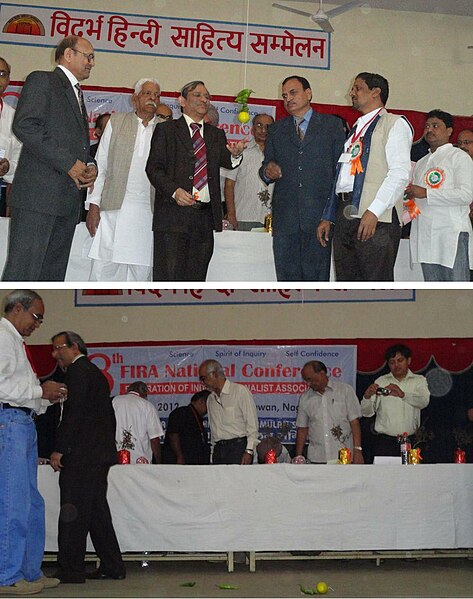
Dr Vilas Sapkal, Vice Chancellor, Rastrasant
Tukdoji Maharaj University, inaugurating the 8th National Conference
of FIRA held in Nagpur by cutting a string of 7 chillies & a lemon,
a charm commonly used by the Hindus to ward-off evil
Prof. Shyam Manav, Founder and Organiser ABANS delivered a special lecture on ‘Role of Rationalism in Development of Country and Humanism.’ The Biennial Reports of FIRA affiliate member organizations were presented by the respective functionaries. The brief  of various propaganda activities including conducting seminar, workshop, publication of rationalist literature were explained by the functionaries. The session proceedings took place in the presence of the National Executive Committee  Members. Madhukar Kample, National President, ABANS, chaired the session.

After lunch, technical sessions  started. U.Kalanathan, Patron, FIRA and President, Kerala Yukthivathi Sangham presented a paper on ‘Secularisation of India.’ He strongly advocated the initiative of separating politics from religion which will facilitate the sustenance of real secularism in the country. superstition  breaking and miracle exposure demonstrations

In the evening superstition  breaking and miracle exposure demonstrations were conducted out by the volunteers of rationalist movement. Walking over thorny platform was demonstrated, exhibiting nothing divine in it except  familiarity and frequent  practices to do it.

Delegates at the Conference

After dinner, an interactive session was addressed by Babu Gogineni, International Director, International Humanist and Ethical Union (IHEU). He discussed  the probable problems and challengers that EVERY rationalist organization might have to face in the prevailing environment and how to function under such circumstances effectively.

Second Day Proceedings  

Miracle Exposure Public Rally

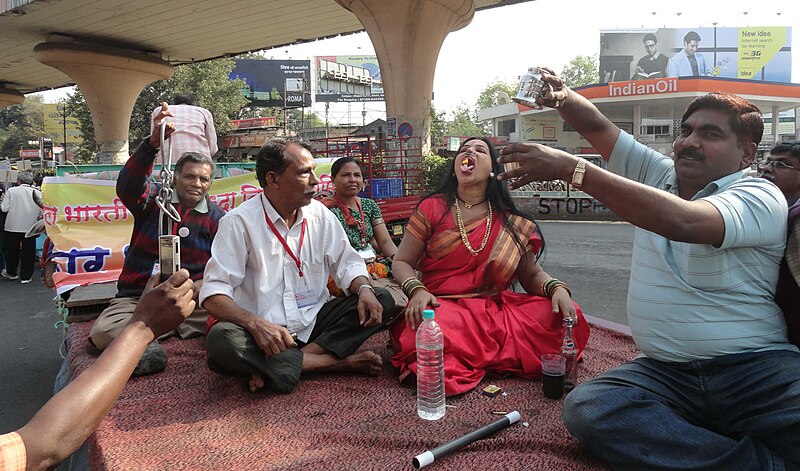
Miracle Exposure Rally - Exposing the 'miracle' of eating burning camphor
At first, miracle exposure public rally was organised where all the delegates representing various rationalist organisations took part. Pulling the Ambassador car by the volunteers, by needle stitched string on their back, demonstrations exposing the deeds of black magic, sorcery – were the phases  of the procession. The procession captured the attention of the public at large.

Session: The Rise of Intolerance in India

G Vijayam presenting his paper. Sitting from the right: V Kumaresan,,
Ramachandra CST Voltaire, Dhaneswar Sahoo
Again the proceedings were started in the auditorium. The technical session ,’ The Rise of Intolerance in India’ was chaired by V.Kumaresan, General Secretary, The Rationalists’  Forum, Tamil Nadu. ( Please see the  excerpts  of the speech in page no 27 to 29) The functionaries of other rationalist organisations viz. Prof. Dhaneshwar Sahoo of Orissa Rationalist Association, Dr.G.Vijayam of Atheist Centre, Vijayawada, Prof. Balwinder Singh Barnala of Turksheel Society, Punjab,  Jayagopal of Atheist Society of India, Visakapatnam, Dr. Anand of Science for Society, Jharkhand, T.V.Manoj of Bangalore Rationalist Association, Ramachandra C.S.T. Voltaire of AMOFOI, Bhubaneswar presented their papers on the rise of intolerance.

Panel Session : Modern Spiritual Godman’s Industry

The Panel Session on “Modern Spiritual Godman’s Industry”  chaired by R.G.Rao a.k.a. Somu,  National Secretary, FIRA.  V.Nehru, President of the Rationalists’ Forum, Tamil Nadu  presented his paper. While addressing, he reminded all the charges leveled against Sai Baba by the rationalists got exposed after his death. More valuables both in kind and cash were recovered from his private room. In Tamil Nadu, Sankaracharya of Kanchi Mutt , the first accused in the murder of the temple manager  which is under the judicial proceedings  is freely wandering under religious clout. Dr.K.Veeramani, President, Dravidar Kazhagam   two decades back exposed by delivereing serial lectures on ‘Who is Sankaracharya?’  After the arrest of Sankaracharya, again he delivered through series of   lectures, ‘ Divine Deeds ! ’. The earlier exposure became a reality now. What rationalists exposed earlier becomes known to the  public explicitly at present.

Resolutions :

To conclude the conference the resolutions were passed on the following lines to strengthen the activities of FIRA.

- to conduct marches towards Parliament for separating politics from religion.
- to form an exclusive Law Commission to enable  insertion of provisions and enactment to adhere the secular value of the state machinery.
- to facilitate the enactment against superstitious belief, black magic, sorcery, etc.
- to conduct training programmes especially for youth on eradication of superstitions.

New National Executive Committee – FIRA

The following functionaries were elected for the National Executive Committee.

Patron: Dr.G.Vijayam, Atheist Centre, Vijayawada.

National President: Prof. Narendra Nayak, Dhakshina Kannada Rationalist Association.

Vice-Presidents:V.Kumaresan, The Rationalists’ Forum, Tamil Nadu, Prof. Balwinder Singh Barnala, Turksheel Society, Punjab, Harish Deshmukh, Akhil Bhartiya Andhashraddha Nirmoolan Samiti, Nagpur, Prof. Dhaneswar Sahoo, Orissa Rationalists Association Bhubaneswar, Kranti, Maharashtra Andolan Nirmoolan Samithi, Pune,Sukumaran, Kerala Yukthivathi Sangham, Thiruvananthapuam

National Secretary: U.Kalanathan, Kerala Yukthivathi Sangham
Publishers of rationalist literature had their presence at the conference

Secretaries: South Zone: V.Nehru, The Rationalists’ Forum ,Tamil Nadu, North Zone: Binder , Turksheel Society, Punjab, East Zone: Samba Siva Rao, Manava Vikasa Vedika , Andhra Pradesh,West Zone: Anil Kumar, Kerala Yukthivathi sangham

Treasurer: R.G.Rao a.k.a. Somu, Goa Science Forum, Panjim Goa

(Courtesy: The Modern Rationalist, March 2012)

(V Kumaresan, Rationalist Forum, Tamil Nadu, 
is one of the Vice-Presidents of FIRA) 

Tuesday, 28 February 2012

Rise of Intolerance in India


G Vijayam

The National Conference of the FIRA is taking place at the critical juncture of modern Indian history. It is crucial for the country as to which road we take-the tolerance or the Intolerance.
Dr G Vijayam addressing the FIRA conference 

Our country is known for the comity of the nations and for its tolerance and accommodation. Indian path to democracy highlighted accommodation and adjustment of diverse view points through dialogue and discussion. The legacy of the freedom movement was unity in diversity. The founding fathers of the Indian Constitution envisioned India as a Federal state with a unity bias. The strength of India lies in its unity and its ability to adjust to new situations without compromising the basic tenets of the Constitution.

The dividing line between tolerance and intolerance is very thin, but with profound consequences to the nation and the people. Which road we take is the crux of the matter.

History bears testimony to the disastrous consequences of intolerance. The Crusades in the Middle Ages of Europe and the 100 Years War, 30 Years War and many other internal and external conflicts within the Nations, led to greater intolerance, resulting in the bloodshed. Much blood was shed in the name of religion and its bigotry. The conflicts between the Catholic and Protestant countries and the other nuances of the in same Christian religion, led to shedding of much blood of the innocent people.

Constitutionalism and to the Emergence of Democracies

This finally led to the idea of Constitutionalism and to the emergence of democracies. The foundation for these is the need for Separation of State and Religion. In other words, Politics and Religion must be separate. The State belongs to all, irrespective of their personal beliefs or non belief and religious preferences, if any. The acceptance of the concept of separation of the State and Religion was an important landmark in the onward march of the society. The supremacy of the State over religion was not that easy and it took centuries to accept the idea.

The emergence of secularism reflects the primacy of the State over all other institutions within the state.

The growth of Democracy in many parts of the world, in particular in India, is equally significant. Democracy may not be best form of Government, but the other alternatives of democracy are the worst. Democracy may be weak and ineffective and incapable of talking decisions fast. But the greatness of democracy is that it reflects the will of the people through periodic elections and people can enthrone, or dethrone the representatives of the people through their power of ballot. The periodic elections are the safety valve in democracy.

Experience of Dictatorship

The dictatorships ruled the roost in the 20th Century, the world over. The Communist, Fascist and tribal dictatorships finally collapsed, because they did not give scope for dissent or difference of opinion. Intolerance is the inherent quality of dictatorships. They brook no opposition. But difference of opinion is bound to be there. People have divergent views. They cannot be silenced forever. The Concentration camps in Germany could not silence opposition for long. The collapse of the Soviet Union which was a super power was not due to any war, but because of lack of freedom and expression of their opinions. The tribal dictatorships like that of Edi Amine in Uganda also collapsed. Thus by the end of the 20th Century, it was more or less clear to the people that dissent is the ascent of society. The will of the people is supreme. The new wave of recent awakening in the Middle East, especially triggered in Syria and Egypt, has created a snowball effect for democratic uprising in the majorly dictatorial area.

The Indian Experience 

What we have achieved in India in 1947 is the political Independence. Democracy gives freedom, but does not guarantee food. Unless and until there is concerted and continuous effort to achieve social and economic equality, mere political democracy will not satisfy people.

The political parties in India have turned into mere vote catching machines without any scruples. They want to cash on the weaknesses of others. Others weakness or lapse is their str2ngth. They do not have constructive or creative approach to rebuild society.

Of late the parties have become intolerant to others and they are looking at each and every issue through partisan and opportunistic lenses. In India, almost all political parties are in power in one state or the other. When they are in power, they want to safeguard their position by hook or crook, even with the most opportunistic alliances and with all types of compromises. When they are in opposition, they shed crocodile tears and try to recapture the power as early as possible. The constructive thinking is at a discount.

Thus in the political sphere, intolerance is growing, as the people in power have a single point of agenda, that is to cling on to power by hook or crook and while the opposition parties are steeped in mudslinging at their opponents. Politics, thus degenerated into, poly-tricks. Every party poses as though it is holier than others. But they do not hesitate to resort to corruption and nepotism when the opportunity comes. What happens in politics has a ripple effect on all other areas of social, economic and educational spheres. There may be some degrees of difference, but not much difference in quality.

As politicians lost their moral fiber and their sole aim is to capture power, they started alliances with the moneyed and the opportunistic groups and individuals. The outcome is too well known to be elaborated here. Anti-social elements capture the legislative and ministerial positions by their money and muscle power.

The political parties started compromising their stand on secularism, freedom of expression and democratic values. It is resulting in the rise of money power and fall in moral standards in public life.

It is the time to build alternatives to strengthen the democratic and secular ramparts we guard. Our sole aim is to achieve social change through democratic and secular means. Our moral fiber is our strength. Without firm commitment, determined action and ready for sacrifice, alternatives to the present dismal situation cannot be built.

The growing corruption in all fields of life -political, economic and social-is eating the vitals of the nation. As moral values are at discount, everyone talks about the corruption of the others. In one state or the other, all major parties are in power, at least as the coalition partners. When the opportunity to do corruption comes, they leave all their sermons to winds, and resort to corruption. The corruption of the ministers at the Union and the State Governments reveal that with some minor exceptions, majority of the politicians are trying to make hey when the sun shines. The degree of difference is in proportion to the opportunities they have to resort to graft. The people at various levels start emulating politicians. Corruption, nepotism, and partisan spirit go together. Corruption in the country is growing horizontally as well as vertically.

People are asking, who is our role model?

Caste and Democracy

Added to the woes, now intolerance is growing in the social field. Caste has become a convenient tool in the hands of the politicians. They are fanning the caste and sub-caste consciousness. In Portuguese language "Casta" means division and the word caste was derived. Since the advent of Independence, how many new castes emerged in India is everyone's guess. Now, many people moved beyond caste professions and they are migrating and are engaged in many other professions. But as the birth of the person is the criteria for caste classification, it opened up Pandora's Box and now the sub-caste consciousness also has grown, which is leading to hostility and intolerance between sub-castes, there is the new cause of intolerance and conflict in society. Caste and religion are intertwined. Religion will not go unless caste is abolished and inter-untouchability and intra-untouchablity is the part of the caste system. Caste consciousness grows at the expense of secularism. Politicians and social leaders are now exploiting the caste differences. Instead of encouraging castelessness and intercaste marriages and intermingling of all, politicians are trying to have a cleavage in the name of caste.  It will have an adverse affect on secularism.

Democracy has given the right to vote through universal adult suffrage. It is a quantum jump, no doubt. It brought new awakening among people. People's consciousness has increased. The media plays a major role in informing the people about their rights. It is a welcome change. But rights and duties are two sides of the same coin. It is a matter of regret that duty consciousness, and the effort to enhance their abilities for social good through collective action has not taken strong roots in the Indian soil. The political leaders and the Trade unions and all ethers are stressing their rights, but not on corresponding duties. Without performing their duties, the short cuts to success are short lived and leads to a bone of contention.

The growing intolerance in political, social and economic, educational and others spheres need to be tackled for the unity and integrity of the nation and society. Positive action with determined commitment will lead to change in the atmosphere. Corruption, nepotism, intolerance, parochial considerations need to be addressed at various levels. Alternatives must be evolved so that there will be a positive action for a positive future.

Role of Individuals and Organizations 

Here comes the role of the individual and all the organizations. Growing intolerance will lead to cut throat competition and instability in the nation and society. In this age of democracy, the citizen's action is bound to have a positive impact on the society in the long run, if not earlier.

For complex and compound problems there is no single or simple solution or instant results. But in a democratic environment the scope for social change is much more and in this age of communications and media, people' receptivity and wave-length can be established relatively faster than the yester years. Hence every conscious and concerned individual or organization must raise their voice against the growing intolerance in the society and its adverse impact on the democratic and secular ramparts we guard. Pleasure lies in pursuit and it is bound to gain momentum as the cause is genuine and the need is profound to the future growth of the nation and the society on peaceful lines. 

(Dr G Vijaym is the Executive Director of Atheist Centre, Vijayawada. This is the paper he presented at the 8th National Conference of  Federation of Indian Rationalist Associations (FIRA) in Nagpur, Maharashtra, held on 11th & 12th February 2012. Dr Vijayam is also elected as the Patron of FIRA)

Thursday, 16 February 2012

The Rise of Intolerance in India


V Kumaresan

V Kumaresan
The rise of intolerance seems to be alarming at present. The peculiar feature of it is that all voices of intolerance are not one and the same. Tolerance to inhuman practices is a age old phenomenon in this society. Human beings who have to be rational must be intolerant to irrational practices and events. They should be intolerant against inequities and injustice meted out to them. When the history of 20 centuries  and even earlier is scanned, it would be vividly evident that the major section of the mankind of this land were made subservient to dogmas and doctrines in the name of  god and religion, thereby they were tempered over a period of time to be tolerant of slavery. It is not mere the existence of social slavery, the slaves were made to enjoy their slavery. The social slavery was glorified as divine and as a design, created by god. Their life style was tuned as such and any violation of it was considered as crime and deserved punishment till such so called deviants are alive and even after their death.

This sort of centuries old inequitable tolerance was sanctified by the people who raise voice of intolerance at present, alarmingly. It is not the same people who designed the inequitable tolerance but they are the people who stake claim for the heritage of sustaining such an evil design in the society.

Presently, the intolerance exists in the society and its rise is not right in a collective sense. The nature of intolerance is not in totality; it is choosy; it is self-oriented. The relativity is lacking. Whenever it is convenient, the fundamentalists of the dominant section of the masses support or oppose on the right to freedom of speech and expression. When religious dogmas of other sects are exposed, the claim for the right to freedom of speech and expression rose to the sky, under the guise of intolerance. When such rights are exercised against their own religious dogmas, then their support for the right to freedom of speech and expression becomes dismal. This is the dilapidated tactics of the culturally dominant, oppressive section of the society.

B R Ambedkar
When ‘fatwa’ was issued by the then political head of foreign state against Salman Rushdie for his Satanic Verses, the other religious countries provided asylum for him. The fatwa issued against him has transnational impact. India need not have any reservation on the version of the Satanic Verses since it is a Secular State. In order to appease the  section of the people in India who follow the dogmas of religion against which Satanic Verses speak; it develops an illusion as if there would arise some security threat had the Britain dwelling Salman Rushdie attended the recently held Literary Festival in Jaipur, Rajasthan. When the security threat was discussed widely, no state machinery either in Maharashtra or Rajasthan was bold enough to share the perceived probable security threat. Even foreign litterateurs who read certain quotes from Satanic Verses at the Festival were pressurized to leave the venue and the country immediately. But the entire blame of probable security threat was shifted, to the premises owner where the Festival was held, under the guise of the apprehension of an individual. In that case what for the State exists, which is expected to maintain law and order. But the strange affair is criticism about such unsecured condition in a Secular State by the other sect of fundamentalists. They raise their voices in support of freedom of speech and expression. What were their views few decades back when Dr. Ambedkar’s book ‘Riddles of Rama and Krishna’ was published in Maharashtra. The same sect which advocates for freedom of speech and expression today was against the publication of Ambedkar’s book. The fundamentalist forces were diplomatic enough to celebrate the Birth Centenary Dr. B.R.Ambedkar, but opposed the publications of his writings. Same is the case when the foreign movie ‘The Da Vinci Code’ was released in India. It was banned for the reason that it hurts the sentiments of the particular religious sect. 

Taslima Nasreen
Latest episode is the release of biography of Taslima Nasrin, its seventh volume, Nirbasan at Kolkata Book Fair. It is just the release of biography of an atheist writer and not even a seminar, workshop or public meeting to deliberate on the contents on the book. The release of the book itself was not allowed at Kolkata, an important city in Secular India. But the adjoining State, Bangladesh, despite its deep faith in the religion against which Taslima Nasrin remains as a prolific writer, has provided a climate for the release of the book. 

In all these episodes, the tendencies of intolerance have been exhibited. But such tendencies are mutually conflicting. They cannot discharge their protest and opposition under one banner. The reason being, the opposing forces hail from different religious sects. Shadowing up their inherent conflicts, they project themselves as a force fighting for the fundamental right to freedom of speech and expression, whenever the dispute is raised about the religious dogmas other than their own. The forces behind the rise of intolerance in the name of fighting for the right to freedom of speech and expression are different with strong conflicting fundamentals ideologically as well as organizationally. 

Under such circumstances, the State which is expressive ‘secular’ constitutionally has to remain neutral, non-aligned and naturally with the support of atheists, rationalists and humanists. But the prevailing position is not like that. The State suffocates and suffers due to these fissiparous tendencies and rise of intolerance. All these inadequacies may be attributed to the secular approach adapted by the State which is indifferent. In letter it is right. The spirit behind it is different. The word ‘Secular’ means non-religious. The State should distance itself from the religious affairs. If one religious practice creates disharmony, the State should approach the issue in a humanistic way. Such approach has to be adopted whatever be the religion that creates nuisance to the society and its harmony. Instead of that, at present, State encourages every religion, of course not equally, provide patronage which cannot be the duty of a Secular State.  

What role we rationalists need to perform at this juncture?

As rationalists, we have to expose the real face of the fundamentalists who speak for the right to freedom of speech and expression for their convenience then and there. The contradiction between such forces should be sharpened and exposed at the times when rise of intolerance is projected as collective efforts with alleged coherences among them.

Certain provisions of constitutional law of India have to be amended. Article 19(i) (a) speaks about the fundamental right to freedom of speech and expression. Article 25 speaks about the right to freedom of practice and propagation of religion. It protects the freedom to practise rituals and ceremonies which are the integral part of the religion.
G Vijayam presenting his paper at the FIRA session on Rise of Intolerance - Sitting (from the right): V Kumaresan, Ramachandra CST Voltaire, and Dhaneswar Sahoo

In exercising these fundamental rights, in the name of ‘reasonable restriction’, freedom of speech and expression is curtailed to protect the sentiments as freedom of practice and propagation of religion. Freedom of religion could be possible only in an island where there exists no other religion. Many rituals and ceremonies are contradicting mutually among the prevailing religions. When the religious sentiments encourages inhuman practices, then the reasonable restriction  need not be applied and should not be applied on  the right to freedom of speech and expression.

Suitable amendments must be brought to provide exception clause on reasonable restriction for freedom of speech and expression providing immunity to the opposition made by fundamentalist. Amending the constitutional provisions is not a simple task. Lot of debates and discussions, involving the real secular political forces and various humanist movements are required. Let the initiatives be done by the rationalists under the banner of FIRA (Federation of Indian Rationalist Associations). We may be miniscule comparing to the vast population who adheres religion, either consciously or as convention without application of mind. The   task is challenging. We should remind ourselves, that in the history, many revolutionary happenings had been initiated only by few individuals. One footstep may look insignificant but necessarily it is the first step for the long march. The droplet may be tiny. It is the basic structure which devolves as the big flow stream. Let us resolve ourselves! Let us start today!

(Excerpts of the speech delivered by V.Kumaresan at 8th National Conference of Federation of Indian Rationalists Associations at Nagpur, Maharashtra  held on 11th and 12th February 2012. V Kumaresan is the General Secretary of The Rationalists’ Forum, Tamil Nadu.)


Share

Twitter Delicious Facebook Digg Stumbleupon Favorites More