Showing posts with label Shiv Sena. Show all posts

Friday, 12 April 2013

Nationalism, Kingdoms and Kings: Looking at Shivaji and Rana Pratap


Ram Puniyani

The legend of some of the kings continues in different forms and is used by different political formations. These political formations draw their identity from the past and project it on the present. These sectarian streams have been using the names of different kings and glorifying them in various ways. There is a hidden message of a politics behind such efforts, as they eulogize the pre-colonial period for their political agenda. While the incidents and events are the same, the way they are looked at by different streams and different schools of historiography are very diverse.

Recently in Mumbai one play is making rounds, ‘Shivaji Underground in the Bhimnagar Mohalla’. (September 2012). Similarly in Rajasthan at various places the big hoardings of Maharana Pratap have appeared. These hoardings proclaim him as the first freedom fighter. This play on Shivaji seems to be a major contribution to the theater on Shivaji after the much hyped and publicized play on Shivaji, ‘Jaanta Raja’ (Enlightened King) by Babasaheb Purandare. Purandare’s Shivaji is an anti Muslim King, with a mission to establish Hindu kingdom, he the protector of Brahmins and Cows (gobrahmin pratipalak). This is a theme song of Hindu nationalism propounded by RSS-Shiv Sena, where Kings like Shivaji fighting against Muslim Kings were the brave warriors committed to the cause of Hindu nation. Here the anti Muslim stance and pro Brahmin stance merges and upholds Cow, the identity used by Hindu nationalist’s time and over again.

The play ‘Shivaji underground…’ takes a totally different stance. Here Shivaji is neither pro Cow Brahmin, nor an anti Muslim hero. It upholds the identity of dalits and targets the Brahmins. The struggle between Dalits on one side and Hindutva, upper caste, politics on the other has been manifesting in Maharashtra from quite some time. Many an events like attack on Bhandarkar Museum, banning of James Lanes book on Shivaji, which doubts the paternity of Shivaji, are few instances of this. The Braminic, Purandare version, of Shivaji gives all the credit to Dadaji Kond Dev, a Brahmin, who is supposed to have mentored Shivaji. The dalit version of Shivaji opposes this and it is due to this that the statue of Dadaji Kond Dev was desecrated recently in Maharashtra.

As such the interpretation of Shivaji goes far back in our history. Phule, the dalit icon of tall stature, called Shivaji as Raja of ryots (poor peasants). Tagore praises him as ‘king of kings’. It was Tilak who saw him as symbol of Nationalism and organized a festival in his name.  Purandare’s play has been made immensely popular and its popularity runs parallel to the rise of Hindu nationalist politics. The ‘Shivaji underground…’ play points out that Shivaji was not for Hindu rule in any way. He was not anti Muslim at all. The highlight of the play is its focusing that Brahmins were clerks in the courts of Muslim as well as of Hindu Kings. The play does give it a total anti Brahminic slant. This play is the first major attempt to challenge the current narration about Shivjai which is constructed around his being a great Hindu patriot. Nathuram Godse, from Hindutva; RSS-Hindu Mahasabha stable, in his book, ‘May it please your honor’, which is his statement of his defense of murdering Mahatma Gandhi in the court, states that Gandhi was a pigmy as for his nationalism was concerned. The real nationalists have been Shivaji, Rana Pratap and Guru Govind Singh. This is the line of thinking of RSS-Hindu nationalism.

In this ideological understanding of RSS, all the kings who fought against Muslim rulers are Hindu nationalists. It’s a total distortion of understanding of history as kings did not fight for religion; their fights were for power and wealth. And kings of same religion also had running battles with each other.

Rana Pratap, being projected as the First Freedom fighter by communal forces is against the truth. The kings before the British rule were fighting to expand or protect their empires.  The era of Kingdoms is not comparable with freedom movement. Just fighting against Muslim King is not being a freedom fighter. Freedom struggle was against British rule, when India was coming to become ‘a nation in the making’ due to industrial, educational and social changes. The era of Kingdoms and logic of Kings can in no way be compared with the Indians coming together to fight the British Empire. Even these kings be it Shivaji or Rana Pratap were neither ruling for religion not for Hindus. Their administration was having both Hindus and Muslims. Their armies were also mixed ones with Hindu and Muslim Generals both, with Hindu and Muslim soldiers both. Rana Pratap had Hakim Khan Sur on his side and Shivaji was having Siddi Sambal and Rustam-e-Jamaan amongst others. Shivaji’s confidential secretary was Maulana Haider Ali.  Shivaji had reverence and respect for the holy people like Hazrat Baba and Ambrose Pinto.

Rana Paratp’s battle against Akbar was not for religion. It was on the issue of Mansabdari (status in the administration). Rana Pratap was asking for a Das hazari, (ten Thousand) Mansab) while Akbar was offering only Panch Hazari. (Five thousand). Interestingly Akbar never came to Haldi ghati where the battle took place. It was Akbar’s commander in Chief Raja Mansingh, assisted by Shahjada Salim, who fought against Rana Pratap. By no stretch of imagination it is anywhere close to a Hindu Muslim battle or a struggle for nationalism. As a matter of fact Tilak and the later genre of Hindu nationalists associating Shivaji with nationalism are totally off the mark as the term nationalism is a recent one coming up with the rise of nation states. The confusion between Kingdoms and nation states opens the window for communalism to infiltrate in a big way.

In Shivaji’s case now a new frontier of presentation has been opened up. This is that of Dalit-OBC on one side and Brahmins on the other. This is an interesting aspect reflecting the current struggle between these two social groups. The play, ‘Shivaji underground…’ is veering more around this theme while equally powerfully quashing the communal interpretation of Shivaji. One observes that dalit bahujan version and Brahminic versions are polar opposites. Dalit The role of Brahmins against Shivaji is particularly worth its mention. One does recall that the local Brahmins had refused to coronate Shivaji on the grounds that Shivaji is a Shudra. It was the priest from Kashi, Gaga Bhatt, who coroneted him with the little toe of his left foot, the organ in the body which is lowest in the hierarchy, as per Braminic norms.  This play highlights the role of Krishnaji Bhaskar Kulkarni, an official with Afzal Khan. But again it is not a question of this or that religion; Brahmins were working for most of the kings, irrespective of their religion. So while Shivaji and Rana Pratap have to be seen in the proper light, as kings with valor, the other interpretations of nationalism, freedom fighters, anti Muslim Kings are all constructs emerging from the communal historiography and need to be dumped. Also what needs to be brought in the arena of the history is the pain and pleasure of average women and the men. What needs to be projected is the interaction of cultures which were the foundation of human progress, cutting across religions.

It is India’s arrested transition to a democratic society due to which the Kings are being brought to glory and identified with. Whatever the virtue of king of any religion, in current times we need icons who were part of India’s freedom movement, a struggle running parallel to the struggle for caste and gender equality. While projecting the kings as heroes, we do need to remember that it was the system of peasants’ exploitation, which was the base of kingdoms. Surely kingdoms are no systems to emulate today and so need to rethink this iconization of Kings!

Wednesday, 9 January 2013

Akhil Bharatiya Marathi Sahitya Sammelan: Heinous Attempt to Intimidate Smt.Pushpa Bhave

Maharashtra Government, Police machinery and Shiv Sena have joined hands to intimidate Smt.Pushpa Bhave, well-known public intellectual, who protested against the decision to give the name of Bal Thackeray to the stage of upcoming Akhil Bharatiya Marathi Sahitya Sammelan session at Chiplun. In response to her statement rightly opposing Sahitya Sammelan’s decision, Shiv Sena leaders publicly threatened her and ‘prohibited’ her from going to Konkan region. Aligning themselves shamelessly with Shiv Sena, police authorities in Chiplun cancelled a symposium which they had decided to hold on the 8th of January in which Smt.Pushpa Bhave was one of the panelists invited to speak. Police authorities did this only to avoid Smt.Bhave speaking at Chiplun. What is more, the police have now specifically asked Smt.Bhave not to enter Konkan! Sri.Sunil Tatkare, minister in Maharashtra’s Congress-NCP government, who is the chairman of Reception Committee of Sahitya Sammelan’s Chiplun session, lent his support to Shiv Sena by affirming that the decision to give Bal Thackeray’s name to Sahitya Sammelan’s stage will not be changed! This is just another example of how government machinery and police under Congress-NCP rule connives with semi-fascist forces.

Rather than being a forum of creative discourse, Akhil Bharatiya Marathi Sahitya Sammelan, in recent years has become a seat of narrow-minded controversies involving casteist and communal right-wing forces on all sides. The Chiplun session also is having its share of superficial controversies and muscle-flexing. Another worrying feature is that of Hindutwa forces trying to use Sahitya Sammelan forums to legitimize their fascistic ideology and historiography. The hall in which last year’s Sammelan was held in Thane was named after V.D.Savarkar. This year, Bal Thackeray’s name is being given to the main stage and an eminent intellectual like Pushpa Bhave is being threatened for opposing that move.

The people of Maharashtra should not allow this game-plan of Hindutwa forces to succeed. We should not allow fascist parties to dictate terms in our state’s cultural field and terrorize our secular intellectuals.

We condemn the tacit support extended by state government to fascist forces bringing in a situation where our state is not being run in a democratic manner as envisaged by the Constitution. We appeal to all progressive forces in Maharashtra to jointly defend constitutional freedoms and secular culture in our state.

(This is a statement issued by DYFI, Maharashtra State Committee: on January 07, 2012, forwarded to us by Ms Rekha Deshpande)


Friday, 30 November 2012

Bal Thackeray: Identity Politics to the Fore


Ram Puniyani

The declaration of demise of Bal Thackeray (November 17, 2012) has brought the Mumbai city to a complete halt. Most of the news channels are relaying his death procession round the clock and having discussion about his tall stature most of the time. His grip on the city had been more or less complete from last three decades in particular. The methods he employed had some supporters on one side but for others it filled the people with fear, as his followers had been openly indulging in acts of vandalism time and over again. Today it is very difficult to say that city has come to a halt merely out of reverence for him alone or fear factor is also there behind this closure of the city will have to be assessed over a period of time.

As per some accounts Thackeray family had migrated from Bihar and finally settled in Maharashtra. Bal Thackeray came to prominence for voicing the need for jobs for ‘sons of the soil’ and with open threats to South Indians, Gujarathis, Biharis in that order. His initial role was that of breaking the left controlled trade unions, at the behest of the industrialists and section of the ruling party, Congress. This action of his had led to lot of violence between the leftist trade unions and Thackeray followers. The peak of this was murder of the CPI trade Unionist Krishna Desai, a blow from which the left trade unions could not recover.

Courtesy: http://www.odiablog.com/
He later jumped to bandwagon of Hidnutva politics, openly supporting the Bari demolition and playing an active part in the horrific Mumbai violence of 92-93. His writings in Saamna, the Shiv Sena mouth piece, were very provocative and could easily come under the clause of ‘Hate Speech’ but despite that the case filed by some Mumbai citizens fell through and Thackeray continued to spread his anti Muslim tirade through his speeches and writings. True later Election Commission disenfranchised him for six years from voting. After Babri demolition, someone suggested that the Shiv Sainiks were the one who demolished it; he cleverly lapped it up and said that if Shiv Sainiks have done it I am proud of that.

The violence which followed the demolition was probed by Shrikishna Commission. This commission’s findings indicted the Shiv Sena supremo. The celebration rallies were organized by Shiv Sena in Dharavi jurisdiction amongst others. The commission pointed out  

“These Celebrations by Shiv Sena had mobs which were chanting provocative slogans: Musalman Ka Do Hi Sthan: Pakistan Ya Kabristhan (Muslims can only be in: Pakistan or Graveyard). In retaliation Muslims shout: Jo ham se takarayega: Mitti me mil Jayega (Those who attack us will be decimated). 

To cite another example of Thackeray’s complicity and role in violence one recalls from Shrikrishna Commission report that “On 1st January 1993 there was an article in Samna under the caption 'Hindunni Akramak Vhayala Have’, (Hindus should become aggressive now) openly inciting Hindus to violence.” (Volume 1 page 13)

The more striking observation of the Commission was

"From the conversation which could be heard [by Yuvraj Mohite, Mahanagar Reporter, at Thackeray house during the riots], it is clear that Thackeray was directing Shiv Sainiks, Shakha Pramukhs and other activists of Shiv Sena to attack the Muslims, to ensure that they give tit for tat and ensure that 'not a single landya (a derogatory term for Muslims) would survive to give the evidence’ [vol.ii, Page 173-174]...the communal passions of the Hindus were aroused to a feverish pitch by the inciting writings, particularly in Saamna and Navakal.” [Volume 1, page 21-22]. “...and violence in January (1993) was taken over by Shiv Sena and its leaders who continued to whip up communal frenzy by their statements and acts and writings and directives issued by Shiv Sena Pramukh Thackeray.”

This is just a small sample of what was the role of Thackeray and his Shiv Sena in The Mumbai violence. After the Mumbai violence he started being called Hindu Hriday Samrat and had a total grip on the politics of Shiv Sena. He was unfazed by the impact of his beliefs and actions. In his famous interview to the time magazine (titled: Kick them out!) during this time he poured vitriol on the Muslims with all abuses and hate. As Muslims were fleeing Mumbai he said that Muslims need to be taught a lesson. If they are fleeing Mumbai, it’s OK; else they should be kicked out.

He has been an opponent of Indo-Pak friendship all through. Be it the question of Indo Pak Cricket match or the concert of Pakistani Gazal singers, Mumbai witnessed the ‘direct action’ of Shiv Sainkis in the form of digging the cricket ground pitch at Kotla cricket ground or vandalizing the Gazal concert in Mumbai. Much before the coming to fore of the terror of groups related to Sadhvi Prgya Singh Thakur or Swami Aseemanand, it was Thackeray who had called for the formation of ‘suicide squads’ by Hindus. A self avowed admirer of Hitler, he conceded that he appreciates Hitler and that he himself has many traits similar to Hitler. He believed in Thokshahi (Dictatorship) not Lokshahi (democracy).

The divisive politics of Hidutva or the identity politics built around ‘sons of the soil’ does run parallel to his opposition to the affirmative action and aspirations of deprived sections of society. True to that he opposed the implementation of Mandal Commission, indicating his anti OBC politics. He was the only one who stated it openly. The other party thoroughly opposed to Mandal, BJP, which is opposed to affirmative action for any weaker section of society, dodged the issue and intensified on Ram Temple issue to bypass this affirmative action for OBCs. Similarly Thackeray has been vehement opponent of dalit aspirations in any form. When the Maharashtra Government published Babasaheb Ambedkar’s book, ‘Riddles of Rama and Krishna, Shiv Sena stood to oppose it in a serious way and there was some violence between Shiv Sena supporters and dalits. When the issue of changing the name of Marathwada University to Ambedkar’s name came, Thackeray opposed it strongly leading to another bout of unrest. It is just a tragedy of our times that despite this clear agenda of Thackeray, some dalit parties are allying with his party at electoral level.

The massive turnout as his funeral is being read as that he was the voice of Marathi manoos. True a section of Marathi people adore him, but the larger section of poor peasants, the workers and dalits from Maharashtra know that Thackeray has been no representative of their aspirations. With so many problems nagging the poor of Maharashtra there is a need to shift the terrain of politics away from identity politics of the likes of Thackeray to the material issues related to bread, butter, shelter and employment. The politics of Hindu nation and Marathi manoos is against the values of Indian Constitution which call for the principles of Liberty, Equality and Fraternity. How did Thackeray’s politics conform to these is a matter of introspection. 

Monday, 1 October 2012

Who is in Whose Land? Thackeray Family’s Bihar Connection


Ram Puniyani

India is facing lot of communal-ethnic strife where the place of origin and religion of people is the marker due to which they are attacked. Many a retrograde political ideologies are based on the ‘first comer’ assertions. The deeper problems related to social resources, economic deprivations and socio-political inequalities are being presented as problems related region or religion of people. In Mumbai, one can see this in its extreme form, in the politics of Shiv Sena and Maharashtra Navnirman Sena (MNS). Both these outfits have a regional-religious chauvinist agenda. They switch from region to religion at the drop of the hat. They also keep combining the two in the aggressive street politics.

The rising star of this sectarian politics, Raj Thackeray, has been in the news for all the wrong reasons, threatening ‘others’ with his usual ‘methods’ of ‘direct action’. Why the state lets the ‘direct action’ of these sectarian outfits go unpunished, is another side of the coin of the story. Recently (Sept 2012) when the Bihar official wrote to Maharashtra police authority that Maharashtra police should have informed the Bihar police before arresting the two criminals who had broken Amar Jawan Jyoti in August 11, 2012 violence, Raj Thackeray retaliated by saying that MNS will declare all the Biharis as infiltrators. As such what Bihar police was asking was a mere routine followed by police of one state while acting in the other state. Thackeray, in order to bake his political bread made it an issue.

Courtesy: http://www.odiablog.com/
While he was talking in this language, an interesting point came up. Congress General Secretary Mr. Digvijaya Singh dug out some history from the writings of grandfather of Raj Thackeray and father of Bal Thackeray, Mr. Prabodhankar Thackeray (?Thakre). Incidentally the spelling Thakre was changed to Thackeray not too far back in History. Singh quoted Thakre senior’s collected works, Prabodhankar Thackeray Samagra Vangmay: Khand (Volume) 5, published by the Maharashtra Rajya Sahitya Ani Sanskritik Mandal when BJP-Shiv Sena was ruling the state. This quote is about the geographical background of the community from which Thackeray’s come, Chandraseniya Kayastha Prabhu (CKP). Singh quoted page no. 45 of the volume 5, which says that Magadha’s corrupt Kshatriya king Mahapadmanand was persecuting his subjects by levying various taxes on them. Many a families from CKP community left Magadha to escape the persecution and greed of Kshtriya ruler and left for Nepal, Kashmir and Bhopal.

The same book mentions that out of those who left Magadh (now Bihar), around 80 families settled in Taal Bhopal and Prabodhankar’s family was one amongst them. As per Singh, Prabodhankar mentions that the Muslim ruler of Bhopal was very kind and was great help to the Thackeray family. This Thackeray family later migrated to Mumbai.  Uddhav Thackeray, cousin of Raj and son of Bal Thackeray, said his grandfather is generally talking about the CKP and not his family in particular. Still Uddhav did not give the alternate version of their families past. Interestingly Parabodhankar’s account breaks another myth. Today his descendents and the practitioners of sectarian politics propagate that the medieval period was a dark period of India as there were many Muslim kings and Nawabs, who were doing atrocities on Hindus. Their version also glorifies Hindu Kings in general. Here in Prabodhankar’s account, a Khstriya (Hindu, warrior caste) king is tyrannical forcing the subjects to leave his kingdom while the Muslim Nawab is helpful for Thackeray family. Stereotyping the kings as per their religion, communal historiography has played a very negative role in the history of our society. In Pakistan and India both, even today such perceptions are part of popular understanding. There is a need to learn from what Thackeray senior writes in his book.

How do we judge citizenship today? Do we have a right to go from one state to another or not? Theoretically it will be accepted by all that it is legally correct. Still in various places and more particularly in Mumbai, Shiv Sena and its clone MNS have been creating havoc on this issue. Their sectarianism is not restricted only to region, but also to religion. In both matters their basic understanding is also totally fabricated and far from truth. As migrants have been taking place in to Metros, big cities, depending on survival opportunities. In pre independence times major migration took place amongst other places to Kolkata in particular. In Mumbai in the decade of 1960s to 1980s, when industrial production was booming here major migrations took place. And the major migrations to Mumbai did not take place from outside Maharashtra. They were from mainly Konkan region of Maharashtra. Even today the migration is taking place, the major migration is to Delhi and Punjab, Mumbai is third on the list. The latest Tata Institute of Social Sciences report tells us that 70% of immigrants to Mumbai are from within Maharashtra itself. In these migrations employment is the reason only for 15% of those coming here to Mumbai. The major reasons for coming to Mumbai are related to such migration being a post marriage relocation and education.

Currently Thackeray family, the original inhabitants from Bihar in the past, are pursuing their spewing of venom against Biharis in particular. Their targets have been changing. The Shiv Sena was propped up by the Mumbai industrialists to break the strength of workers unions. Shiv Sena was then subtly helped by the ruling Congress. Shiv Sena initially attacked the South Indians, with the slogan ‘Uthao Lungi Bajao Pungi’ (Beat up the lungiwallahs, South Indians). Then their targets shifted to Gujarati’s for time being. In between Shiv Sena also postitoned itself on the bandwagon of Hindutva politics of RSS, and took the lead in 92-93 Mumbai violence with slogans like ‘Muslaman ka Do hi Stan: Pakistan ya Kabristan’ (Muslims can have only two abodes: Pakistan or graveyard). They demonized the Muslims, all this has come out in the Srikrishna report, which is yet to be implemented in letter and spirit.

Lately, North Indians are the major targets of the politics of regionalism. This Shiv Sena-MNS politics is totally against the norms of our Constitution. The aggressive politicians also need to present the reality in an honest manner. If 70% of immigrant to Mumbai are from Maharashtra are Marathi Manoos,(Marathi speaking people) what do you do with them? There are problems. But the problems are not with Biharis or Nepalis coming here to explore survival options. The whole concept of development and the state polices need to be organized in a way where some areas don’t get burdened by the pressure of population. The victims of politics based on region and religion are the poorer lot, while in later case the poor rich divide has been abolished during last two decades.

At another level, religion, nation state, and regions are concepts which should help the humanity grow. Spencer Wells has shown that genetic lineage of the human race goes to Africa! Nation state is the concepts, which came to overcome the tyranny of the kingdoms. Nation states have a contribution for human society, only in so far as they bring in democratization of society and do away with feudal values. Regions in a nation state are meant to provide mechanisms for regional growth and barring that they should be fluid and inclusive in all sense of the word. The ilk of Thackeray needs to learn the moral of story from their lineage. It will do us good if they can also learn a bit from Tagore’s universalism and Spencer Wells theories about migrations of human race.

Sunday, 3 July 2011

Sleeping with the Enemy - Ramdas Athawalay allies with Shiv Sena

Ram Puniyani 

Electoral politics has its own strange logic. While Gopinath Munde, the leader of BJP was hobnobbing with Congress (June 2011), in recent times the leaders from Shiv Sena, Narayan Rane and Sanjay Nirupam have joined Congress in recent years, Ramdas Athawalay, of Republican Party of India, a party claiming to be the party of Dalits based on the ideology of Dr. B.R. Ambedkar has allied with Shiv Sena and are holding joint election rallies. It defies total logic as to how the avowed votaries of Hindu Rashtra (Rane, Nirupam) glibly shift to the Congress, formally a secular party, a party opposed to the goal of Hindu Rashtra. How Gopinath Munde, who has been working for the goal of Hindu Nation, Ram Temple was trying to switch over to Congress. Equally surprising is the fact as to how, Indian National Congress, with the legacy of Gandhi and Nehru can think of taking these politicians, with opposite ideology into its camp?

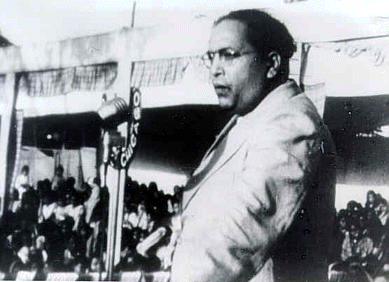
BR Ambedkar
More surprising than this has been the RPI, Shiv Sena alliance. One recalls that from last few years a slogan was floated in the political circles that Shiv Shakti (Shiv Sena)+Bhim Shakti (Followers of Ambedkar, RPI) is equal to Desh Bhakti (Patriotism). And since then this hobnobbing has been in progress. As such the politics of both these parties is very strange and logically totally opposed to each other’s agenda. 

Shiv Sena was propped up by the Mumbai Industrialists, in collusion with the section of Congress leadership to break the hold of Left trade unions in Mumbai in 1970s.  From there it went on to launch the tirades against South Indians, (Lungiwallahs), and in a series of ‘hate other’ politics it targeted Gujaratis and later North Indians. During this period it did indulge in street violence and intimidated these regional-linguistic groups. Later it latched on the Rath (Chariot) of Hindu Rashtra and boasted to be a part of Hindutva politics in alliance with BJP. Its leader Bal Thackeray boasted that if his Shiv Sainiks have been in the lead of demolition of Babri Masjid, he will be proud of that fact. Shiv Sena also has been seriously implicated in the post demolition Mumbai violence by Shrikrishna Commission report. 

As far as its political agenda is concerned it has been the most vociferous party opposing the issues related to dalits. After the publication of Dr. Ambedkars collected works, the volume on ‘Riddles in Hinduism’, book heavily critical of Lords Ram and Krishna, was opposed by Shiv Sena on the streets, it opposed the move to change the name of Marathwada University to Dr. Ambedkar University and to cap it all; it was the only electoral party which opposed the implementation of Mandal Commission.

On the other are the leaders of dalit movement, the so called inheritors of the legacy of Dr. Ambedkar. Ambedkar all his life talked of annihilation of caste, opposed the notion of Hindu Rashtra and went on to convert to Buddhism on the ground that Hinduism is based on Brahminic theology which upholds caste and gender inequality at deeper level. His core political legacy was to educate, organize and agitate for the democratic rights of dalits. It is in this direction that he formed Independent Labor Party (1936), Scheduled Caste Federation (1942) and laid the outline of the political principles for the Republican Party of India (RPI).

This RPI soon suffered the fate of splits; it was also co-opted by various bigger parties like Congress and BJP. The major agitation launched by Dada Saheb Gaikwad of RPI, did galvanize the dalit movement, but after that the dalit leadership has been groping for the path of its future agitations. The formation of militant Dalit Panthers in the decade of 1960s peaking in 1970 was a brief lasting phenomenon, again leading to splits and weakening of the cause. The equation of politics started changing with Kanshiram who took another path to power. He want on to train the cadres for long time, focused the power in his hands and soon became politically successful, passing the baton on to Mayawati, who through different trajectories succeeded in becoming the Chief Minister of UP. She did ally with SP and BJP on the way, canvassing for Narendra Modi in Gujarat Elections, and justifying the Gujarat carnage as being due to the Godhra incident. Today BSP is the ruling party in UP, it has given a boost to dalit identity but the condition of dalits has far from improved. 

Where does the dalit movement go from here? A section of dalits has benefitted form the reservations, education and other accompaniments of affirmative action for dalits. At the same time the reaction to enhancement of dalits position in society has been the rise in the politics of Hindu Rashtra, something which aims at subjugation of dalits and woman. This politics of Hindutva as such resurfaced with the attacks on Dalits and OBCs on the ground of reservation and later on in a clever move has strategized to co-opt Dalits and OBCs and is using them against religious minorities, killing two birds in one stone. Interestingly the political strategies of RSS-BJP-Shiv Sena are too shrewd and ‘clever’. So far their symbolic use of section of leadership of religious minorities and dalits have served the cause of RSS politics very well, barring probably in UP where Mayawati did succeed in coming to power. Still here there is a change in her own language while trying to retain power, from Bahujan (Dalit, OBCs) to Sarvajan (All). This slogan while looking good on surface does hide the changing dynamics of Mayawati in which the old upper caste are trying to regain their upper hand in a hidden way.

The Shiv Sena-RPI alliance is plain opportunism from both the sides. Shiv Sena is totally opposed to the Ambedkars’s values of Liberty, Equality and Fraternity, while RPI was meant to reflect the aspirations of dalit masses for social equality, political place in the society and a dignified life. At core these have values diametrically opposed to each other. Can they be political allies? For RPI, this path has been chosen on the plea that since Congress has not given adequate political power to the leaders of RPI, and they want a share in the power. They think alliance with Shiv Sena-BJP is the path to dalits political power. Time alone will tell the righteousness of this strategy but one thing is sure, if at all, this alliance will give power to a couple of leaders of RPI but the issues of dalits cannot be addressed by the more dominant political allies, the BJP and Shiv Sena, whose very agenda is against the interests of downtrodden masses.

While Shiv Sena-BJP has shrewdly tried to wean a section of dalits for its electoral advantage, they may also be able to use RPI leadership for their own calculations of electoral power. As far as dalit movement is concerned, the challenges are immense and playing junior partners to the parties totally opposed to the political values of Ambedkar will be counterproductive. The only path for dalits for an empowerment seems to be social agitations and movements around their material issues, issues of security, equality and dignity. This though a painful path is the only option available for the better future of vast sections of those deprived from last many centuries. There can’t be shortcuts for the goal of Equality, in all spheres of social economic and political life of dalits.  

Share

Twitter Delicious Facebook Digg Stumbleupon Favorites More