Showing posts with label MM Kalburgi. Show all posts

Tuesday, 24 November 2015

Returning Honors is an Attempt to Save Democracy

Ram Puniyani


Last few weeks have seen a flood of ‘returning’ honors by writers, scientists and artists. These awardees in way have stood up to make themselves to be counted. There are also various statements from academics, historians, artists and scientists showing their concern about the growing intolerance and erosion of our plural values. Those who returned the honors are amongst the outstanding contributors to literature, arts, film making and science. They in a way have been pouring their heart out at what is going on at social level. The growing intolerance has taken the lives of Dabholkar, Pansare and Kalburgi. There are incidents like where the lynching of one Muslim on the issue of beef eating which has shaken the conscience of the society. In the face of this strong statement from diverse sections of society those related to the ruling party, BJP; its parent organization RSS and many of its affiliates have been strongly criticizing these people on flimsy grounds.

At the same time the President of India disturbed by the happenings in the society; time and again has been reminding the nation about our core civilizational values of pluralism. The vice President has told that it is the duty of the state to protect the ‘right to life’ of citizens. The international rating agencies like Moody have pointed out that unless Modi reins in his colleagues, India stands to lose her credibility. Disturbed by the current growing atmosphere of intolerance the eminent citizens are feeling uncomfortable. So we have the earlier statement of Julio Rebeiro that he is feeling disturbed as a Christian in India. Now Naseerudding Shah said that he is being made to realize his Muslim identity for the first time. The poet, film maker Gulzar stated that the times have come where people ask your religion before they ask your name. Many prominent entrepreneurs like Narayan Murthi and Kiran Majumdar Shaw have shown their concern over growing intolerance. In the same boat of those calling for preserving values of pluralism are people like Raghuram Rajan, the RBI Governor.
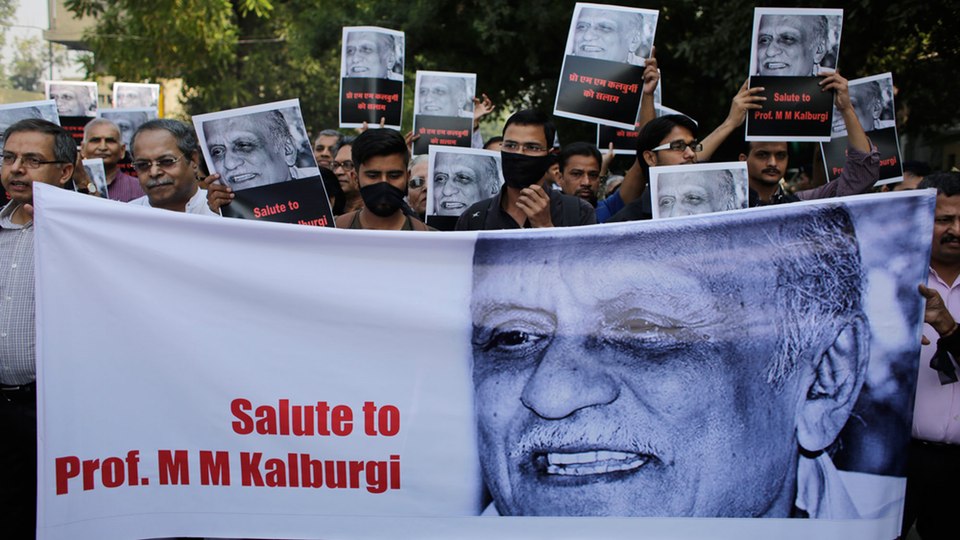

The ruling dispensation, the BJP leaders have come out scathingly on these creative people-scientists and labeled the whole process as ‘manufactured rebellion’ as put by Arun Jaitley. It has been alleged that those returning awards are the leftists or those who were recipients of privileges from the state when Congress was the ruling party and now with BJP coming to power from last one year, they are baffled and so the protests. It has been alleged that these people are trying to derail the ‘development story’ being written by the BJP under the leadership of Narendra Modi. Jaitley even goes to say that Narendra Modi is the victim of intolerance by these people returning their awards. Some like Rajnath Singh have pointed out that it is a mere ‘law and order’ problem for which state governments are responsible while these people are targeting Modi government.
                                                                                                      
As such what has happened is neither a law and order problem nor the one related to loss of patronage as it is related to the much broader phenomenon related to intense communalization of society. This time the degree of communalization has crossed the civil limits. The jibe that these people did not return their awards at the time of emergency, anti Sikh violence, migration of Kashmiri Pundits and at the time of Mumbai blasts of 1993 is a very superficial way of dealing with the social response to the phenomenon of growing intolerance and its degree. As the awards which have been returned and the statements put out by different groups do give the reasons for the same and these reasons pertains to the cumulative process and not this or that event. All these incidents mentioned by Jaitley and company have been a tragic part of recent Indian history. Many a writers did protest against most of these incidents, many of them had not even been awarded at that time.

The present times cannot be compared with the tragic incidents of the past for various reasons. Take the case of emergency for example. It was a dark chapter of Indian history, still it was the authoritarianism imposed mostly from the top. What is most disturbing in the current times is the vast network of organizations related to the ruling party whose followers either they themselves create hatred in the society or they mobilize the social sectors through hate speech; the result of which is violence. Currently there is a twin attack on the values of tolerance and liberal space. From the top the ruling dispensation has people like Yogi Adiyanath- Sakshi Maharaj, Giriraj Singh, Sadhvi Niranjan Jyoti who keep spreading sectarian message while basking in the glory of power and at the societal level divisive statements prevail.

At yet another level is the institutional control by communal ideology. Our major institutions and educational places are being mauled by divisive ideology. Our frontline areas of science and technology are being tampered day in and day out. The promotion of blind faith is the byproduct of this very policy. Blind faith and the large section of religious entrepreneurs (Babas, Modern Gurus) have a major say and have a major influence on the present political powers. As such the ideology spread by RSS, the one of Hindu nationalism, is dominating on social and political field. And lastly at the level of social thinking the ‘Hate other’ ideology has been promoted through various conduits using the issues like Ghar Wapasi, love jihad and beef. It is this which is creating the intense social insecurity amongst the religious minorities. It is this which is leading to incidents like Dadri. Such incidents are being projected as law and order problem to deliberately overlook the erosion in democratic space.

Essentially the insane communal violence has its roots in the prejudice leading to hate for the religious minorities. And that’s what flows from the ideology of Hindu nationalism, or any other sectarian nationalism, in the name of any religion or race. In current times the fountainhead of Hindu nationalism which is, the major factor here, is RSS. Not to say that Muslim sectarianism has its own divisive and supplementary influence. Through different conveyer belts this ideology assumes the ‘Hate other’ sentiment and that’s where cow slaughter, beef eating become the ground to kill the people. The practitioners of sectarian nationalism vow that ‘we will kill and get killed’ while defending our Holy mother the cow.

This is just one case in point. The major factor leading to present atmosphere lies in the qualitative transformation of ‘hate for others’. The stereotyping of minorities which began with Hindu nationalism has assumed horrendous proportions where the likes of Gulzar have to say what he said. So while the Jaitleys will keep undermining the steps taken by these people and while the Rajnath Singhs’ will keep dubbing it as a law and order problem, the dissatisfaction amongst those standing for democracy is growing, liberal space and tolerance is shrinking. We will have to keep thinking of more ways to draw the attention of larger sections of society towards the threat looming large on our democratic society, the threat of sectarian propaganda and politics leading to stifling of democratic space. And these are not the ordinary times, the divisive process have assumed menacing proportions and cannot be hidden by the illusory growth story!

Sunday, 15 November 2015

Three Murders and a Lynching

Ram Puniyani

Laws of nature cannot be applied to human society so directly. Still sometimes these have been used to explain-justify social catastrophes, “When a big tree falls. Earth shakes (in the aftermath of anti Sikh massacre 1984), ‘every action has equal and opposite reaction’ (during Gujarat carnage of 2002) are too well known. I have been very puzzled from last month or so since the scholars-writers, who have returned their honors and are being questioned as to why they did not do so when emergency happened or anti Sikh violence took place or when the mass migration of Kashmiri pundits took place or when the Mumbai train blasts killed hundreds of innocent lives.  I am tempted to think of the laws of physics of ‘qualitative transformation’ during heating or cooling of water, the temperature remains the same but water becomes either steam or ice.

Govind Pansare, Narendra Dabholkar, MM Kalburgi

When Dr. Dabholkar, Com Pansare and then Prof Kalburgi were killed over a period of months, the danger signals started being perceived but still it took the beef lynching of Mohammad Akhlaq to give a message that something has drastically changed in the society, and the spate of returning  of Sahiya Academy, National and state, awards followed in quick succession. Their protest was against the rising intolerance in the society. The incidents that followed and ran parallel to these ‘award-returns’ were equally horrific. The killing of a trucker on the assumption that he is carrying cows for slaughter; beating of a MLA in Kashmir Assembly by BJP legislatures and the scattered incidents of attacks on Muslims on the ground of beef consumption are too striking. We are currently facing a situation where anybody can incite the violence by just uttering the word beef, while seeing mutton or some such thing. We are living in an atmosphere where cow cannot be shooed away even if she is blocking the traffic.

The viciousness of atmosphere is not lost on the social perceptions. The insecurity of minorities has gone up by leaps and bounds. One knows that since the present NDA regime came to power all those ‘spewing hate’ are working overtime. For one Akbaruddudin Owaisi there is an army of Sakshi Mahraj, Sadhvis, Yogis and what have you. This army of mostly saffron robed or the one’s with the association with Hindu Nationalist politics has high position within their political combine, what is known as Sangh Parivar. The prime Minister himself had exerted the Hindu youth to emulate Maharana Pratap to save the honor of Mother cow during the election speeches. During this last over one year, words like Haramjades  (illegitimate) have been used with gay abandon. On the mere suspicion; a Pune techie Mohsin Shaikh was done to death. Serial attacks on Churches were passed off as thefts, the love jihad bogey was kept alive and the likes of Yogi Adityanath, the top BJP leader from UP, stated that for every one Hindu girl marrying a Muslim, Hindus should bring 100 Muslim girls. Muslim youth have been barred from participating in festivals like Navaratri. Mukhtar Abbas Naqvi, the BJP’s Muslim face advised those wanting to eat beef to go to Pakistan. The glorification of Mahatma’s killer Godse has been stepped up and temples are being planned in his memory, while a BJP MP from Kerala stated that Godse was right but he chose a wrong target. Atmosphere of communal violence has gone up in a big way during the preceding year.


Even after the awards started being returned the BJP leadership looked down upon the writers/scholars and overlooked the phenomenon which has lead to returning of awards. To mock these writers Buddhi Shuddhi puja path (purification of intellect ritual) has been organized and BJP spokespersons are humiliating them in talk shows with all their ferocity. To cap it all the Haryana Chief Minister, an old RSS pracharak, said that Muslims can live here but only if they will give up beef eating. No doubt the BJP Chief Amit Shah has talked to some of these leaders behind the close doors, but that does seem to be a mock drill as the leaders concerned did say that they went to meet their chief for some other reasons and none of them gave any serious apology.

Disturbed by what is going on, the President Pranab Mukherjee on three occasions urged the nation to uphold, pluralism, the core civilizational value of the country and to uphold tolerance. The Vice President Hamid Ansari reminded the Government that it is the duty of the state to uphold the ‘right to life’ of citizens. The index of the changing social atmosphere is reflected by the statements of two outstanding citizens of the country. Julio Reibero, the top cop, expressed his pain and anguish by saying that “as a Christian suddenly I feel stranger in my own country.” And the renowned actor Naseeruddin Shah had to point out that “Have never been aware of my identity as a Muslim until now.”

These are not ordinary times. The values of pluralism and tolerance have been pushed to the margins. With this Government in power all the wings of communal politics, the RSS affiliates, have unleashed themselves in full blast. Communalism is not just the number of deaths due to violence, it is much more. The foundation of this violence begins with the manufacture of perceptions about the religious minorities. These perceptions based on history and some selective aspects of present society are given an anti human tilt and interpretation. This is used to create hatred for the minorities and that’s where the communal elements can unleash violence either as a massive violence like Gujarat or Mumbai or Bhagalpur or Muzzafarnagar or the one in Dadri. This creates the divides in society which over a period of time is converted into polarization. And polarization is the foundation of electoral strength of party wanting a nation in the name of religion. As per Yale study, the communal violence is the vehicle which strengthens BJP at electoral level.

Communalism has been planted in India over a century and a half ago. The British policy of ‘divide and rule’ used communal historiography as a major weapon. This type of interpretation of history was picked up by communal organizations and given an anti Hindu or anti Muslim tilt and gradually this has been strengthened after every act of violence which has been the outcome of their politics. The present phase is the one where the cup of communalism is spilling out from its earlier levels or boundaries. The intensity of ‘Hate’ constructed around temple destructions, love jihad has been supplemented by the oft used tool of beef. In the present situation where the divisive elements, who are in center stage of politics also know that they are safe and secure as the present Government precisely wants what they are doing, their contrary posturing notwithstanding.

The present combination of the Government guided by the ideology of Hindu nationalism and the ‘fringe elements’ having same ideology, has a vast network and with a wide reach. This party has the advantage that mostly it does not have to dirty its hands in the local agenda of sectarian nationalism, and so there are many elements which can do the local work for dividing the society. The so called fringe elements now are occupying the center stage, and so the ‘qualitative change’ in the situation.  The flood of awards being returned is due to the situation created by deeper communalization of society. This is manifested in growing intolerance, attack on plurality and is leading to the insecurity of minorities, which has qualitatively transcended the earlier limits. The question is how to uphold the values of Indian Constitution in the current times?

Monday, 26 October 2015

Assault on Syncretic Traditions


Ram Puniyani


The country is undergoing a regressive attack in different fields of life. Apart from the political undermining of secularism, pluralism and Indian nationalism, the cultural pluralism and valued syncretic traditions are also under severe attack. The intensity is increasing. On the back of the murders of dissenting rationalists (Narendra Dabholkar, Govind Pansare and M M Kalburgi), the bans on food,, a literary siege is being erected. The writers steeped in a multicultural, plural milieu are under attack on sectarian grounds.

From Kerala known for the culture which has kept the identity of different religions and has also led to their intermixing, comes the news that the renowned literary critic and Malayalam scholar, Dr. M.M. Basheer was threatened and told to stop his column on Ramayana, Ramayana Jeevithasaramritham. There have been major non Hindu writers like Thomas Mathew, poet and popular lyricist, the late Yusuf Ali Kecheri who have contributed to such themes which so far have looked beyond the religious divide. Basheer got abusive phone calls as to how a Muslim like him has any right to criticize the Hindu God. He was just commenting on Valmiki’s criticism of Lord Ram to call Sita for Agni Pariksha(trial by fire). Basheer, a practicing Muslim, for the first time was made to feel that he is a Muslim. Unable to bear the barrage of aggression of Sangh Parivar elements, Hanuman Sena in particular, he stopped his series. As such he has contributed over 50 articles on the theme. 

MM Kalburgi

There are two major points which are very disturbing in the ongoing assault on plural ethos of the country. The first one is that there are innumerable literary people and saints, who irrespective of their own faith have contributed to the cultural aspects of religion in the sub continent. The legendary classic contributions of Rahim and Raskhan on the life of Lord Krishna cannot be eroded from the literary history of the sub continent. Who can forget the contributions of Dara Shikoh’ in translating the Upanishads into Persian. The Nawab of Bijapur had number of Veena players in his court for invocation of Goddess Saraswati. Even a decade ago we enjoyed the richness of Bismillah Khan’s shehnai, many of his compositions are dedicated to deities.

Shiekh Mohammad a saint from Maharashtra has been the major figure in the Warkari tradition, built his work around god Vithoba (God standing on brick), which is the major part of Bhakti tradition in Maharashtra. Saints like him and others like Ramdev Pir, Satya Pir stand tall in synthesizing the trends of cultural integration. We have Miyan Mir, another Pir in Punjab who was invited to lay the foundation of Golden temple. Even today villages and towns of different parts of India have Sufi shrines and Bhakti saint memorials, where people from all religions throng and pay their respects.

This syncretism was deeply expressed by Kabir, Nanak and Tulsidas in particular. They reflected the synthetic trends and the influence of both religions in their lives and works. Nanak went on to pick up from Hinduism and Islam both, while Tulsidas mentions in his Kavitavali about living in a mosque. Kabir communicated with people in simple Hindi and reflected the ‘building of bridges’ between the two communities.

Communal politics in India, which began in the colonial period went on to associate culture and traditions exclusively with religion. Today the seeds of division have gone so deep that in recent times we saw the eminent painter M.F. Husain being hounded to the extent that he had to leave the country. His roots were in the village where there was a serious mix of Hindu-Muslim traditions and he regarded Hindu themes as part of his heritage. Interestingly his work did not come under attack till the decade of 1980s, when the communal cauldron started affecting different aspects of our society and vehemence of intolerant elements went on destroying the creations of people like Husain. Hindi film and TV world has the best of such traditions in likes of Shakeel Badayuni (Man Tarpat Haridarshan ko Aaj-Baiju Bawra) and Javed Akhtar (O Palanhare Nirgun aur Nyare-Lagan) writing beautiful devotional songs and Rahi Masoom Raza scripting B.R. Chopda mega serial Mahabharat.

Another aspect related to attacks on Basheer is also related to the interpretation of the Lord Ram story. In the subcontinent and even in the far East hundreds of versions of the Ram saga are prevalent. The Hindutva politics has picked up a version of Ram story which is that of Ramanand Sagar's serial. The classical essay of A. K. Ramanujan, ‘One hundred Ramayanas’, was forced out of the curricula in Delhi University. This brilliant essay narrates the beauty of the diverse telling of Ramayana. Ambedkar’s ‘Riddles of Hindusim’ criticising Ram for banishment of Sita and punishing Shambuk, also met with a hostile reception.

How do we restore the complex cultural, religious, literary pluralism of India is something which the social movements need to ponder over in times to come.

Share

Twitter Delicious Facebook Digg Stumbleupon Favorites More