Thursday, 17 May 2012

Politics through Food Habits


Ram Puniyani

In the middle of April 2012 Osmania University (OU) witnessed an unusual violence on the issue of eating beef. A section of dalit students’ were demanding that University Hostels should have beef on the menu. They also organized a beef festival in which a large number of students ate beef biryani. The festivity was not to last long as the ABVP, the student wing of RSS, created rampage, a student was knifed, a bus was torched and ruckus was created in the university. The Vice Chancellor of OU knelt to the aggressive cow protectors and said that beef will not be introduced in the menu.

Just a month ago the in the Kurmaguda area of Hyderabad a group of youth associated with Hindu communal group were arrested for throwing beef inside a Hanuman temple, who later spread the word that Muslims have defiled our temple and turned their guns against the hapless minority, torched few buses. A little while ago the ruling BJP government in Madhya Pradesh had introduced a bill prohibiting the consumption of beef in the state. Other BJP ruled states in one form or the other are introducing legislations, which prohibit the slaughter of cow.

The place where Muslims were butchered mercilessly under the Chief mastership of Modi the ‘care of cow’ has gone one step up and state has opened centers for cataract and dental surgery of the Mother Cow. The goal of the Hindu state of Gujarat under Modi is to open more such centers so that Mother cow does not have to travel more than three kilometers for accessing these services, this while innumerable victims of Gujarat carnage, are yet to recover from the trauma of the carnage, aided by the apathy of state.

So far most of these legislations and the accompanying propaganda have been directed primarily against Muslim minority, which is demonized as the butchers and eaters of ‘our holy cow’. The OU episode shows the other side of the agenda of cow politics. While there had been cases of murders of dalits on the pretext of skinning a dead cow (Jhajjar, Haryana) and VHP defending the act saying that cow is too holy to spare the dalits. Still primarily it is the Muslim community which has been the target of propaganda emanating from RSS- Combine stable.

With dalits, the other target of RSS combine, the issue is not just of identity. It is related to the livelihood and food habits of dalits-Adivasis. The cow as a symbol of RSS combine has been in the fore since the rise of communal politics during the British rule. As such the cow has been in the forefront of communal battles of upper castes in India earlier also. The Brahmanical reaction to rise of Buddhism was countered by putting forward the symbol of cow. Some Dalit scholars hold that cow was cleverly chosen and one of the reasons cow stole a march over the equally useful buffalo was its color. It is not a coincidence that the dark skinned people have faced the wrath of the elite in one form or the other.

A file photo of supporters eating beef biryani
at the beef festival in Osmania University -
Image Courtesy: Deccan Chronicle
The scholars of Vedic India Prof D.N.Jha, Dr. Pandurang Vaman Kane and champion of social justice Dr. B.R. Ambedkar, all have pointed out that cow was verily eaten during Vedic period. With the rise of agricultural society, and need for preserving cattle wealth; the religions-ideologies promoting non-violence in the form of Jainism and Buddhism came up and campaigned against senseless sacrifice of cow in Vedic yagnas (sacrificial ritual).  

The current communal politics has twin agenda. At surface it wants to subjugate the minorities and is using the emotive issues to create a mass hysteria against minorities. Lord Ram and Cow are the major tools of communal political mobilization. While the supporters of RSS combine generously donate for the welfare of cow, it is the dalits who practically take care of the grazing and other needs of Holy mother. Last some time a pressure is being built up culturally and politically that beef eating communities give up this integral part of their habit.

The food patterns are changing under intense propaganda still as of now the consumption of beef in India is higher than that of mutton and chicken put together. Its export is also a major business. The RSS combine on one side aims to subjugate the Minorities and on the other wants to maintain the status quo of social relationship of caste and gender. These are subtle and overt maneuvers implemented through political and cultural conduits. Attitude of communal politics to dalits has been a complex one. The anti dalit violence of 1980 against reservation, the anti OBC violence of 1986 against promotion of OBCs in jobs, and its strengthening of Kamandal politics (Rath Yatra and the Babri demolition) in response to Mandal were a part of this.

At another level the strategy is to co-opt dalits into Hindutva fold. From middle of decades of 1980s RSS has activated Samajik Samrasta Manch (Social Harmony Forum) which has been mobilizing dalits around that. The Gurus like Sri Sri Ravishanker have been saying that there should be harmony between upper and lower caste, while he keeps quiet about the prevalent social injustice in various forms. The aim of the communal politics is to maintain the status quo of caste and gender.

Through Samajik Samrasta Manch the message of undermining caste atrocities and social injustice is actively propagated. Supplementing this is the cultural assertion and imposition of elite norms on the whole society. Food habits are a part of culture and for large sections of dalits and Adiviasis beef had been an integral part of their food. Incidentally there is a vigorous campaign to promote vegetarianism and denigrate non vegetarian food practices.

While the large section of dalits is struggling for social and economic justice, a section of dalits is undergoing the process of sanskritization as well. It is in this light that the symbols of dalit assertion in the matters of food habits and cultural expressions are being attacked openly. The compromised state apparatus is not able to stand up to this onslaught of communal politics to preserve the social and democratic rights of dalits and other marginalized sections of society, be it the matters of their physical security, questions of equity and food habits. It is a blatant attempt to manipulate culture, to impose elite norms, through influencing the food habits, which are so much cultural in their nature.

It seems Mother Cow may be the major emotive weapon to be used for the politics deriving its legitimacy from Hindu religions’ identity. Interestingly it reveals the twin goals of this politics. At surface it is to reduce the minorities to a status of second class citizen and at deeper level to subjugate dalits at social, political and cultural level.

Wednesday, 9 May 2012

Federation of Karnataka State Rationalist Associations: First State Conference

We reproduce below a communication received from Karnataka Rajya Vicharavadi Okkootta (Federation of Karnataka State Rationalist Associations):

Federation of Karnatka State Rationalist Associations (Karnataka Rajya Vicharavadi Okkootta) is organizing the 1st state level rationalist conference at SHRAVANABELOGOLA on 18th & 19th of May 2012.
As you are aware, a get-together of more than 100 rationalist and humanist activists and sympathizers was held on March 14, 2010 in Bangalore. It was decided at the meeting to form a Federation of rationalist and humanist groups active in various districts of Karnataka in order to coordinate the activities of these groups at the state level. Subsequently, during the last two years, our activists visited about 22 districts of the state and held meetings with various groups and individuals. Those districts which we could not cover, we got in touch with activists over telephone.
To keep up the momentum generated through these contacts, to consolidate the gains and to build up the organization further, it has been decided to organize the first state conference of the Federation at Shravanebelogola on 18th & 19th of May 2012. In order to make the conference a grand success, we request your participation.


VENUE:


MANJUNATHA KALYANA MANTAPA (Near Bus Stand)
SHRAVANABELOGOLA,
Hassan District

Delegate Fee: Rs: 200/- only
(Towards accommodation, on 18th night. lunch, tea, & dinner & breakfast &lunch on 18th &19th respectively)


Delegates can sent the delegate fee of Rs.200/- by ECS transfer to

Srinivas Natekar
SB A/c No. 007201016498
Corporation Bank, Shravanabelogola
IFSC Code: CORP0000072

For Programme Details, the delegates may contact any of the following persons

  1. B.V.V. Subbarao (Bangalore) - Mobile:  9886679088;   Land Line: 080 -41476288 
  2. Srinivas Natekar (Shravanabelogola)  -  Mobile: 9844614676;  Land Line: 08176-257875
  3. Dr.H.R.Swamy (Hassan) -   Mobile: 776004088
                                         Email: vicharavadi@gmail.com

Greetings:


I welcome the Karnataka conference and this is timely. We need to inculcate scientific attitude among students and youth which will take society in to future development. Today the reactionary forces gained upper hand and set the rational cloack backwards. The child abuse of inculcating religion to the kids from childhood onward should be stopped.

Innaiah Narisetti
USA
Wed, May 9, 2012 at 3:42 PM

***

Thanks for the invitation.

I am happy to know about the conference and I wish the conference all success.We are also celebrating the national conference at Hyderabad on 9th and 10th June 2012.I am forwarding the message to our friends.

With regards

Gumma Veeranna
President
A.P.Rationalist Association
Wed, May 9, 2012 at 3:59 PM
***

Sunday, 6 May 2012

India’s Blasphemy Law: Section 295A of IPC

Narendra Nayak

Section 295A. Deliberate and malicious acts, intended to outrage religious feelings or any class by insulting its religion or religious beliefs
[295A. Deliberate and malicious acts, intended to outrage religious feelings or any class by insulting its religion or religious beliefs.— Whoever, with deliberate and malicious intention of outraging the religious feelings of any class of [citizens of India], [by words, either spoken or written, or by signs or by visible representations or otherwise], insults or attempts to insult the religion or the religious beliefs of that class, shall be punished with imprisonment of either description for a term which may extend to [three years], or with fine, or with both.]


This section of the IPC pertains to insulting religions and religious beliefs. Made by our colonial masters to divide and subjugate their vassals, like many other provisions of the archaic laws made by them, this section too has been carried over into our laws and is being used now mainly to persecute and hound people who may have points of view contrary to those of the powers that be. The rationalist movement and other progressive forces have been mostly at the receiving end of persecutions under this but the others have been no exception. The word 'persecution' has been deliberately used here as most of the cases booked under this section have resulted in acquittals of the accused and all they have had as punishment is the period of the 'due process of law' which can take several years to couple of decades to complete.

Sanal Edamaruku
The recent one in this issue is the attempt to prosecute a rationalist from Delhi, Sanal Edmaruku. He has been quite active on the TV channels denouncing superstitions and god men on them and has been a regular feature on many of them. The most recent controversy in which he has been involved is the one of a cement crucifix of Jesus Christ in Bandra, Mumbai dripping water from its feet. There were hot discussions of some TV channels about the veracity of this so called miracle and there were some hot exchange of words in between him and others leading to complaints against him under the above mentioned section 295A of the Indian Penal Code for deliberate and malicious acts leading to outrage religious feelings of any class here read as the Roman Catholic community. Again, the act does not pertain to the miracle of the dripping cross but other words used in the course of the discussions which have outraged the religious feelings of a group of people called as The Organisation of Concerned Catholics (OCC) and the Catholic Secular Forum (CSF) who had lodged complaints against Sanal at the Juhu and Andheri police stations. It was said that Sanal’s contentions that the so called 'miracle' was promoted by the church to fleece gullible people and the prefix used for the head of the Roman Catholic church by calling him Mr. Pope had angered these Catholics who chose to file this complaint. It was in the newspapers that the Mumbai have summoned Mr. Edamaruku for questioning on this complaint. A committee to defend him under the leadership of the eminent Supreme court lawyer Mr.N.D,.Pancholi has been formed and funds are being collected from all over the world for his defense.

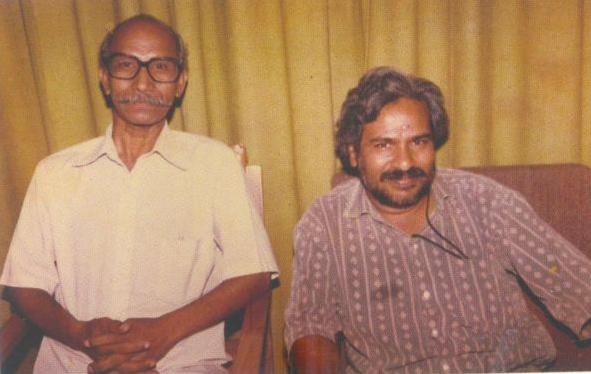
Karantikar (left) with Telugu Revolutionary Folk Singer Gaddar
It is not the first time that this section is being used or that Sanal Edamaruku is the first one to be hauled up under this. A couple of years back Krantikar, State President of Andra Pradesh Rationalist Association and Executive Committee Member of Federation of Indian Rationalist Associations had been hauled up under the same sections and had been in prison for quite some time as he had refused to apply for bail. His crime - he had translated some write ups of Taslima Nasreen which had been published more than decade back and were available to the world at large on the web into Telugu and had published that in book form, which had again angered the local fundamentalist Muslims who were after his blood. The ruling congress party in the state had brought all these sections upon him to please their so called 'minority vote bank'! The way it was done it was pretty obvious that the case would be thrown out by the court but the 'persecution' part of it was more important for the govt.!

Just at the time of the Sanal case hitting the headlines a student of Hyderabad, Kartik had been arrested on the same grounds for reacting that there is no god to someone who had greeted him on Hanuman Jayanthi day. He had been arrested and was in police custody for having expressed his convictions and exercising his constitutional right! Again, the same law was used by a right wing student organisation to target a member of a rival organisation. The saffron gangs are experts in using this law to harass those who do not see eye to eye with them. In fact, they used it to file complaints against those who organised and participated in a 'beef festival' on the campus of Osmania University recently. Though one's dietary habits are one's personal business, one mans food can be another one's religious sentiment! So, people could file complaints under section 295A for eating beef (Hindu religious sentiments), Pork (Muslim religious sentiments), any non vegetarian food (Jain religious sentiments) and so on ad infinitum! It could be also argued that even the menus of hotels are publications which are deliberately and maliciously composed to hurt them and so on.

Like many of the archaic laws made by our colonial masters have been relegated to the dust bin in their country, this law too deserves the same fate. In fact it has been advised by them that we should do so! Yet, we choose to have these which are an affront to the very concept of human rights. If a person has the right to propagate one's religion we should also have the right to question the same. All the religions thrive by striking the fear of the unknown into the minds of people and by spreading superstitious beliefs and questioning any of them would be construed as hurting the religious sentiments and cases filed under section 295A! If those who do so are members of a movement like ours then it could be added that the intent was 'malicious and deliberate'!

I can recall some instances from the past when we have been threatened with this. About a decade ago, I had made a public statement about cows urine being the urine of animal like any other- for instance a dog! At that time a campaign was started by the peddlers of the concoctions containing cow’s urine that it was an attack on the religious sentiments and I should be booked under this section. A big debate went on for weeks and finally a legal luminary concluded it by saying that though I deserved to be punished under that it could not be done as I was born in a Hindu family! If I were to be born in a family professing some other religion then I could have been prosecuted! He also added that criticism and reform was a salient feature of Hinduism! So, the whole controversy died a natural death. We have been threatened with the same when we questioned faith healers of Christianity- the excuse was that they were just conducting prayer meetings! The same was threatened when we exposed one Aslam Baba who was supposedly conducting surgical operations with tailor’s scissors! A couple of years ago when we had tried to investigate Mary's flex prints shedding tears we had to struggle very hard to keep out any such allegations of 'hurting religious sentiments' !

Does this law have a role in our society? Well let us take a look at article 51 A H of the constitution of India which deals with the duties of the citizen it states that-51A. Fundamental duties It shall be the duty of every citizen of India (h)to develop the scientific temper, humanism and the spirit of inquiry and reform. With a constitution which states this and with a section of the IPC which is contrary it is the article of the constitution which should prevail.

Hulikkal Nataraj
This has been also stated in the Hulikal Nataraj vs Govt of Karnataka judgment of the Karnataka High court. In this case a case was filed against him for making a statement at a placed called Madikeri in Kodagu district of Karnataka. He had stated in a public lecture that the so called miracle at Sabarimala at the Aiyappa temple area was man made. It was about a flame called as Makara vilakku from a hill called as Ponnambala Medu which was opposite the temple. The locals who wanted to hound him and harass him had filed a complaint with the local police station and the station house officer had straightaway filed an FIR and a charge sheet and tried to arrest Nataraj who had gone to the High Court for quashing the case. After a couple of years the judgment came as an indictment of the whole system. In fact the judge called the Home secretary to the court and also withheld the increment of the Sub Inspector who had attempted to arrest Nataraj.


A couple of years back when we had tried to investigate the phenomenon of flex prints of Mary shedding ‘tears’ at the church in Aluva, Kerala there were attempts to convert that too as clash between various sections and to convert it into a outraging religious sentiments issue as in the case of Sanal mentioned above. But, we were very careful in our approach that nothing much could be done.

Such laws like section 295 A of the Indian Penal Code have no place in a civilized society and need to be consigned with many of such to the trash bins of history. Finally after mulling over the legal issues and the secular aspects of the law, a philosophical question needs to be addressed- why does an omnipotent deity need the services of a mundane law made by puny human beings to set right alleged infractions of divine laws made by a higher force? This is for the religious whose feelings are ‘offended’ to answer! 

Saturday, 5 May 2012

Savarkar: Was He a Rationalist?


R.A. Jahagirdar 

We publish this essay by Justice RA Jahagirdahr (1927-2011) on the Hindutva ideologue Vinayak Damodar Savarkar  in the context of the 8th National Conference of Federation of Indian Rationalist Associations (FIRA) held in Nagapur on 11-12 February 2012. The official souvenir brought out during the conference had a photograph of Vinayak Savarkar with the astonishing remark that the rationalists cannot forget his contributions to humanity. This attempt to put this Hindutva ideologue, who in fact coined the word “Hindutva”, on a rationalist pedestal is nothing but reprehensible. Despite the enormous quantity of literature available today conclusively establishing that Savarkar was a rabid Hindu communalist, it is surprising that some ‘rationalists’ still project Savarkar as their leader. What was still more surprising was that the entire FIRA leadership did not make even a murmur against this crude attempt on the part of the local host (Akhil Bharatiya Andhashraddha Nirmoolan Samiti) of the conference to use the FIRA platform to project their ideology.  It is in this background that we publish this essay by the late Justice RA Jahagirdhar (1927-2011). Courtesy: Collected Works of Justice R.A. Jahagirdar (Retd) (1927-2011) published by Rationalist Foundation, Pune. The book can be downloaded at http://www.arvindguptatoys.com/


It is generally be1ieved that Savarkar was a rationalist, despite his belief in Hindutva. He advised the general public of India, more particularly Hindus that Vedas, Upanishads and Puranas are good literature but not guides. They should be kept in the cupboard as pieces to look good. Even Bhagwad Gita allegedly dictated by Lord Krishna was a piece of literature and only expounded what he regarded as a good guide. It described four phases of man and we are free to follow any one as the pathway to God. In short, he did not believe in the supernatural.

Vinayak Savarkar
On these and other grounds Maharashtra Andhashraddha Nirmoolan Samiti has hailed him as a great social reformer of Maharashtra. If one reads the piece on Savarkar, he is in fact, regarded as a rationalist of Maharashtra on par with Gadge Maharaj, who tried to teach people to clean Maharashtra - even personally sweeping the land and bylanes of the city and villages. He in his own language admonished the people to lead a personal good life. Gadge Maharaj never invoked God for the social reform he preached and in fact did not personally practice any rituals. He took a broom in his hand and set an example of how and why the streets and public places be swept.

This was not the rationalism of Savarkar. Though Savarkar advocated that meat prohibited for the high caste Hindu, should be eaten by them. No food was prohibited by Savarkar. Savarkar’s advocacy that Hindus should eat meat was based upon the belief that meat has strength. But it was a myth, because he forgot that an elephant, though so huge was strictly vegetarian and if an occasion was available to it, it could also lift a lion (who was a strict nonvegetarian) with his trunk and injure or kill it. The lion could attack and kill an elephant more because of his agility and mobility. But Savarkar was right in the absurdity of the ban on meat. Meat was a taboo to orthodox Hindus because it was animal food. No food was prohibited, according to Savarkar. Food should he chosen on the basis of its nutritional value and not on the basis of religious edicts. He might even have ridiculed the Muslims and Jews for prohibiting eating of pork because the people of Kodagu (Coorg in English) eat it as a regular food item. To Americans, English and even Europeans, no food is prohibited. Africans also eat almost any food, scarcely barring some. Despite being born in a Chitpawan Hindu family (a sect of Hindus), Savarkar advocated or at least did not prohibit eating meat. But should he be regarded as a rationalist for this? It would be a very narrow conception. Hitler was a vegetarian. Akbar was a vegetarian.

A group photo of people accused in the Mahatma Gandhi's murder case. 
Standing: Shankar Kistaiya, Gopal Godse, Madanlal Pahwa, Digambar Badge. 
Sitting: Narayan Apte, Vinayak D. Savarkar, Nathuram Godse, Vishnu Karkare
In this connection, it is interesting to note that M.N. Roy, the great rationalist, persuaded Virendra Chattopadhyaya to eat beef in Germany. Roy told Chattopadhyaya that Hindus forbade eating cow’s meat (beef), in India, not in Germany. So one can safely say that, Savarkar was a rationalist in matters of food.

That is not all. Because Savarkar said although the Vedas and Upanishadas are Hindu scriptures, no one reads them. Therefore, it is said that Savarkar was a rationalist. Normally if a person’s source of knowledge is articles in a book, he is not a rationalist. Similarly, one who regards a person or a book holy can never be a rationalist.

It is perfectly in order that a rationalist or even a common man should reject Vedas and Upanishads. Puranas do not teach any moral lesson. Shambhuk episode, Wali incident, Sita’s totally unjust Agnipariksha and some other features make Ramayana unacceptable. Mahabharat is still worse. There are many persons in Mahabharat who were not born legitimately. Of course, this is imagination but the bulk of Hindu population believes in them, as they are entertaining. Due to their entertainment value and because of technical and other reasons they attracted audiences on T.V. on Sunday mornings. But Bible was a failure in this predominantly Hindu kingdom. One can speculate how a serialization of Quran would fare. Of course, the rationalists regard them as myths. The three books mentioned are no doubt figments of imagination for the rationalists. It is not mentioned that Savarkar condemned these as wrong on ethical grounds or any of the Puranas on any other ground. Rationalism as an appellation can hardly be applied. Ramayana, Mahabharata are good entertainment stories, as Arabian Nights but no human being should and can use them for self edification. There are so many irrational propositions in them, which no rationalist can accept. Puranas come in the same category. Probably they were composed in the third or fourth century to arrest Buddhism and Lokayat. Upanishads are a different story. Though they are attached to Vedas, they contain theoretical discussion and not one of them has canvassed that God exists. Even Kathopanishad and Brihadaranyak Upanishads do not advance the theory of theism. A rationalist cannot believe the Vedas. Rigved and Yajurved contain at places such unrefined passages which are not brought to the notice of the believers. Even Atharvaveda and Sam Veda do not contain any educational material. Rationalists study them but by no stretch of imagination can accept them. Savarkar in his voluminous writings examines them but does not condemn them. As such, he might be a normal Hindu but definitely not a rationalist.

The literature to which I have made reference so far does not contain any law that might have governed the Hindus. Sometimes as Ram Shastri Prabhune says, they might have been weighed as Hadith; sometimes a story, here or there, attributable to God or Gods might have given guidance or even wrong guidance. For example, Shambuka episode earned for Rama the Sobriquet Purushottam from Agastyamuni, one of the eight Rishis who were the preceptors of Rama. Unfortunately, some of the Hindu kings thought they were following Sanatana dharma by behaving according to these irrational, incoherent and even unjust laws which endorse beheading of Shambuka (a Shudra youth) by Rama. They cannot he called rationalists.

But the book which acted as a law book for Hindus, like Savarkar, was a Smriti called Manusmriti. Even till 1956, the Courts, including Privy Council, accepted the law propounded by Manusmriti as the law of Hindus. It is the most irrational book which should not have seen the light of day. No rationalist could accept the legal propositions that the Hindus were expected to follow. Did Savarkar condemn the book? No, he even praised the book and said the weakness of the Hindus was cause of not following the book. Remember this was before 1956. There is no book in the world which treats the so-called Shudras and women as contemptible and untouchables as inhumanly as Manusmriti. I venture to think that the Hindus believed in Manusmriti and accepted it is the reason why India has not produced a single philosopher after Sankaracharya. There were only Bhaktas like Tukararam, etc. but not thinkers or philosophers. Many of the Bhaktas, it seems, were, schizophrenic. All Bhaktas were not of the same hue. But Hindus accepted all of them with equal reverence.

There is not enough space here to enumerate all the irrationalities of Manusmriti. But it is sufficient to remember that Manusmriti tells us that the woman in her childhood depends upon her parents, in her youth or adulthood on her husband and in her old age on her children. No woman deserves freedom, women’s sensual pleasures must be kept under control, the man is the one to whom the woman adheres, a woman should get a loaf of bread, a seat and ornaments.

There are still more ‘gems’ about woman written in Manusmriti. Remember, though Manusmriti was a Smriti, it was a law, binding upon Hindus. In 1940, Savarkar in his presidential address of Hindu Mahasabha showed his commitment to Manusmriti and said that if the lessons of Manusmriti were learnt, Hindu society will be stronger. Savarkar was bold enough to say that “our Hindu nation shall prove again unconquerable and a conquering race as we proved once (Samagra Savarkar Sangrah, published by Maharashtra Hindu Mahasabha, Pune p. 426.) I must casually mention that Hindu Mahasabha has done a great service by publishing all Savarkar works in 1960 for only Rs. 160/-

Manusmriti further said that:

A) Shudras were born from the feet (of Brahma);
B) God has given only one occupation to Shudra viz. serving the high caste;
C) If a Shudra arrogantly teaches the Brahmin about the latter’s duty, the King shall cause hot oil to be poured in Shudra’s ears;
D) If a Shudra pretends to be of a higher caste, his lips should be branded;
E) No collection of wealth should be made by a Shudra;
F) The son of a Brahniin from a Shudra woman inherits no property.

There are more ‘gems’ like these in Manusmriti which no rational man can endorse. But Savarkar did. Read this in Savarkar’s Samagra Sahitya (original in Hindi).

“Manusmriti is that scripture which is most worshipable after Vedas for our Hindu nation, and which from ancient times has become the basis of our culture, customs, thought and practice. The book for centuries has codified the spiritual and divine march of our nation. Even today, the rules which are followed by crores of Hindus in their lives are based upon Manusmriti. Today Manusmriti is Hindu Law. That is fundamental.” (Emphasis provided.) Savarkar was addressing a joint conference of Hindu Mahasabha and RSS.

Savarkar has a reputation of being the leader and mentor of Hindus. Untouchahility was a part of Hindu Dharma. Ambedkar fought against it all through his life and ultimately embraced Buddhism. No religion or society in the world (except Hindus) has sanctified untouchables. Savarkar was not averse to untouchability, though later he established Patit Pavan Sangh in Ratnagiri. It has never traversed beyond Ratnagiri and Pune. Untouchability is regarded as a curse by all (except Hindu Mahasabha and RSS). Even Mahatma Gandhi condemned it, though he could have been unwilling to exclude them from the Hindu fold. Untouchables were regarded as ati-Shudras but outside the pale of caste-system. Gandhi would have probably accepted them in the Shudra caste.

We have already seen how Manusmriti regarded untouchables. Even the shadow of an untouchable cannot fall upon a Brahmin or in his path. But he made some cosmetic changes to Hindu society. While permitting caste Hindus to dine with untouchables, he emphatically said in 1939 that the Hindu Mahasabha, “will not introduce or support compulsory legislation regarding Temple entry by untouchables, etc. in old temples beyond the limit the non-Hindus are allowed by Custom as in force today.”

Thus, he was not in favour of unqualified entry of Harijans in temples as Ambedkar had launched in Kalaram temple; Kakasaheb Gadgil participated in Parvati in Pune and Senapati Bapat, in general.

On 20th June, Savarkar again guaranteed that the Hindu Mahasabha shall not enforce any legislation regarding the entry of untouchables in the ancient temples or be compelled by law for amending any sacred ancient and moral usage or custom prevailing in those temples. In general, the Mahasabha will not support any legislation, which may be thrust upon it.

While considering the reformist views of the Savarkar brothers, so far as personal law is concerned, let alone a rationalist, was Savarkar even a reformer?

I have already mentioned above that Savarkar never made efforts to ameliorate the condition of untouchables. Though he founded the Patit Pavan Sangh but with Bhagurkars Patit Pavan Sangh untouchables remained untouchables. Hindu Mahasahha as an organisation did nothing for untouchables. Savarkar opposed, as mentioned, the entry of untouchables into temples. Gods of caste Hindu temples were surely, the Gods of untouchables too, but the latter had no access to them. Laxman Shastri clearly advised Gandhi that untouchabilily had no sanction of Shastras. Savarkar never endorsed this view. This is the inhumanism of the rationalist Savarkar.

A couple of matters, not pertaining strictly to rationalism need be mentioned here. He was a Hindu Nationalist believing that Hindustan belonged to Hindus and no one else. Akhand (undivided) has always been the motto of Hindu Mahasabha of which Savarkar was the President. In fact, it was founded by him. Yet, on 15th August, 1943 (four years before partition) he said, “I have no quarrel with Mr. Jinnah’s two nations theory that Hindus and Muslims are two nations. We Hindus are a nation by ourselves and it is a historical fact that Hindus and Muslims are two nations.”

In the same place he mentioned that Hindus would he in the dominant position. Dominant in what, say—more taxes, more posts etc. Savarkar says nothing about it. Rest of the speech is confusing and incoherent and at least needs no examination. A nation is always based upon territory. Muslims, as a nation in Savarkar’s confession, would occupy a territory. Then where is Akhand Hindustan (undivided India)?

At one time Sindh and Bengal had Coalition Ministries. Shyam Prakash Mukherjee (son of Ashutosh) was a minister in the Bengal. Savarkar’s hatred for Congress was so intense that Dhananjay Keer (almost official Biographer) mentions that, “Savarkar had advised the Hindu leaders in the Muslim majority provinces to join Ministries formed by Muslim League (Keer -p.348)

This is the Hinduism or nationalism of Savarkar. That Savarkar was opposed to Quit India movement need not be held against him. Consistent with this view he advised Hindus to join armed forces “not to defeat fascism but to strengthen Hinduism.” In fact, he chided Nehru for opposing fascism for, according to Savarkar, Hitler and Mussolini knew what was best for their countries.

When in Ratnagiri Jail (where he had been transferred), Savarkar wrote his magnum opus Hindutva, wherein he made a distinction between Hindutva and Hinduism. All those who come under the umbrella of Hinduism were Hindus, for according to Savarkar, those whose history, gods, pitrubhumi (father’s home-land) and matrubhumi (mother’s home-land) were within and from this land were Hindus; so defined, Sikhs. Buddhists and Jains were Hindus but not Muslims and Christians. Muslims’ attachment was for Kaba and Mecca, their holy places. Christians looked towards Jerusalem where Jesus was crucified. Their Pitrubhumi was India but their Punyabhumi (land of worship) was abroad, not Hindustan. Therefore, they are not Hindus. Savarkar’s confusion and incoherence are evident here. He equated religion with nation. But see what he says elsewhere that “change of religion leads to change of nationality.”

I have given enough material to show that Savarkar was not a rationalist. He was communal. I do not hold against him that he was acquitted in Gandhi murder case. The government did not appeal against him. Being a lawyer I would say, agreeing with the Supreme Court, that he was doubly innocent.

Friday, 4 May 2012

Electoral Equations and Secular Values

Ram Puniyani

The UP Assembly elections results (Feb 2012) gave a clear mandate to theSamajvadi Party of Mulayam Singh. Congress was claiming that the results of UPwill be a shocker, meaning a surprisingly better performance of Congress. Asresults came through Congress was nowhere close the claims it made or theresults it expected were nowhere close to the expectation. Prior to theelections the main leaders of UP Congress with Rahul Gandhi in the lead,campaigned vigorously. The carrot of reservations for Muslims was dangled andthe Congress President Sonia Gandhi’s tears on Batla house encounter were ondisplay, but it seems the Muslim voters in particular were notimpressed. So far Congress had a very safe equation with the Muslim voters,also called ‘Muslim vote bank’ by its critics. The understanding was that sinceMuslims know that communal BJP is not the option where will they go exceptvoting for the ‘secular’ Congress.

Where do matters stand? It is true that large section of Muslims realizethe BJP can never be the option for Muslims as BJP is the epitome of Communalpolitics, it is the political child of RSS, which is working for the agenda ofHindu Rashtra through its multiple progeny like VHP, Bajrang Dal, VanvasisKalyan Ashram and myriad other organizations. In communal violence while theCongress has played despicable role in anti Sikh riots of 1984, it has alsobeen the mute witness to the series of anti Muslim riots and pogrom againstMuslims.  The justice to the victims of violence has not been activelypursued by the Congress, wherever it has been the ruling formation, Mumbaiviolence of 1992-93 being the worst example of ignoring and marginalizing thevictims of carnage. The Muslims have also suffered at the hands of Congressruled Governments in the aftermath of acts of terror, particularly those ofMecca Masjid, Malegaon, Ajmer and Samjhauta express blasts. In the aftermath ofthe blasts Muslim youth were arrested, tortured, their carriers as young mencrushed and later they released for the lack of any credible evidencewhatsoever.

Still despite all these lapses Muslim community has realized thatCongress is a lesser evil, more particularly after the Gujarat anti Muslimpogrom under the leadership of Narendra Modi, where the transformation of a democraticset up to a semi fascist Hindu rashtra is more than visible. They have alsoseen that the real culprits of bomb blasts mentioned above belonged to the RSSpantheon, for which BJP made all the efforts to shield them.

This distinction between Congress and BJP seems to be more or less clearand when one reflects on the acts of commission and omission of NDA Governmentat the centre between 1998 and 2004.Having kept aside the BJP as an electoraloption what happens to Congress claim to be a secular party or the onecommitted to interests of minorities. There is a mixed bag here. On one sideCongress has instituted Sachar Committee and Rangnath Misra Commission, whichhave given the true picture of the plight of Muslims. At the same time theimplementation of the recommendations of these reports is too slow, if at all.The intimidated Muslim minority is looking for policies which can lift it upfrom the stifling atmosphere of ghettoes in which they have been forced to livedue to the massive communal violence and the preceding and accompanyingdemonization of the community in the social space. A large section of communitywants quotas, but putting it as an electoral promise cannot fool the community,which is seeing the dismal fate of Sachar Committee and Rangnath MisraCommission.

The Batla House encounter, the refusal of the UPA II Government toinstitute a proper inquiry into it and the accompanying demonization of Muslimyouth was a big blow to the community which is struggling against odds to come outof ghettoization and wishes to embrace modern education and take advantage ofopportunities to the best of its capabilities, which at present are notadequate to pull it out of the morass in which it is trapped. This Batla Houseencounter and the negative attitude of the Congress for a proper inquirycommittee showed that Congress does not have courage to take up the issue ofsecurity of Muslims in the right earnest. Mere tears don’t protect you. Theevent in the neighboring Rajasthan, where the police entered the mosque andopened the fire to kill those inside was also something which cannot bepardoned at all.

Congress seems be a mixed platform and a pragmatic party as far as theprinciples of secularism are concerned. It will go this far and refuse to takethe decisive steps for principled democratic-secular values. One knows that thestate apparatus has also been heavily communalized and it takes a strong willpower to take up principled secular stand and to live up to that. In UP itseems the Muslim voters had the choice between Mulayam Singh and Congress.Mulayam had also temporarily allied with Kalyan Singh, who had presided overthe demolition of Babri mosque, but that was a brief alliance. Riots in Mau andother places had erupted during the Mulayam regime. Here surely Mulayam musthave sounded like the lesser evil vis a vis BJP or Congress.

Is this the same Congress, which had the glorious tradition of MahatmaGandhi and Pundit Nehru, who staked their all for preservation of secularvalues? With the present dithering attitude of the Congress leadership suchclaims are nowhere close to acceptable. Many a Congress youth are also muchcommunalized. One does not know whether this grand old party, is making itsworkers know about what secularism is, what is the truth behind the prevalentbiases against minorities; how Gandhi (Mohandas) had ensured the Hindu-Muslimunity by staking his life and how Jawaharlal stood like a rock supporting theedifice of plural values. A party is made by the workers and their mindset.While leadership dithers on such issues the workers, by and large have no clueas to how to take up the issues of Muslim minorities, battered by the onslaughtof communal violence and communal politics. UP Assembly election results apart fromother things are a pointer for the party to take up the legacy of MahatmaGandhi and Jawaharlal Nehru, if it wants to make a positive contribution toIndian democracy.

Share

Twitter Delicious Facebook Digg Stumbleupon Favorites More