Sunday, 1 July 2012

Targeting Innocents: State and Human Rights of Minorities

Ram Puniyani

In Kalyan a Muslim youth Bilal Shaikh was slapped with a non-bailable cognizable offense (May 2012) under section 333, after he jumped the traffic signal. He was assaulted brutally by the police for having arguments with them, suffered a fracture in right arm and was in jail for eight days. The policemen who beat him up got released with the non cognizable warrant.

Another Muslim youth Mohammad Amir Khan, age 18, preparing for his school exam, was abducted by police, charged with being the mastermind of serial blasts in Delhi, was charged under all the possible sections, tortured in jail for 14 years and finally released in 2012 when no evidence was proved in the courts.

In the series of blasts, for which now Aseemanand-Pragyasingh Thakur and company is now cooling the heels in jails, many a Muslim youth were arrested after every blast in Malegaon, Mecca Masjid (Hyderabad), Ajmer and Samjhauta express. In all the cases the Muslim youth had to be released as police had no credible evidence of any sort. In the meanwhile many of them had to drop out from their studies and their careers were ruined.

In the recently released (June 2012) report by Tata Institute of Social Sciences, the observation is that 36% of the jail inmates in Maharashtra are Muslims while the population of Muslims in state is close to 10.6%. The report was sponsored by the Maharashtra States’ Minorities Panel. The findings of the report are in conformity with the Sachar Committee report and general observation of Human rights activists.

Most of the arrests of Muslim youth are prompted by the prevalent stereotype of ‘Muslims are criminals, terrorists’. These stereotypes are highly prevalent not only in society but also amongst the bureaucracy, particularly the police and amongst intelligence agencies. Many in the police force are totally in the grip of communal thinking and with their infinite power they unleash themselves against the Muslim youth at every conceivable opportunity. The rise of communalization of society and more particularly after the coming up of the terrorism of Al Qaeda variety, the stereotypes about Muslims have worsened. One recalls that this type of terrorism was subtly brought up by United States for pursuing its goal of controlling the oil wealth. The attitude of authorities has become more anti minority and this in turn has undermined their professionalism and they are guided more by their biases than by the rules of law.

There are multiple reasons for the Muslim youth being targeted by the state authorities. True, that some Muslim youth have fallen prey to the illegal activities due to the abject poverty which they have to suffer. Still the major reason for their being indiscriminately arrested by the police relates to the misconception regarding acts of terrorism and communal violence.

In communal violence, the major culprit instigating the violence is majoritiarian communal forces. The study of different inquiry committee reports by Teesta Setalvad (Communalism Combat, March 1998) shows that in most of the cases of violence it is the RSS related organization, already prevalent or floated specially for the occasion, which is in the lead. Even in Mumbai violence, Shrikrishna Commission held Shiv Sena as the major factor leading the violence. As such Muslims are 13.4% of the Indian population according to 2001 census, but amongst the violence victims 90% are Muslims. Police and many a times political leadership takes the attitude which increases the insecurity of the community.

The worst part of this phenomenon is that in popular perception it is alleged that it is Muslims, who start the riots. Dr. V.N. Rai, who has done a major study on the communal violence points out that generally a situation, is created where the minority community is forced to throw the first stone on many occasions. To worsen the matter, after the violence the majority of those who are arrested for communal violence are Muslims again.

The recent acts of terror and attitude of police are very reflective of the whole process. In most of these acts of terror, Malegaon, Ajmer, Jaipur and Samjhauta express blast, many a Muslim youth were arrested as the ones’ who have done the act. Police machinery produced evidence of their involvement with some Pakistan based terror group; SIMI was always blamed for many of these acts. Even at that time there were enough pointers that police investigations and action defies common sense. Police had the standard formula for arresting Muslim youth after every blast. They made it a practice to implicate the Muslim youth and put on their head the charge of blast and their link with Lashkar-E-Tayyaba, Indian Mujahideen, SIMI or some such group. Social activists kept pointing to the authorities about the leads showing in another direction from where the acts of terror were emerging. Police totally biased with prejudiced mind set kept on repeating the same pattern over and over again.

Once Hemant Karkar’s immaculate investigation showed the link of Malegaon blast to Sadhvi Pragya Singh Thakur’s motor cycle and her links with many Hindutva groups the matters came to a halt. Sadhvi’s links with Swami Dayanand Pandey, Lt Col Prasad Shrikant Purohit, retired Major Upadhaya, Swami Aseemanand and many others of Hindutva ideology revealed that police till then was totally acting in a wrong manner. In this light Human Rights organization ANHAD (Act Now for Harmony And Democracy), organized a tribunal in Hyderabad, ‘Scapegoats and Holy Cows’. The report of this tribunal was very damning of the actions of the investigation authorities and the state. Logically with the arrest of Saffron terror gangs the acts of terror seem to have come to a halt.

Despite this, the attitude of police remains as biased as before and in the day to day life they display this partisan behavior. This biased attitude of state machinery, police and intelligence authorities in the main, has been ruining the life and careers of many a Muslim youth. The feeling of insecurity amongst the community as a whole is on the rise. This feeling of insecurity is crippling the possible growth of the community. Those implicated in such acts are also boycotted by the community and have faced immense personal, social and economic losses. It is time that the Human rights groups intensify their campaign to protect the innocent Muslim youth, the legal measures need to be strengthened whereby the police cannot exercise its biased attitude in arresting any Muslim youth. Measures are needed to ensure that police-intelligence agencies takes up more professional attitude overall and more particularly in the matters related to minority youth. The Government needs to wake up and apply the correcting measurs.

Apart from preventive legal steps we also need to work against the prevalent social biases against Muslims in particular. The myths against the community, which are historical and contemporary issues, which are related to the causes of acts of terrorism need to be countered by spread of truth about these myths. It is the duty of state and social organizations to undertake and promote such awareness programs through lectures, workshops, popular booklets and through mechanisms like T.V. and media in particular.

Friday, 29 June 2012

Nitish-Modi Spat: Debating Secularism


Ram Puniyani

Nitish Kumar in an obvious reference to opposition to Modi’s possible projection as the Prime-ministerial candidate of NDA, in the next parliamentary elections said that NDA’s Prime Ministerial candidate should be one with secular credentials. His aide went on to say that Vajpayee had the intention of sacking in the wake of Gujarat carnage and the NDA lost 2004 Parliamentary elections due to the Gujarat carnage and role of Modi in the same (June 19, 2012). In response Lalu Yadav questioned Nitish as to how he, Nitish, continued to be part of NDA after Gujarat happened? The BJP spokesmen talked at various levels. One of them said that ideologically Vajpayee, Advani and Modi are all the same. Another one said that Hindutva is truly secular and liberal so why Modi cannot be the PM candidate. RSS Supremo Bhagwat buttressed the point by saying as to why the nation cannot have a Hindutvawadi prime minister?

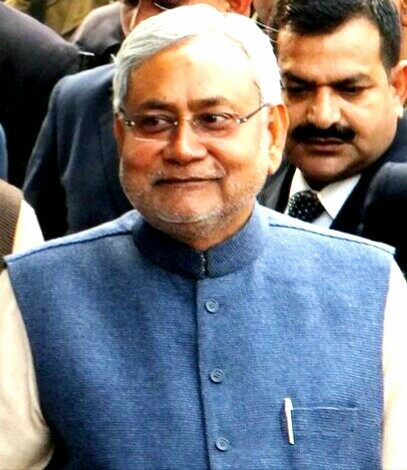
Nitish Kumar
With this the ever continuing debate about secularism and the nature of Hindutva is in the social space once again. One concedes that Kumar is no secular angel. When BJP came to become the largest single party in Lok Sabha in 1996, no one dared to ally with it that time as it’s communal face was starkly obvious due to its role in Babri demolition and consequent violence, which was too fresh in people’s memory. By 1998 in a similar situation many parities including Kumar’s JD (U) could not resist the temptation of power and struck some minimum common program to share power with the BJP. Though his JD (U) had a common minimum understanding with BJP, right under Kumar’s nose BJP during NDA regime communalized the polity to no end. Saffronization of text books was done and introduction of courses like Paurihitya and Hindu Rituals in the Universities being just few examples of the Hindutva agenda, were starkly visible. When the carnage broke out in 2002, Kumar was the minister for railways and in that capacity he ignored the investigation of Godhra train burning, which was mandatory as per the rules. Due to this Modi’s concoction that train burning was a preplanned act by Muslims went unchallenged for a long time. Kumar could have called Modi’s bluff that the train burning was a planned act by Muslims.

Nitish was part of the cabinet. What did he tell Vajpayee at that time one does not know, but as a secular person, his threat of pulling out from the Government would have set the house in order to a great extent. Even today, right under his nose his ally; the BJP of Bihar, is communalizing the polity. Communalism is not just communal violence. Communal violence is just the superficially visible part of the process of communalization, which aims to abolish secular space and liberal values.

Some of the statements of BJP spoke-persons are partly true also. The claim that Vajpayee, Advani, and Modi (one can add even people like Praveen Togadia, Promod Mutallik, Vinay Katiyar and the likes) are similar, is true to a great extent. They are all ideologically committed swaymsevaks, (RSS trained Cadres) working for the agenda of Hindu Rashta, the goal of RSS politics. There are dissimilarities amongst them also; there is a division of labor amongst them also. Since BJP is not hoping for coming to majority on its own strength, it has to keep a liberal façade. Precisely for this reason Vajpayee was the prime Minister, while prime mover of the chariot of communalism through Ram Temple campaign, Advani, was forced to play the second fiddle. When Vajpayee withdrew from the scene, Advani decided for the image change over and he suddenly realized the secular worth of Jinnah. It is another matter that he overplayed the game and their patriarch, RSS, decided to clip his wings and demote him. All the top brass of BJP, VHP, Bajrang Dal, Vanvasi Kalyan Ashram and many other RSS outfits are primarily the RSS swayamasevaks, which is too well known by now.

When the previous avatar of BJP, Jan Sangh, merged in Janata Party in the wake of lifting of emergency, the other components of Janata party, socialists in particular, demanded that the Jan Sangh members should give up their membership-affiliation with RSS. For Jan Sanghis breaking link with RSS was unthinkable and they decided to pull out from Janata Party and then they regrouped as Bharatiya Janata Party, as it is known at present. Vajpayee, in his famous address to NRI Indians in Staten Island, US, asserted that he is Swayamsevak first and anything else, PM, later.

In that sense they are on the same ideological wavelength but playing different roles at any point of time. They are communal to the core, with the agenda to work for religion based nationalism.  To say that Hindutva is secular and liberal is like putting the reality on its head. Hindutva is not Hinduism. Hinduism is an umbrella of various religious streams, which flowered and existed in this part of the world. Hindutva as a concept and political ideology started emerging during colonial period and was later popularized by Savarkar. He defined it as ‘Whole of Hinduness’, a combination of Aryan race, culture and language. In particular Hindutva is based on the Brahmanical stream of Hinduism, subtly promoting caste and gender hierarchy, reviving the feudal hierarchical system in the modern idioms.

When the whole nation was coming together on the principles of Liberty, Equality and Fraternity, the upholders of Hindutva, coming from the sections of Rajas, Jamindars and section of upper caste Hindus kept aloof from the struggle against British. They came together as Hindu Mahasabha and later founded and supported RSS.  Their politics was parallel and opposite of the politics of Muslim League, which was arguing on the similar line for an Islamic state, Pakistan. Muslim League also had base amongst the landed aristocracy, Nawabas, Jagirdars and later joined by educated elite. Hindutva stream, Hindu Mahasabha-RSS projected the glorious Hindu past and asserted we are a Hindu Nation from times immemorial. Muslim League identified with the rule of Muslim kings and traced their lineage to the first invasion of Muslim King in this part of the world. The National movement under Gandhi was for throwing away the yoke of colonial rule and for social change of caste and gender relations. It articulated that we are a Nation in the making.

MS Golwalkar
Here one can see the instrumentalist use of religion by a section of society, elite, who wanted to preserve their privileges in the changing social dynamics. The sharpest articulation of Hindutva politics came from M.S. Golwalkar, who in his ‘We or our Nationhood Defined’, eulogized fascism and asked for a second class citizenship for Muslims and Christians. Today the RSS cadres unable to swallow the blunt formulation of their politics by Golwalkar deny the existence of this book. The dilemma of RSS and its progeny is to keep the democratic face till they come to a majority when they can unleash their full scale agenda. Currently also their trained swayamsevaks are infiltrating in different wings of the state, media and education apart from forming the organizations like BJP etc. So who is secular in BJP? They claim that they believe in justice for all and appeasement of none. This is a very cleverly worded sentence to hide their intention of continuing the discrimination of those suffering in the present scheme of things.

How does one understand the difference between Hinduism and Hindutva? One has to take recourse to the example of the ‘father of the nation’ to avoid the heavy academic debates. Gandhi was a Hindu but not a follower of Hindutva. Godse and the RSS tribe are the practitioners of ‘Hindutva politics’. For this politics a Hindu like Gandhi is unacceptable ideologically as he could reach the zenith of secular ethos while being the best of the Hindus! We do realize that while the statement by Nitish Kumar is a symbol of shadow boxing it also presents one of the aspects of the political reality being witnessed by the nation. 

Wednesday, 27 June 2012

The Levitation "Miracle" at Kamarali Durvesh Dargah

After we uploaded Premanand’s writing on the 'miracle' at Kamarali Durvesh Dargha, Shivapuri, Pune, we came across a very interesting article on the same ‘miracle’. It was published in Skeptical Inquirer in its Spring/Summer 1978 issue (Volume II, No.2). Since this article is not easy to come by, we post it here for the benefit of our readers.

The Leviation "Miracle" At Shivpuri

When Philip Morrison, the book editor of Scientific American magazine, heard about a remarkable demonstration that was said to take place in a temple courtyard near a small town in India, he was curious enough to ask questions of a firm of scientists and engineers located in Bombay. Their director, Mr. R.C.Globe, was familiar with the phenomenon, and replied fully to Morrison's inquiry.


We produce here Mr. Globe's reply to Morrison: 

I thank you for your letter....with reference to the stone lifting at Shivpuri. As requested, herewith details of this supposed and mysterious power which it is said and believed lifts the stone ball.

I give some of the details which you may find interesting.

The mausoleum contains the body of a saint, a Muslim named "Kamarali Darvesh" who died about 700 years ago. There is always a Muslim in attendance to satisfy the curiosity of visitors to witness the "unaccountable and mysterious" lifting of a round stone ball which stands the larger of two on the ground adjacent to the entrance of the "Durgah," the Urdu name for the word "mausoleum."

This ball of basalt (or sand-stone, which is lighter)is about 14 inches in diameter and thus weighs about 140 pounds. Visitors must not attempt to influence the "spirit" which is said to lift it unless there is an odd number of men, i.e., 5, 7, or 11, no women being allowed to join the solemn(?) proceedings. The men gathered round the ball are then instructed by the attendant to touch the ball with one finger and when he gives the signal by voice, the men must shout in a loud voice in unison, the name of the saint, i.e., "KAMARALI DARVESH," but in a drawling tone of voice, when the stone will lift of its own accord; mark you, with the forefinger of each man still touching it.
The mausoleum is outside a small village, Shivpuri, about 16 miles from Poona, in the State of Maharashtra, Western India. I visited the place purposely to see this lifting by a mysterious power which is attributed to a divine entity, but failed to connect it with the "spirit" of the dead saint.
By mathematical calculation the stone weighs about 140 pounds so that 9 men pushing with one finger exert a force of about 15.5 pounds each, sufficient to lift the stone without any exertion or apparent effort. This of course is not believed by any Indian; they insist that it is the Unknown Power which does the lifting. No amount of discussion will move this belief out of their minds.

I don't believe that the joining up of ectoplasm supplied by each member of the group is responsible for lifting up of the stone ball.

To add to Mr.Globe's account may seem superfluous, but some interesting physical facts should be made clear. When the ball is resting on the ground, any force applied as shown (F) will tend to make it roll, unless exactly countered by an opposite and equal force. With a number of persons crowded about the ball, such equal pressure all around seems unlikely. Therefore, the ball will tend to roll in one direction or another.


Now it is not clear from the account given just what instructions are provided by the attendant present to supervise the miracle. If he gives the men reason to believe that their forefingers must maintain firm contact with the ball, conditions for it to begin rolling are optimum. There is no doubt in the minds of the faithful at this manifestation that the ball is now moving by divine force. To keep in touch with the ball is now more difficult, and each pushes harder, so that the small push necessary is delivered readily, and up goes the ball.

As the ball rises, the angle at which each person applies pressure will change, and the ball should accelerate, since the individual pressures are resolved into a much more direct upward push. 

Monday, 25 June 2012

Abraham Kovoor’s Case Diary: Miracles at Lourdes

Abraham Kovoor


Every lay-member of the Roman Catholic Church, who is encouraged by the Church to go on pilgrimage to Lourdes, should read the book "Eleven Lourdes Miracles" by Dr. DJ. West, M.B. CH. B., D.P.M. (Duckworth).

Dr. West critically examines the eleven cases that have been proclaimed miracu­lous by Canonical Commissions dating between 1937 and 1952. Each case has passed through the three stages necessary for adoption as miracles. They have been investi­gated and reviewed by the Lourdes Medical Bureau, by the International Medical Commission in Paris, and finally by the Ecclesiastical Commission. Anyone of these three bodies may reject a case, and it is interesting to see how many are rejected.

In the years 1946, '47 and '48, the Lourdes Medical Bureau found 194 cases worthy of further examination, and eventually only 19 of these cases were passed on to the International Medical Commission. The Medical Commission accepted only one of these. In 1949 they accepted three and rejected three. Of the six cases accepted by the International Medical Commission only three have been declared by the Eccle­siastical Commission.

It will be seen then, that the church does not rashly pronounce a miracle cure. Dr. West takes the eleven cures pronounced miraculous by the Canonical Commis­sion since 1946. But he first makes clear the restricted nature of the 'miracles'. They are not, he says, "of a type that an outsider would consider self-evidently miraculous. There are no cases of lost eyes or amputated legs sprouting anew. There are very few cases of recovery from incurable diseases, and very many cases of dramatically swift recovery from serious but potentially curable conditions like tuberculosis". He adds; "In most cases no claim can fairly be made about the cure unless the patient is sub­jected to rigorous examination immediately before and immediately after the alleged cure. Unfortunately, this never happens".

One of the eleven cases is considered in detail. It is that of Miss G. Clauzel, whose Rheumatic spondylitis with compression of the nerve roots was allegedly cured during Mass on August 15th, 1943. The patient's own doctor (Dr. Maurin) provides the chief medical document dated May 21't, 1944, and this is given in full. Dr. West finds that; "As a medical document, Dr. Maurin's report, like so many of the accounts to be found in the Lourdes files and publications, is curiously imprecise and unsatis­factory. Miss. Clauzel had an obscure disorder of many years' duration, and at no stage does she appear to have had a complete investigation such as would be carried out on a similar case in any modern hospital”.

The fact that the consultant referred to was a psychiatrist is withheld. "Dr. Maurin's explanation of the whole case in tenns of extensive nerve-root compression is scarcely plausible". Miss. Clauzel's symptoms seem to be more severe and extraor­dinary than can be accounted for by the spinal arthritis and postural defect which is all that is indicated in the X-ray report dated August 20th 1945. Dr. West suspects hysteria, and "if the Clauzel case is just another example of hysteria cured dramati­cally by suggestion, it hardly seems worthwhile discussing it further".

The Lourdes’s Medical Bureau's report throws no further light on the nature of the illness, but it reveals "an attitude" of mind in the doctors responsible, wh9 seem determined to avoid the obvious natural explanation".

The report of the Canonical Commission is also given, but it merely reiterates their own particular interpretation of the evidence "with no consideration of alterna­tive possibilities", and it glosses over "the absence of any clear evidence as to the organic basis of Miss Clauzel's illness".

Dr. West concludes that "in this and in many other instances the Lourdes Bureau has lent its support to cures without sufficiently investigating the case and without giving fair consideration to interpretations that do not fit in with the idea of a miracle".

Image Courtesy: Wikipedia
The other cases are no more rewarding for the miracle seeker. Mrs. Costas (1947) has 'such obvious possibilities for ordinary explanations' Even if Francis Pascal had been miraculously cured of his blindness in 1938, "the medical documentation is so poor that we could never be sure of it".

Colonel Pellagrin's case of liver abscess and fistula (1950) is not remarkable for the healing, but for the "coincidence between the closure of the fistula and the visit to Lourdes", and the alleged rapidity of the healing. There is, also "impreciseness re­garding crucial dates", and "as a result of treatment the Colond"'s fever was cured, his general health improved and his weight increased long before he visited Lourdes. The closure of the fistula was merely the last stage of a lengthy process of recovery".

Sister Mary Marguerite did not go to Lourdes, but recovered after prayer and the taking of Lourdes water. "Without careful medical substantiation of such case, the sceptically minded are unlikely to be interested", says Dr. West, and "the original dossier has disappeared from the Lourdes files". In the report of the LOURDES BUL­LETIN No.69, July 1946, "we are told practically nothing" and the nun's medical adviser, Dr. Philouze, reveals "a surprising lack of appreciation of the sort of informa­tion required so that one cannot place much confidence in his medical judgment."

Miss. Cannin was said to be suffering from tubercular peritonitis when cured i~ 1947, but Dr. West protests against the view that T.B. peritonitis was "finally estab­lished on clinical grounds". Ail that one can say is that the "patient suffered from a long-standing but fluctuating abdominal disturbance of undetermined origin". "It could have been in part, functional" he continues, for she "had recovered several times before, and she recovered again very rapidly after her visit to Lourdes".

"Such an event" he says; "deserves no special comment".

Jeanne Fretel's case (1948) "seems practically most remarkable; it is a tragedy that information is so lacking. On the unsatisfactory, jumbled and inconsistent infor­mation available, no definite scientific statement can be made about Jeanne Fretel's condition”.

The absence of "crucial evidence" is "regrettable" about Fraulein Traute Fulda (1950).

Regarding Mrs. Cauteault (1952), since the underlying cause is so obscure, the diagnosis is more of a label than an exact scientific concept, and it may well cover a while a variety of philosophical processes ...”

In the case of Miss. Louise Jamain (1937) Dr. West concludes, "it is sad and tantalizing that there should be conflict between the bacteriological and radiological findings, and consequent doubt as to the interpretation of the case".

Lourdes water in individual plastic bottles
for distribution
courtesy: Wikipedia
Mrs. Rose Martin's (1947) case deserves clear scrutiny because it is claimed that she was cured of cancer. She had a swelling in the bowel which was diagnosed as cancer, but Dr. West finds it "surprising" that her surgeon (Dr. Fey) “did not consider it worthwhile to make sure the swelling was cancerous by ordering a biopsy or at least by carrying out a rectoscopy". Dr. Strobino at Lourdes "argues that the diagnosis of cancer was virtually certain and a biopsy unnecessary since the patient was bed­ridden and wasting away"; but this argument carries little conviction, says Dr. West, because "other complications besides cancer could have produced both swelling and wasting illness". Several examples are given but the most likely is that Mrs. Martin was simply suffering from severe constipation and that the lump was a mass of compressed faeces". It is known that she was taking large doses of morphine - a drug which causes severe constipation - and it is significant that the Lourdes doctors stress that there had been "no abnormal evacuation of the bowels prior to the dramatic recovery". If there had been, says. Dr. West, "It could have been an. important point in favour of the compressed faeces of inflammatory mass interpretations, hence the importance of denying it". “Unfortunately for the protagonists of the miracle cure”, he continues, "the Lourdes dossier contains an account by Mrs. Martin herself of just such an evacuation during the journey. A nurse, Miss. Glory, remembers that Mrs. Martin used the bed-pan, and that she was constantly demanding morphine. On the advice of the pilgrimage doctor, Miss Glory, gave an injection of Lourdes water and camphor instead of the morphine - a fact that "may well explain the sudden relief of the patient's constipation and passing away of the offending matter and the conse­quent recovery". Dr. West doubts Mrs. Martin's cancerous condition and “therefore fails to see why her recovery was considered miraculous or even partially remarkable.

Each of the eleven cases mentioned in this book is found wanting. Insufficient evidence, unsatisfactory diagnosis, sometimes a lack of honesty; these and other fac­tors help to create the illusion of Lourdes!

The weakness of the Lourdes doctors, says Dr. West, "is that, being impelled to arrive at a predetermined goal, they cannot let themselves be carried along by the facts, and must strive to carry the facts with them.

Dr. West is unlikely to convince a fervent Catholic, but he cannot fail to impress the critical reader. While the Lourdes Medical Bureau claims eleven miraculous cures during the years 1937 to 1952, no mention is made of the hundreds of deaths ­miraculous or otherwise - which have taken place at Lourdes during the same period!

It would be equally revealing and interesting if, like Dr. West some one in this country conducts a scientific research into the numerous alleged miracles at the nu­merous "Lourdes" scattered allover Ceylon such as Madhu, Talawila, Thevatta, All Saints, St. Sebastin, Adam's Peak, Kataragama, Munneswaram, Koneswaram, Thirukethiswaram, Beruwala etc.

Editor's Note: The book referred to by Dr Kovoor, "Eleven Lourdes Miracles: A Critical Analysis of "Miracle Cures" at the Lourdes Shrine, Based on Medical Investigation of Selected Case Histories" was published by Helix Press in 1957. The book seems to be now out-of-print.
 

Courtesy: Abraham Kovoor, Exposing Paranormal Claims, published by B. Premanand
Date of Publication: 15 March 2000

Sunday, 24 June 2012

Miracles in Islam: Kamarali Darvesh Dargah of Shivapuri

B Premanand

Islam is one of the few religions which state that no human being can perform miracles . But for a religion to survive, miracles are a must. If we visit some of the mosques and darghas we will find that many miracles are believed to occur there.

Though the Prophet Muhammad destroyed almost all idols and idol-wor­ship, he failed to completely wipe out idols. There remains one stone in Kaba worshipped by Muslims. This is because gullible people need something to hold on out of fear of the present and the future. Only true education can make people courageous and fearless to face the reality.

Kamarali Darvesh Dargah

Image Courtesy:
http://your-cityguide.blogspot.in
While in Maharashtra I came across a dargah in Shivpuri, where a stone of 70 kg was raised on the finger tips of eleven believers and this was considered a miracle. Kamarali Darvesh, a muslim saint who died 700 years ago is buried there. Eleven believers keep their index finger under the stone and singing in unison the name of Kamarali Darvesh, lift the boulder of sand stone on their fingers. We demonstrated that a similar stone of 70 kg could be lifted by four people on their index fingers.

(For a detailed scientific explanation of this "levitation miracle", see this article appeared in Skeptical Inquirer, Spring/Summer 1978)

Experiment: 39

Effect: Four volunteers lift a 70 kg. boulder on their index fingers without feeling its weight.

Props: A round stone weighing 70 kg.

Method: Stand on four sides of the stone with your index finger under the stone. When "one, two, three" is said, be ready and when "up" is said, raise the stone on the finger tips.

The stone rises up without the volunteers feeling any weight because the weight of 70 kg is distributed on four fingers and so the weight on each finger is only 17 kg. The timing of raising should be when you say "up" so that all the four exert force at the same time. Moreover, the momentum of the first force used to raise the stone reduces its weight on the finger tips.

Experiment: 40

Effect: Four volunteers lift a person weighing more than 70 kg to 150 kg. on their finger tips without feeling any weight. Uri Geller, the self­-professed psychic demonstrated this trick claiming it to be by his psychic power.

Props: A stool, a person weighing more than 70 kg. and four volunteers to lift him.

Method: The volunteer to be raised sits straight on the stool with his hands on his knees and his legs straight. The other four volunteers clasp both their hands, closing all the fingers except the index fingers kept straight touching each other. Two tall volunteers stand at the back with their index fingers under the arm pits of the person to be raised. The other two place their index fingers under the knee joints and prepare to lift. While saying ‘one, two, three’ they get ready and when "up" is said, they raise the person and lower him gently.

Youngsers demonstrating how the miracle works
 (at a Science Workshop held  in Port Blair in May 2013)

The timing of lifting the person at the same time makes the person go up.

Though there are hundreds of such miracles happening at the places of worship and narrated in the scriptures of every religion we shall go into those miracles at a later stage.


For a scientific explanation of the so-called miracle in Kamarali Durvesh Dargah, click here. The article appeared in Skeptical Inquirer in its Spring/Summer 1978 issue (Volume II, No.2)


Share

Twitter Delicious Facebook Digg Stumbleupon Favorites More