Tuesday, 24 November 2015

Skepticism: Ancient 'East' and Modern 'West' - Part III

Bina Gupta


In this section, I would like to draw special attention to the epistemological problem of perception versus inference, and the bearing it has on the respective metaphysical theories of Hume and Carvaka[i]. There exists a basic similarity between Hume and Carvaka in that for both thinkers theory of perception form the basis of their skepticism on many related matters such as substance, assumptions about the nature of causality, status of the causality, status of the external world and belief in the supernatural and other related issues.  For the sake of clarity, this section of my paper is further divided into four parts. The first part provides a brief explanation of the importance of the relation between impressions and ideas in Hume's epistemology. The second part discusses the status of the world independent of consciousness in Hume and Carvaka.  The third part discusses the question of how the Carvaka arrived at the view that the knowledge can be obtained from perception only, and the question of the relationships between perception and inference in Hume and Carvaka. The fourth part analyzes the striking parallel between Carvaka’s and Hume’s treatment of causality.

In the Treatise, Hume begins his study of the human understanding with a careful investigation of the contents of our minds. In the opening lines, Hume gives us a classification of what he call “perceptions of the human mind”. He holds that “everything which appears to the mind is nothing but a bundle of perception”, and that “to hate, to love, to think, to feel, to see; all this is nothing but to perceive”.[ii]  He then divides the perceptions of the mind into impressions and ideas. An impression for him is the immediate datum of experience: for example, sensations, passions, as they make their first appearance in our minds. An idea, for Hume, is a “faint copy of an impression.” These ideas and impressions always correspond to each other.  In other words, there can be no idea in our mind, if we do not have a corresponding impression; a blind man cannot have any notion of color, nor a deaf man sound. He makes a further distinction between simple and complex impressions and simple and complex ideas. However, the important distinction between impressions and ideas is that the former appear first in consciousness and the latter are copies of the former. All knowledge is derived from impressions and the way to ascertain the truth of any simple or complex idea is to trace its origin to the impression or impression from which it is derived.

This relationship between impression and ideas is very important in Hume’s philosophy. His purpose is to show that we cannot have any idea corresponding to which there is no impression. For example, he asks, from what impression the idea of substance is derived? And, he concludes that we have no idea of substance apart from the idea of a mere collection of particular qualities. He states: “When we entertain, therefore, any suspicion that a philosophical term is employed without any meaning or idea (as is but too frequent), we need but to inquire, from what impression is that supposed idea derived? And if it be impossible to assign any, this will serve to confirm our suspicion.”[iii] Thus, Hume rejects the notion of substance, whether material or spiritual. 

The Carvaka philosophers, like Hume, stressed the validity of perception as the main avenue of knowledge. As such, they thought that only the four elements, earth, fire, water, and air constituted the whole of reality for these and only these are the things we perceive. The infinite variety in this world is explained by different combinations and proportions of the four elements.  Mind, as well, is but a certain ordering of earth, water, fire and air. This emphasis on perception has its parallel in the importance Hume puts on impressions. Just as Carvaka would deny the existence of anything which cannot be perceived, in the same way, Hume would deny the meaningfulness of an idea which cannot be broken down into its constituent impressions.  However, it is obvious that there is a great difference in the point of view between the two positions. The Carvaka is making a sweeping metaphysical claim, while Hume is making an epistemological claim. In this sense, the Carvaka is more optimistic about man’s capacity for knowledge. Although our knowledge is limited by what we can perceive we nevertheless can perceive the only reality namely, matter, whereas Hume’s epistemological point of view claims it is impossible for us to know things in themselves. One never comes into contact with the physical object, but only with the impressions of what we believe to be caused by physical objects. This is not to suggest that Hume outrightly denies the existence of external physical objects. Rather, he is denying that our natural belief that objects exists outside of consciousness is philosophically defensible. Hume, unlike Berkeley, did not begin with the intention of denying the existence of the objective world independent of human consciousness and perception but nevertheless reached the same conclusion. In his words:

Nature has not left this to his choice, and has doubtless esteemed it an affair of too great importance to be trusted to our uncertain reasoning and speculation. We may well ask, what causes induces us to believe in the existence of body? That is a point, which we must take for granted in all our reasoning.[iv]

In summary, for Hume there is no rational justification for saying that bodies or things have a continued and independent existence external to us.

Let us now consider the question of how the Carvakas arrive at the view that knowledge can be obtained only by perception. They argue for perception by a process of elimination. Indian philosophers generally recognize four sources of knowledge – perception, inference, verbal testimony and comparison. The Carvaka claims to have shown that the last three means have serious defects and, therefore, perception is the only valid source of knowledge. They reject inferential knowledge because for a valid inference to be possible, the truth of the universal connection must be established. From a statement like “if A exists then B exists”, we cannot infer B’s existence on the basis that we know that A exists unless A and B are universally connected. In concrete terms, we cannot say that it is going to rain by perceiving black clouds and rain are invariably related. But how, the Carvaka asks, is the universal connection known? As perception is confined to the present we cannot perceive universal connection. The senses give us only the particulars. In order for us to infer the one from the presence of the other, we must apply it to the past (experiencing its similarity with the situation), present as well as to the future and on this make a prediction the mind perceives the universal connection because the mind cannot perceive external objects like clouds and rain except through the sense-organs. Nor is it correct to claim that we can establish universal connection by inspecting a large number of cases in which we perceive a connection between things, since there is nothing which necessarily prevents a failure of connection in the future, that is, incongruence with the past experience. In summary, the existence of inference as a source of valid knowledge is equally unfounded, as the essential condition for the possibility of inference cannot be established.

Hume derives the content of his skepticism on the basis of his analysis of the limitation of sense-perception. He shows that all our ideas, simple or complex, can be reduced to original impressions. The idea of the ‘golden mountain’, though not derived directly from experience, is formed by combining the idea of a ‘mountain’ with the idea of ‘gold’, both of which are objects of experience. The Carvaka also wants to claim that objects of experience, in whatever combination, can be the only objects of knowledge. However, the Carvaka do not give an adequate account of the multiplicity of experience, for surely, perception alone does not tell us that everything we experience is composed of either earth, water, fire and air or any combination thereof. Only on the basis of perception one would naturally make a very important distinction between the four basic elements in Carvaka ontology and the human body. Nothing in the unaided perception can persuade us that there is an underlying identity between the human body and these elements. Hume’s point of view, it should be obvious, avoids this difficulty. There are, of course, difficulties of a different sort in Hume’s position, but I will not discuss them here as they do not fall within the scope of this paper.

The Carvaka’s criticism of inference is quite similar to Hume’s criticism of causality as a necessary connection. True to his method, Hume accounts for our idea of causal necessity as purely a result of certain experiences. We say that A causes B because A and B are always experienced together as either temporally or spatially connection with one another. Hume, like the Carvaka, rejects the notion that because two things have always been experienced together that they must necessarily be so connected. He says:

If we define a cause to be an object precedent and contiguous to another, and where all the objects resembling the former are placed in a relation of priority and continuity to those objects, that resemble the latter, we may easily conceive, that there is no absolute or metaphysical necessity, that every beginning of existence should be attended with such an object[v]

Hume and the Carvaka are therefore in complete accord in their skeptical views on necessary connection in causality. The Carvakas, like Hume, assert that necessary connection cannot be established even by the observation of several instances because by observing several instances we cannot know that there is no smoke in the absence of fire. However, as for the problem of the origin of this idea of necessary connection, Hume and the Carvaka give very different answers. Hume argues that this is a false idea by stressing the subjective elements of our ideas. The constant conjunction of two things is the objective element of our experience, while necessary connection is the subjectively contributed element. As with the belief in the external and independent existence of objects, the belief in a causal necessity is a natural belief but one which is found to be without any real empirical justification. The Carvakas, on the other hand, naturally did not accept this kind of explanation of false idea, as one of their central concerns was the refutation of the idea of a universal moral law which states “as you sow, so shall you reap.”  According to Carvaka, the best way to refute this idea was to undermine its basis presupposition, namely that there is a necessary connection between one’s status (or condition) in this life and one’s karma as accumulated from previous lives. To admit that the idea of causal necessity has at least a subjective base would obviously not have served the Carvaka’s claim. Such an admission would have conceded entirely too much to the opposition. They wanted to prove the falsity of Vedic religion not simply its unjustifiability. But then the problem remains: how to account for the origin of false ideas? Hume posits a kind of natural disposition in human nature to account for them. However, he does not call them false ideas but merely empirically unprovable one. The Carvakas, on the other hand, and this is perhaps the most salient difference between Hume and Carvaka, is quick to assign a more insidious cause to false ideas. Any opinion which is not in conformity with what we directly experience is either due to a deliberate and selfishly motivated distortion of experience or else the result of some kind of gross mental deficiency. But in no way is it natural to believe in things which are not met within sense-perception, if ‘natural’ is taken to mean psychologically natural in Hume’s sense.

The Carvaka emphasis on the validity of sense-perception is primarily a way of combating the kind of inferential knowledge needed to support spiritualism. These ancient Indian skeptics do not seem to have been troubled by the problem which preoccupies Descartes in his First Meditation.  Although the Carvaka is aware of the limitation of knowledge derived from the senses, they do not give a thoroughgoing critique of knowledge as such. They simply assume that what the senses immediately represent to us possesses external physical reality. The materialism of the Carvaka School, then, has a touch of what is sometimes called naïve realism. In this connection, the term ‘lokayata’, the Indian equivalent for materialism, is especially interesting.  One of its meanings is “prevalent in the world or the opinion of the common people”. It would seem then, that naïve realism or the intuitive belief in the existence of objective reality is not solely a western phenomenon. However, Indian materialism is much more than common sense speaking the language of philosophy. In the first place there is no hint of dualism in it. Not only is the physical world real, but anything which is not physical is unreal. In the second place, although the Carvakas do not go so far as to turn skepticism on the presupposition of materialism itself it is unique in disposing, solely by the use of logical arguments, the major alternatives to materialism. But, again, a notion which the Carvakas did not entertain and one which Hume did, is the possibility of complete ontological skepticism, at least in its theoretical aspect. However, in terms of its practical application the Carvaka skepticism is unequalled in its consistency. Hume had many reservations about the nature of religious beliefs, but nevertheless, he seems to have had some sympathy for religion. In contrast, the Carvaka held that religion is a moral and philosophical pestilence because or ostensibly because it is faulty in its logic. So, considering its time and place the Carvaka skepticism is amazingly bold in the extent to which it criticizes Vedism and without any doubt much bolder than the skepticism of Hume.

In conclusion, we can see that Hume’s skepticism is making a much stronger claim about the impossibility of valid inference than Carvaka. Although Carvaka accepted perception as the primary source of knowledge, they did not want to claim the impossibility of knowing the nature of things. They rejected not only verbal testimony, comparison, as a source of valid knowledge but rejected inference as well. However, their skepticism contains an important inconsistency: on the one hand, they maintain perception to be the only source of valid knowledge, but, on the other, also assert that everything is composed of earth, water, fire and air, which cannot be known from perception. That is why some materialist like Purandara allowed inference, but only from what is perceivable to what is also in principle perceivable.  In contrast, Hume denies the possibility of knowing the thing in itself independent of experience, which is the result of his extreme idealistically oriented empiricism. He state:

Now since nothing is ever present to the mind but perceptions, and since all our ideas are derived from something antecedently present to the mind, it follows, that it is impossible for us so much as to conceive or form an idea of anything specifically different from ideas and impressions.[vi]

Thus, the mind does not have anything present to it except perception and therefore cannot experience any universal connection between objects. The assumption of such a connection, for Hume, does not have any rational foundation. He admits limited skepticism as both “durable” and “useful”.  By questioning the soundness of popular notions, the skeptic sets new problems, directly supplies different fresh philosophical problems and saves philosophers from dogmatism to a large extent.  On the Indian scene, for example, the influence of materialism was considerable at one time and both the astika and nastika schools took great pains to refute the Carvaka materialism and skepticism before proceeding to establish their own view.  In Western philosophy Kant states, “I openly confess my recollection of David Hume was the very thing which many years ago first interrupted my dogmatic slumber and gave my investigation in the field of speculative philosophy a quite new direction.”[vii]  However, Hume rejected excessive skepticism of the Jayarasi type as untenable in practice. He writes:

Fore here is the chief and most confounding objection to excessive skepticism, that no durable good can ever result from it while it remains in its full force and vigor. We only ask such a skeptic, What his meaning is? And what he proposes by all these curious researches? He is immediately at a loss and knows not what to answer.[viii]

I would contend that although Hume correctly noted the danger of extreme skepticism of the Jayarasi type and made a distinction between his own skeptical outlook and extreme skepticism, his own skepticism presents as great a threat to philosophy. Though Hume believes from the standpoint of common sense that an independent world exists outside of our minds his epistemological skepticism rules out the possibility of our  mind “really” knowing objects external to us, which forces him to concede that this system leaves open the possibility of solipsism, the impossibility of disproving religion and, most importantly, the impossibility of obtaining objective knowledge.


[1] In this section of the paper the term “Carvaka” will be used synonymously with materialism
[ii] David Hume, A Treatise on Human Nature, edited with an analytical index by L.A.Shelby-Bigge (Oxford: Clarendon Press, 1888), P. 67.
[iii] David Hume, An Inquiry Concerning Human Understanding, edited with an introduction Charles W. Hendel (Indianapolis: The Bobbs-Merril Company, Inc., 1975), p. 30.
[iv] Treatise, p. 187
[v] Ibid., p. 172
[vi] Ibid., p. 67
[vii] Immanuel Kant, Prolegomena to Any Future Metaphysics, with an introduction by Lewis White Beck (Indianapolis: The Bobb-Merrill Company, Inc., 1976), p. 8
[viii] Inquiry, p. 168

This essay was first published in Indian Philosophical Quarterly, Vol. IX, No.1, October 1981

At the time of publication of this essay, the author, Bina Gupta, was with Department of Philosophy, University of Missouri, Columbia.



Ramkrishna Bhattacharya on György Lukács

Ramkrishna Bhattacharya

György Lukács (13 April 1885 – 4 June 1971) was a Hungarian Marxist philosopher, aesthetician,literary historian, and critic. He was, according to Wikiipedia, one of the founders of Western Marxism, an interpretive tradition that departed from the Marxistideological orthodoxy of the USSR. He developed the theory of reification, and contributed to Marxist theory with developments of Karl Marx's theory of class consciousness. He was also the philosopher of Leninism. He ideologically developed and organised Lenin’s pragmatic revolutionary practices into the formal philosophy of vanguard-party revolution (Leninism).


In this lecture given at Goethe Institute Max Muller Bhavan, Kolkota, Dr Ramkrishna Bhattacharya speaks on Georg Lukacs as philosopher and aesthetician.


Returning Honors is an Attempt to Save Democracy

Ram Puniyani


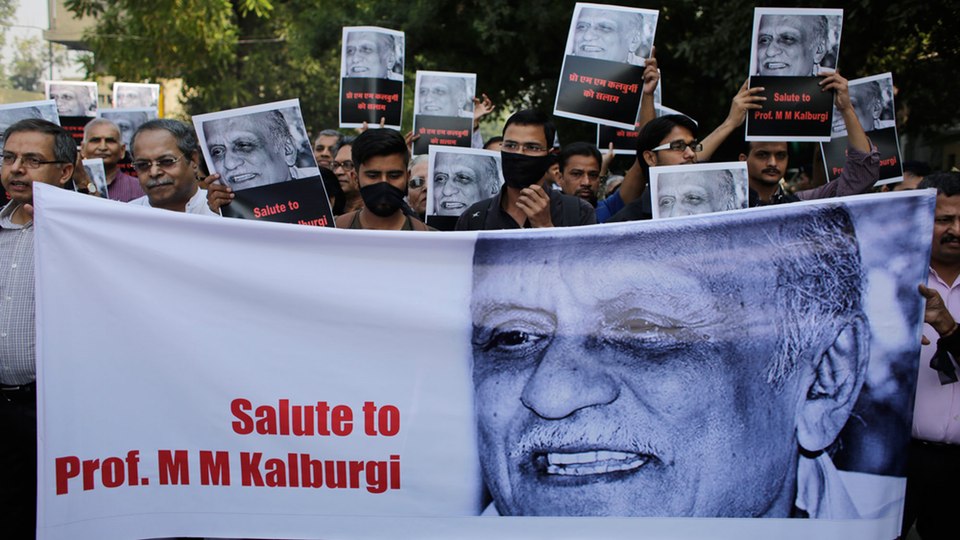
Last few weeks have seen a flood of ‘returning’ honors by writers, scientists and artists. These awardees in way have stood up to make themselves to be counted. There are also various statements from academics, historians, artists and scientists showing their concern about the growing intolerance and erosion of our plural values. Those who returned the honors are amongst the outstanding contributors to literature, arts, film making and science. They in a way have been pouring their heart out at what is going on at social level. The growing intolerance has taken the lives of Dabholkar, Pansare and Kalburgi. There are incidents like where the lynching of one Muslim on the issue of beef eating which has shaken the conscience of the society. In the face of this strong statement from diverse sections of society those related to the ruling party, BJP; its parent organization RSS and many of its affiliates have been strongly criticizing these people on flimsy grounds.

At the same time the President of India disturbed by the happenings in the society; time and again has been reminding the nation about our core civilizational values of pluralism. The vice President has told that it is the duty of the state to protect the ‘right to life’ of citizens. The international rating agencies like Moody have pointed out that unless Modi reins in his colleagues, India stands to lose her credibility. Disturbed by the current growing atmosphere of intolerance the eminent citizens are feeling uncomfortable. So we have the earlier statement of Julio Rebeiro that he is feeling disturbed as a Christian in India. Now Naseerudding Shah said that he is being made to realize his Muslim identity for the first time. The poet, film maker Gulzar stated that the times have come where people ask your religion before they ask your name. Many prominent entrepreneurs like Narayan Murthi and Kiran Majumdar Shaw have shown their concern over growing intolerance. In the same boat of those calling for preserving values of pluralism are people like Raghuram Rajan, the RBI Governor.


The ruling dispensation, the BJP leaders have come out scathingly on these creative people-scientists and labeled the whole process as ‘manufactured rebellion’ as put by Arun Jaitley. It has been alleged that those returning awards are the leftists or those who were recipients of privileges from the state when Congress was the ruling party and now with BJP coming to power from last one year, they are baffled and so the protests. It has been alleged that these people are trying to derail the ‘development story’ being written by the BJP under the leadership of Narendra Modi. Jaitley even goes to say that Narendra Modi is the victim of intolerance by these people returning their awards. Some like Rajnath Singh have pointed out that it is a mere ‘law and order’ problem for which state governments are responsible while these people are targeting Modi government.
                                                                                                      
As such what has happened is neither a law and order problem nor the one related to loss of patronage as it is related to the much broader phenomenon related to intense communalization of society. This time the degree of communalization has crossed the civil limits. The jibe that these people did not return their awards at the time of emergency, anti Sikh violence, migration of Kashmiri Pundits and at the time of Mumbai blasts of 1993 is a very superficial way of dealing with the social response to the phenomenon of growing intolerance and its degree. As the awards which have been returned and the statements put out by different groups do give the reasons for the same and these reasons pertains to the cumulative process and not this or that event. All these incidents mentioned by Jaitley and company have been a tragic part of recent Indian history. Many a writers did protest against most of these incidents, many of them had not even been awarded at that time.

The present times cannot be compared with the tragic incidents of the past for various reasons. Take the case of emergency for example. It was a dark chapter of Indian history, still it was the authoritarianism imposed mostly from the top. What is most disturbing in the current times is the vast network of organizations related to the ruling party whose followers either they themselves create hatred in the society or they mobilize the social sectors through hate speech; the result of which is violence. Currently there is a twin attack on the values of tolerance and liberal space. From the top the ruling dispensation has people like Yogi Adiyanath- Sakshi Maharaj, Giriraj Singh, Sadhvi Niranjan Jyoti who keep spreading sectarian message while basking in the glory of power and at the societal level divisive statements prevail.

At yet another level is the institutional control by communal ideology. Our major institutions and educational places are being mauled by divisive ideology. Our frontline areas of science and technology are being tampered day in and day out. The promotion of blind faith is the byproduct of this very policy. Blind faith and the large section of religious entrepreneurs (Babas, Modern Gurus) have a major say and have a major influence on the present political powers. As such the ideology spread by RSS, the one of Hindu nationalism, is dominating on social and political field. And lastly at the level of social thinking the ‘Hate other’ ideology has been promoted through various conduits using the issues like Ghar Wapasi, love jihad and beef. It is this which is creating the intense social insecurity amongst the religious minorities. It is this which is leading to incidents like Dadri. Such incidents are being projected as law and order problem to deliberately overlook the erosion in democratic space.

Essentially the insane communal violence has its roots in the prejudice leading to hate for the religious minorities. And that’s what flows from the ideology of Hindu nationalism, or any other sectarian nationalism, in the name of any religion or race. In current times the fountainhead of Hindu nationalism which is, the major factor here, is RSS. Not to say that Muslim sectarianism has its own divisive and supplementary influence. Through different conveyer belts this ideology assumes the ‘Hate other’ sentiment and that’s where cow slaughter, beef eating become the ground to kill the people. The practitioners of sectarian nationalism vow that ‘we will kill and get killed’ while defending our Holy mother the cow.

This is just one case in point. The major factor leading to present atmosphere lies in the qualitative transformation of ‘hate for others’. The stereotyping of minorities which began with Hindu nationalism has assumed horrendous proportions where the likes of Gulzar have to say what he said. So while the Jaitleys will keep undermining the steps taken by these people and while the Rajnath Singhs’ will keep dubbing it as a law and order problem, the dissatisfaction amongst those standing for democracy is growing, liberal space and tolerance is shrinking. We will have to keep thinking of more ways to draw the attention of larger sections of society towards the threat looming large on our democratic society, the threat of sectarian propaganda and politics leading to stifling of democratic space. And these are not the ordinary times, the divisive process have assumed menacing proportions and cannot be hidden by the illusory growth story!

Monday, 23 November 2015

Dickens, Shaw and Marx: Contrasting Approaches

Ramkrishna Bhattacharya

No two authors could be more unlike than Charles Dickens and George Bernard Shaw. Dickens was notorious for the saccharine sentimentality that pervades his novels. His rainbow humour - smiling through tears - endeared him to many readers all over the world. But there are others who complain that his appeal is invariably to the heart, never to the head. Shaw, on the other hand, was a sworn enemy of sentimentalism; rationalism was his forte. Yet quite unabashedly Shaw declared in 1906: '... I am a supersaturated Dickensite' (Shaw on Dickens 65). Again, in June 1914 he wrote: 
I am a Dickensian if by a Dickensian you mean a person who read all Dickens eagerly in his nonage. I read a good deal of him in my childhood before I dreamt of asking whom a book was by. I was a good deal influenced by him (Shaw on Dickens 74).
On yet another occasion (July 1919), readily admitting the influence of Dickens upon him, Shaw made a devastating comment: ‘Nothing but the stupendous illiteracy of modern criticism could have missed this fact’ (qtd. in Shaw on Dickens viii).

Shaw’s Foreword to a revised text of Dickens’s Great Expectations, published in 1947, contains some of his penetrating comments not only on Dickens, but also on what made Dickens so significant to him. 

And yet Shaw was not uncritical in his evaluation of Dickens. In a letter to Kate Perugini, daughter of Dickens, Shaw wrote: ‘His (sc. Dickens’s) limitation was the Shakespearean limitation: the current philosophies and religions of his day (Great Portland St – Good God!) were perfectly useless to him; and he never arrived at a philosophy or religion of his own’ (Shaw on Dickens 63). Nevertheless Shaw was charitable enough to admit that even this ignorance ‘had its advantages; for although it prevented him from understanding things that are intelligible enough to a superior person like myself, it also saved him from cooking his books to fit his philosophy, instead of depending on his enormous power of observation’ (Shaw on Dickens  63). 

Shaw finds fault with both Dickens and Shakespeare for the absence of any philosophy in their works. In his Epistle Dedicatory to Man and Superman (1903) Shaw said:
 I read Dickens and Shakespear (sic) without shame or stint; but their pregnant observations and demonstrations of life are not co-ordinated into any philosophy or religion: on the contrary, Dickens’s sentimental assumptions are violently contradicted by his observations; and Shakespear’s pessimism is only his wounded humanity (Shaw on Dickens  108).
Shaw does not deny that
[b]oth have the specific genius of the fictionist and the common sympathies of human feeling and thought in pre-eminent degree. They are oftener saner and shrewder than the philosophers just as Sancho-Panza was often saner and shrewder than Don Quixote. They clear away vast masses of oppressive gravity by their sense of the ridiculous, which is at bottom a combination of sound moral judgment with lighthearted good humor’ (Shaw on Dickens  108).
This absence of philosophy, however, was definitely a hindrance: ‘But they are concerned with the diversities of the world instead of with its unities: they are so irreligious that they exploit popular religion for professional purposes without delicacy or scruple…’ (Shaw on Dickens  108). All this, Shaw says, led to one great fault in their creations: ‘Neither of them could do anything with a serious positive character…’ (Shaw on Dickens 109).

Shaw’s evaluation of Dickens is marked by his antipathy towards the latter’s lack of any well thought-out worldview. Shaw dismisses ‘the compact Tale of Two Cities’ as ‘pure sentimental melodrama from beginning to end, and shockingly wanting in any philosophy of history in its view of the French Revolution’ (Shaw on Dickens  46).
 
In a study of Ruskin vis-à-vis Dickens, Shaw asserts:
Charles Dickens was one of the greatest writers of the 19th century, and one of the greatest writers that England has ever produced. One of the greatest books in the English language is Little Dorrit, and when the English nation realises it is a great book and a true book there will be a revolution in this country. One of the reasons I am a revolutionist is that I read Little Dorrit when I was a very small boy (Shaw on Dickens  111). 
In this essay Shaw points out another shortcoming of Dickens:
Yet a comparison between Charles Dickens and John Ruskin, another great writer, brings home how astonishingly Philistine Dickens was. He really knew nothing about anything except literature, and that was a very serious handicap to him. One gets a far broader wisdom very often from Ruskin than from Dickens… (Shaw on Dickens 111).
Shaw explains that he uses the word Philistine ‘in the popular sense of a man who knows nothing about art.’ Dickens in this respect, however, was not an exception, for in England the authors of the nineteenth century were ‘the most appalling Philistines – even the greatest of them’ (Shaw on Dickens 111).

Shaw is at his paradoxical best when he brings Karl Marx in contrast to Dickens: 
The difference between Marx and Dickens was that Marx knew that he was a revolutionist whilst Dickens had not the faintest suspicion of that part of his calling. Compare the young Dickens looking for a job in a lawyer’s office and teaching himself shorthand to escape from his office stool to the reporters’ gallery, with a young Trotsky, the young Lenin, quite deliberately facing disreputable poverty and adopting revolution as their profession with every alternative of bourgeois security and respectability much more fully open to them than to Dickens (Shaw on Dickens 49).
This, however, is not the only reference to Marx in Shaw’s comments on Dickens. As if to compensate for this harsh   judgment, Shaw declares: ‘Yet Little Dorrit is a more seditious book than Das Kapital. All over Europe men and women are in prison for pamphlets and speeches which are to Little Dorrit as red pepper to dynamite’ (Shaw on Dickens 51).1

 All this comes after a scathing comment on Dickens’s limitations: 

You may read the stories of Dickens from beginning to end without ever learning that he lived through a period of fierce revivals and revolutionary movements in art, in philosophy, in sociology, in religion: in short, in culture. Dean Inge’s remark that “the number of great subjects in which Dickens took no interest whatever is amazing” hits the nail exactly on the head. As to finding such a person as Karl Marx among his characters, one would as soon look for a nautilus in a nursery (Shaw on Dickens 51).

Over and over again Shaw makes a sharp distinction between Dickens the novelist and Dickens the man. It would perhaps be better to say that the distinction is between the man and his works. This no doubt would win the approval of Georg Lukács who insisted on objectivity to the last day of his life (Eörsi 32). Dickens the man was no better than ‘an English gentleman of the professional class, who would not allow his daughter to go on the stage because it was not respectable’ (Shaw and Dickens 52). Shaw again brings in Marx as a typical representative of what Dickens was not. In spite of all his seriousness, Shaw observes,
…Dickens never saw himself as a revolutionist. It never occurred to him to found a Red International, as Marx did, not even to join one out of the dozens of political reform societies that were about him. … He knew so little about revolutionists that when Mazzini called on him and sent in his card, Dickens, much puzzled, concluded that the unknown foreign gentleman wanted money, and very kindly sent him down a sovereign to get rid of him (Shaw on Dickens  52).2 
Shaw brings in Marx in relation to Dickens again in a different context:

Marx and Dickens were contemporaries living in the same city and pursuing the same profession of literature; yet they seem to us like creatures of a different species living in a different world. Dickens, if he had ever become conscious of Karl Marx, would have been classed with him as a revolutionist. The difference between a revolutionist and what Marx called a bourgeois is that the bourgeois regards the existing social order as the permanent and natural order of human society, needing reforms now and then and here and there, but essentially good and sane and right and respectable and proper and everlasting. To the revolutionist, it is transitory, mistaken, objectionable, and pathological: a social disease to be cured, not to be endured (Shaw on Dickens 48).

#
             
It is quite probable that Dickens did not know anything about Marx. But Marx did know much about Dickens. A correspondent of the Chicago Tribune noticed the works of Dickens and Thackeray in Marx’s private collection (Prawer 395-96). There is, however, only one occasion in Marx’s printed works when Dickens is mentioned by name.3  It appears in an essay written in English and published in the New-York Daily Tribune (August 1, 1854). Dickens is named along with Thackeray, Charlotte Brontë, and Mrs Gaskell who are said to have painted the English middle class as ‘full of presumption, affectation, petty tyranny and ignorance’ (Marx-Engels 339-40). The editors of Marx-Engels Werke have pointed out that parts of the manuscript of this article were radically revised by the editors of that journal (Prawer 237). Hence everything the essay contains should not be blindly accepted as coming from Marx’s pen. Although much has recently been made of a statement in this essay (‘The present splendid brotherhood of fiction-writers in England, whose graphic and eloquent pages have issued to the world more political and social truths than have been uttered by all the professional politicians, publicists and moralists put together…’) and the honour of being such an author attributed to Dickens alone (in Wikipedia and several printed works), the authenticity of the text of this essay, particularly this kind of hyperbole, is not beyond question.  

However, there are several allusions to Dickens’s characters in Marx’s works which exhibit his close acquaintance with the works of the English novelist. They are not to be found so much in the works meant for publication but in his letters. Dickens was indeed one of Marx’s favourite authors. As S. S. Prawer observes:

There are also constant additions to Marx’s canon of literary excellence: Homer, Aeschylus, Ovid, Lucretius, Shakespeare, Cervantes, Goethe, and Heine are joined, successively, by Dante, Diderot, Cobbett, Balzac, Dickens, and many others (401). 

Marx does not go into the merit of Dickens’s works, nor does he pay much attention to the contents of the novels and the message they convey. Dickens to him was basically a fashioner of typical characters, so typical as to represent any individual who belongs to the type. Dickens was memorable to him as the creator of a variety of odd and curious characters who can be recalled in relation to other people of Marx’s own times. In a letter, for example, Marx speaks of ‘the modern bourgeois Pecksniff- style…’ (qtd. in  Prawer 174), alluding to the notorious self-server in Dickens’s Martin Chuzzlewit.  Pecksniff comes handy in reference to Napoleon III of France who is called ‘the imperial Pecksniff’ (Prawer 262).4  Similarly in his Ethnological Notebooks (posthumously published) both Jeremy Bentham and Henry Maine are called ‘Pecksniff’ and ‘Pecksniffian’ respectively(Prawer 361-62), apparently as  terms of disapproval. There are references to Tupman, a character in Pickwick Papers (Prawer 186). Marx also speaks of the ‘Pickwickian sense’ in which politicians employ their words (Prawer 252). Richard Cobden is called ‘umble’ like Uriah Heep, a hypocrite in David Copperfield (Prawer 203). Two other characters from Dickens, Wackford Squeers (the cruel headmaster in Nicholas Nickleby ) and Artful Dodger (the nickname of a pickpocket in Oliver Twist ), are mentioned as specimens of cruelty and unscrupulousness (Prawer 252). Marx again mentions Wackford Squeers (Prawer 392) in connection with the editor of the National-Zeitung, Berlin.

Literary allusions are galore in Marx’s less known work, Herr Vogt : English authors, such as Shakespeare, Samuel Butler of Hudibras  fame, Alexander Pope, Lawrence Sterne, Byron, and last but not least, Dickens. Both in Capital , vol. I and Herr Vogt, Bill Sikes, a vicious thief in Oliver Twist, is made to appear as a ‘voluble cut-throat’ (Prawer 340). Marx calls Gladstone’s style of oratory ‘Circumlocution-Office style’ (Prawer 358) and explains the term for the benefit of his German readers who had not read Little Dorrit : it is employed to describe the style of function of Government bureaucracy.

Marx once said, ‘Individuality and specificity are an integral aspect of typicality’ (qtd. in Prawer 410).5 Referring to this formulation, Prawer observes:

 In this way a novel by Balzac or Dickens may become a ‘concrete universal’ – it may reveal more of the dynamic of nineteenth-century life in France and England, and of the workings of human nature in its general as well as its temporally and sociologically particular aspect, than the writings of most historians, economists, and sociologists (Prawer 410).

 Marx used to collect literary nicknames from a wide number of sources; they do not show any inclination to choose only such authors who had a philosophy of their own (as Shaw demanded). Marx’s admiration for Dickens is purely literary: he never bothers to reflect on Dickens’s personal views regarding the burning issues of his times. On the contrary, Marx hugely enjoyed the peculiarity of the characters that Dickens created.  
      
To sum up then: Shaw’s evaluation of Dickens is coloured by his own propensity towards philosophizing in his plays and the sense of purpose that must, he felt, permeate every work of art. He discovered in Dickens’s works the full potential of a ‘revolutionist’, although in his personal life and thought Dickens himself was far from being so. Marx, on the other hand, found in Dickens’s novels a delightful gallery of characters who could be picked up and projected as typical representatives of human follies, foibles and vices.

Notes and References

1 Shaw considers Little Dorrit to be ‘Dickens’s masterpiece among many masterpieces’ and Great Expectation ’his most compactly perfect book’ (46).
2 Dan H. Laurence and Martin Quinn, editors of Shaw on Dickens, inform us that Mazzini and Dickens later became friends (52 n6).
3 Engels too is known to have mentioned Dickens once by his pen name, Boz (Marx-Engels 297). He makes a distinction between the older kind of romance and the modern novel dealing with the fates and fortunes of the poor, the despised class, replacing those of kings and princes. As examples of the ‘new class of novel writers’, Engels mentions George Sand, Eugène Sue, and Boz (i.e., Dickens). This distinction between romance and the novel was later explored in more details by Arnold Kettle, a twentieth-century Marxist critic (33-37).
4 On another occasion Napoleon III is called ‘the Quasimodo of the French Revolution’ (Prawer 252), alluding to the poor hunchback in Victor Hugo’s novel, Notre-Dame de Paris (translated into English as The Hunchback of Notre-Dame), not, however, in the sense of a pathetic grotesque figure, but, as Marx himself explains, as a terrifying Quasimodo.
5 Engels too appreciated this quality in characterization. In a letter (November 26, 1885) he told Minna Kautsky, a German novelist, that her ‘characters exhibit the sharp individualization so customary in your work. Each of them is a type but at the same time also a definite individual, a “Dieser” [This one], as old Hegel would say, and that is how it should be’ (Marx-Engels 87). In another letter (beginning of April 1888), to Margaret Harkness, an English socialist-feminist author,  Engels defined realism as ‘besides truth of detail, the truthful reproduction of typical characters under typical circumstances’ (Marx-Engels 90).


Works Cited

Eörsi, István. György Lukács, Fanatic of Reality, The New Hungarian Quarterly, Vol.12.  No.44, Winter 1971, pp.26-34.
Kettle, Arnold. An Introduction to the English Novel, vol.1. London: Arrow Books, 1962 (first published 1951).
Laurence, Dan H. and Martin Quinn (eds.). Shaw on Dickens. New York: Frederick Ungar Publishing Company, 1985.
Marx, Karl and Frederick Engels. On Literature and Art. Moscow: Progress Publishers,1976.
Prawer, S.S. Karl Marx and World Literature. Oxford: Oxford University Press, 1978.

Acknowledgements: Amitava Bhattacharyya, Siddhartha Datta and Sunish Kumar Deb. The usual disclaimers apply.


Prof Ramkrishna Bhattacharya taught English at Unversity of Calcutta, Kolkota and was an Emeritus Fellow of University Grants Commission. He isnow a Fellow of Pavlov Institute, Kolkota


Sunday, 15 November 2015

Three Murders and a Lynching

Ram Puniyani

Laws of nature cannot be applied to human society so directly. Still sometimes these have been used to explain-justify social catastrophes, “When a big tree falls. Earth shakes (in the aftermath of anti Sikh massacre 1984), ‘every action has equal and opposite reaction’ (during Gujarat carnage of 2002) are too well known. I have been very puzzled from last month or so since the scholars-writers, who have returned their honors and are being questioned as to why they did not do so when emergency happened or anti Sikh violence took place or when the mass migration of Kashmiri pundits took place or when the Mumbai train blasts killed hundreds of innocent lives.  I am tempted to think of the laws of physics of ‘qualitative transformation’ during heating or cooling of water, the temperature remains the same but water becomes either steam or ice.

Govind Pansare, Narendra Dabholkar, MM Kalburgi

When Dr. Dabholkar, Com Pansare and then Prof Kalburgi were killed over a period of months, the danger signals started being perceived but still it took the beef lynching of Mohammad Akhlaq to give a message that something has drastically changed in the society, and the spate of returning  of Sahiya Academy, National and state, awards followed in quick succession. Their protest was against the rising intolerance in the society. The incidents that followed and ran parallel to these ‘award-returns’ were equally horrific. The killing of a trucker on the assumption that he is carrying cows for slaughter; beating of a MLA in Kashmir Assembly by BJP legislatures and the scattered incidents of attacks on Muslims on the ground of beef consumption are too striking. We are currently facing a situation where anybody can incite the violence by just uttering the word beef, while seeing mutton or some such thing. We are living in an atmosphere where cow cannot be shooed away even if she is blocking the traffic.

The viciousness of atmosphere is not lost on the social perceptions. The insecurity of minorities has gone up by leaps and bounds. One knows that since the present NDA regime came to power all those ‘spewing hate’ are working overtime. For one Akbaruddudin Owaisi there is an army of Sakshi Mahraj, Sadhvis, Yogis and what have you. This army of mostly saffron robed or the one’s with the association with Hindu Nationalist politics has high position within their political combine, what is known as Sangh Parivar. The prime Minister himself had exerted the Hindu youth to emulate Maharana Pratap to save the honor of Mother cow during the election speeches. During this last over one year, words like Haramjades  (illegitimate) have been used with gay abandon. On the mere suspicion; a Pune techie Mohsin Shaikh was done to death. Serial attacks on Churches were passed off as thefts, the love jihad bogey was kept alive and the likes of Yogi Adityanath, the top BJP leader from UP, stated that for every one Hindu girl marrying a Muslim, Hindus should bring 100 Muslim girls. Muslim youth have been barred from participating in festivals like Navaratri. Mukhtar Abbas Naqvi, the BJP’s Muslim face advised those wanting to eat beef to go to Pakistan. The glorification of Mahatma’s killer Godse has been stepped up and temples are being planned in his memory, while a BJP MP from Kerala stated that Godse was right but he chose a wrong target. Atmosphere of communal violence has gone up in a big way during the preceding year.


Even after the awards started being returned the BJP leadership looked down upon the writers/scholars and overlooked the phenomenon which has lead to returning of awards. To mock these writers Buddhi Shuddhi puja path (purification of intellect ritual) has been organized and BJP spokespersons are humiliating them in talk shows with all their ferocity. To cap it all the Haryana Chief Minister, an old RSS pracharak, said that Muslims can live here but only if they will give up beef eating. No doubt the BJP Chief Amit Shah has talked to some of these leaders behind the close doors, but that does seem to be a mock drill as the leaders concerned did say that they went to meet their chief for some other reasons and none of them gave any serious apology.

Disturbed by what is going on, the President Pranab Mukherjee on three occasions urged the nation to uphold, pluralism, the core civilizational value of the country and to uphold tolerance. The Vice President Hamid Ansari reminded the Government that it is the duty of the state to uphold the ‘right to life’ of citizens. The index of the changing social atmosphere is reflected by the statements of two outstanding citizens of the country. Julio Reibero, the top cop, expressed his pain and anguish by saying that “as a Christian suddenly I feel stranger in my own country.” And the renowned actor Naseeruddin Shah had to point out that “Have never been aware of my identity as a Muslim until now.”

These are not ordinary times. The values of pluralism and tolerance have been pushed to the margins. With this Government in power all the wings of communal politics, the RSS affiliates, have unleashed themselves in full blast. Communalism is not just the number of deaths due to violence, it is much more. The foundation of this violence begins with the manufacture of perceptions about the religious minorities. These perceptions based on history and some selective aspects of present society are given an anti human tilt and interpretation. This is used to create hatred for the minorities and that’s where the communal elements can unleash violence either as a massive violence like Gujarat or Mumbai or Bhagalpur or Muzzafarnagar or the one in Dadri. This creates the divides in society which over a period of time is converted into polarization. And polarization is the foundation of electoral strength of party wanting a nation in the name of religion. As per Yale study, the communal violence is the vehicle which strengthens BJP at electoral level.

Communalism has been planted in India over a century and a half ago. The British policy of ‘divide and rule’ used communal historiography as a major weapon. This type of interpretation of history was picked up by communal organizations and given an anti Hindu or anti Muslim tilt and gradually this has been strengthened after every act of violence which has been the outcome of their politics. The present phase is the one where the cup of communalism is spilling out from its earlier levels or boundaries. The intensity of ‘Hate’ constructed around temple destructions, love jihad has been supplemented by the oft used tool of beef. In the present situation where the divisive elements, who are in center stage of politics also know that they are safe and secure as the present Government precisely wants what they are doing, their contrary posturing notwithstanding.

The present combination of the Government guided by the ideology of Hindu nationalism and the ‘fringe elements’ having same ideology, has a vast network and with a wide reach. This party has the advantage that mostly it does not have to dirty its hands in the local agenda of sectarian nationalism, and so there are many elements which can do the local work for dividing the society. The so called fringe elements now are occupying the center stage, and so the ‘qualitative change’ in the situation.  The flood of awards being returned is due to the situation created by deeper communalization of society. This is manifested in growing intolerance, attack on plurality and is leading to the insecurity of minorities, which has qualitatively transcended the earlier limits. The question is how to uphold the values of Indian Constitution in the current times?

Share

Twitter Delicious Facebook Digg Stumbleupon Favorites More