Monday, 12 March 2012

Piercing Tongue or Cheek with Needle or Trident


B Premanand


Experiment: 28


Effect: No pain or blood when the tongue or cheek is pierced with a sharp needle or trident.

Props: One very sharp needle or trident, tincture of iodine, cotton.

Method: 

An activist of Periyar Dravida Kazhagam, Coimbatore
at the 8th FIRA National Conference in Nagpur
a) Pull the tongue out and, holding it tight, just pierce it with the sharp end of the needle or the trident with a straight swift stroke. Before the volunteer knows anything, you have pierced his tongue. There is no pain or blood. Draw out the needle or the trident straight.

b) Open the mouth with your finger and thumb from both sides, stretching the part of your cheek just beyond the lips. This is a very elastic flesh. Then merely push in the trident slowly and gently at a point about half an inch from where your lips start. Only a slight prick is felt. Push it right through the other side of the cheek. Remove it the same way keeping the cheek stretched with your fingers. There will be no blood or scar.

Is this a "miracle"?
If these are miracles then every woman or girl who pierces her ears and nose must also have supernatural powers. Instead of the trident they put orna­ments to beautify themselves. But Babas perform the same feat and claim it is a miracle.

In the 70's Palani Baba came to my home. He pierced his tongue with a trident and asked for Rs.250 for god. I told him that since god is believed to be the creator of all of us, the universe and its wealth, then we all as children of god have equal right of god's wealth. So a part of the money he had collected in the name of god also belonged to me. And I snatched about Rs.300 from his plate. When god is all powerful he does not need petty cash from his children. Moreover, god is not a beggar for us to give him money or anything. In fact, god has created all wealth for his children so that they may live in peace and harmony. 

He got angry, called me names and cursed me, saying I would die the next day. Thousands of babas have cursed me thus. If one believes in curses such dire negative suggestions always work. Later, I found that his piercing of the tongue was the trick described below. 

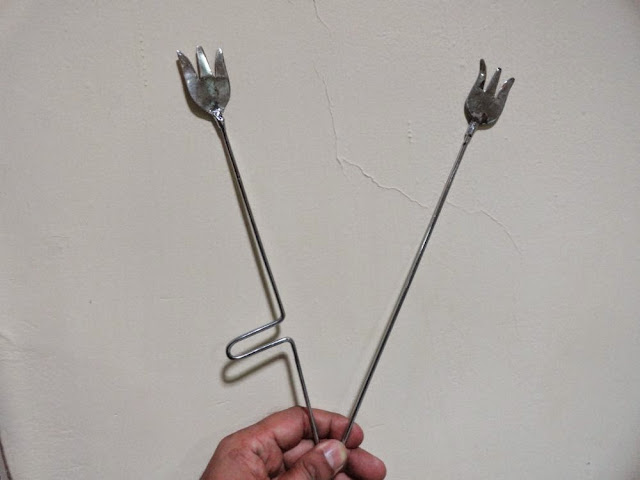
A trident with a bend in the shaft is also used by some
to creat a false impression of the tongue being being actually pierced

Sunday, 11 March 2012

Terror Acts’ Investigations and RSS


Ram Puniyani


Supreme Court slammed the RSS Sarsanghchalak, Dr. Mohan Bhagwat for stating that Karakre had told him that he was under tremendous pressure to nail the RSS in unsolved cases of terror acts like, Malegaon, Ajmer, Samjhauta Express blast (Feb 28, 2012). As per the Chief of RSS, he knew Karkare well and Karkare had solicited his cooperation for solving these cases, and in the context of that had told him about the pressures being put on him.

 One knows that Karkare was under pressure during that time. One also knows that the investigations in the acts of terror were leading nowhere and after every blast number of young Muslim boys were arrested, the blame was put on some affiliate of Lashkar, Al Qaeda etc. After Karkare took over as the chief of Maharashtra Anti Terrorism Squad, the things started moving. The turning point was the meticulous investigation by Karkare’s team which led to the unearthing of the motor cycle used in the Malegaon blast, the motor cycle belonged to Sadhvi Pragya Sing Thakur, the ex ABVP (RSS affiliate) activist, and the leads took the ATS to the whole set of terror group, which were called later as Saffron terrorism by the Union Home Minister P. Chidambaram.
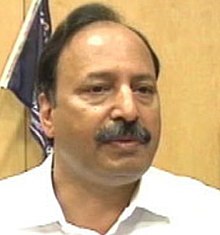
Hemant Karkare

These investigations led Karkare to Swami Dayanand Pandey, Lt Col. Prasad Shrikant Purohit, Swami Aseemanand, Indresh Kumar, Sunil Joshi, Kasangra and the number of those close to the RSS or close to RSS affiliates. The implication of this was very clear.

Once this Hindutva network got exposed the acts of terror which were occurring at regular intervals in front of mosques and other places, where Muslims congregate for prayers came to a halt. As such it was ironical that the blasts were focussed to kill the Muslims and after every act again Muslims were arrested. With the Rajasthan ATS joining the process of investigation the evidence against these Hindutva elements became further clear.

The confession of Swami Aseemanand in presence of the magistrate gave the full details of the modus operandi of these acts of terror. The people involved in these acts believed that they are doing these dastardly acts to avenge the Muslim terrorists and that these acts aimed to pave the way for Hindu Rashtra. Swami Aseemanand, the VHP leader working in Gujarat, who was the architect of Shabri Kumbh Mela was the key figure in these blasts in many ways. In the statement given by him in presence of the magistrate he confessed that their group was involved in these activities.

Since then more and more beans have been spilling from the Sangh stable, the latest one being that of involvement of Kamal Chauhan in Samjhauta blast. Chauhan has been labelled as the disgruntled element by his parent organization, RSS. This again is the standard ploy by RSS. Most of those who are caught doing these acts of murders or blasts are claimed to have left the organization some time ago or if possible their association with RSS combine is put under the wraps.

One recalls that there was a time when nobody believed that RSS associates can be part of these acts of terror. RSS claims they do not believe in violence. Their claims have come to be exposed one after the other. Now their claim is that they are being implicated by the ruling party to appease the minorities; or that those being charged for acts of terror are clean people and are deliberately being implicated in terrorist acts. Going by the expose after expose, the RSS at one level is trying to disassociate from these terror accused, on the other is propagating that they are accused but not guilty and on yet another level claiming that the investigation authorities have been pressurized to nail the RSS cohorts.

 This defence is very weak. The statement of RSS Chief is coming at a time when Karkare has already become a martyr for the cause of defending the country. There is no way he can confirm or deny what the patriarch of Sangh Combine is saying. But yes there are some clues which can tell as to what is the truth.

Lets recall that Sadhvi Pragya Thakur was caught for her alleged role in Malegaon blast, none other than Lal Krishna Advani went to the Prime Minister to complain about the torture of Pragya Singh Thakur and demanded investigation into Thakur's torture. At the same time another Hindutva leader Bal Thakre condemned Karkare, calling him anti National and wrote in his mouth piece Saamna that ‘we spit on his face’! Another Hindutva warrior Narendra Modi called Karkare as Deshdrohi (anti National). Incidentally both these, Thackeray and Modi, are hailed as ‘Emperors of Hindu hearts’. Later Modi called Karkare as a great patriot after his death. Modi went to the extent of offering one crore Rupees to Karate’s widow, which she gracefully refused.

 On the contrary Congress leader Digvijay Singh claimed that Karkare had called him on the night of 26/11, the day Mumbai was attacked by Kasab and gang, and said that there is a tremendous pressure on him from the Right wing. Digvijay Singh also showed the press clipping to that effect and pointed out that BSNL, Bhopal cannot give the records of the conversation between him and Karkare as the matter was more than a year old at that time, and BSNL does not keep record beyond a year.

There is another source which tells us the direction from which Karkare was being pressurized. Julio Ribeiro, one amongst the police of officer of highest integrity in the country, in his obituary to Karkare (Times of India, Mumbai Edition 28th Nov 2010) pointed out that there was a direct insinuation into the work of Karkare, who was intimidated by Advani and other Hindutva gang. Karkare sought solace and advice from his senior Ribeiro, Ribeiro confirmed that Karkare was being harassed and intimidated by the associates of Advani-Modi and company. Ribeiro advised his junior colleague to carry on with his work irrespective of the pressures. "He came to me because he was looking for someone to hold his hand," Ribeiro told IANS on phone from Mumbai while stressing that Karkare was not a man to be politically influenced.

While this is what the truth is, one can see the motive behind Bhagwat’s statement in the face of so many of his cabal either charged or in jail. In an earlier event Bhagwat’s predecessor K. Sudarshan had also played a similar game. During the investigation of Babri demolition, when the role of RSS combine was coming more and more to surface, Sudarshan said that he heard Gandhian  Nirmala Didi saying that there was a blast inside the mosque which demolished the mosque. Fortunately Didi was alive that time to deny something being said in her name.

So there is some pattern in the statements of RSS chiefs!

Lokayata Materialism


Debiprasad Chattopadhyaya

[This essay was first published as part of a collection of essays, Indian Thought - An Introduction, edited by Donald H Bishop, and published in 1975. 
  1. Background
  2. Lokayata Epistemology
  3. Social Ethics
  4. Consciousness
  5. Lokayata and Indian Materialism]

I. Background

It is generally assumed that Indian materialism can be discussed today only on the basis of what the others had to say about it. Not that nothing is accepted as authentic statements of the materialists. A few scraps are indeed admitted to be so. Pecu­liarly, however, even these are recovered from the writings of their opponents. Such, then, is supposed to be the characteristic limitation of our knowledge of Indian materialism. This, though not wholly true, contains an important element of truth, about which it is necessary for us to be clear first. This is perhaps best done by way of recapitulating the main historical data that we have.

The Indian proto-philosophical literature of c. the 7th century B.C., called the Upanishads, contains a number of references to distinctly materialist views. In default of any ground to think that these are all references to a unified world-view deserving to be called the materialism of ancient India, we are left to presume that during this period there are many thinkers with a positively materialist proclivity. The Upanishads themselves do not tell us who they are, their views being generally branded as characteristic of the devils (asuras). Or, the story is told that when the great battle between the gods and devils is going on, Brihaspati, the preceptor of the former, goes in disguise among the latter and preaches this degenerating philosophy to bring disaster to them.

Not many centuries after the Upanishads, in the Pali canons of early Buddhism, we frequently come across the name Lokayata, meaning either "that which is essentially this worldly" or "that which is prevalent among the common people." But these works are peculiarly vague about the nature of the view referred to by this name. This is all the more peculiar because the works are fully aware of the materialistic or proto-materialistic tendencies of the age, which are sometimes associated with individual thinkers like Ajita Kesakamball and Payasi but never identified with the Lokayata. This leads some modern scholars to think that in the Pali Buddhist works the name Lokayata does not stand for any philosophy at all; it means instead something like "nature-lore".

However, it is different in the Arthasastra, the famous work on Indian polity which could have been as old as the 3rd century B. c. According to it, Lokayata is definitely the name of a philosophy, and, as a matter of fact, one of the three logic-oriented philosophies it recognizes. The name also occurs in the epics Mahabharata and Ramayana as an undesirable heretical view. These epics moreover speak of a certain demon called Carvaka, who, because of his arrogant impiety, had to be burnt alive by the pious Brahmins.

The grammarian Patanjali of c.150 BC refers to a commentary on some original Lokayata work. The Buddhist work Divyavadana - which probably assumes its present form in the 4th century A. D. but which undoubtedly records a much older tradition-also speaks of an original work on the Lokayata and of some commentary on it. But such Lokayata works, evidently once in circulation, are irrevoc­ably lost. The recent furore created by the discovery of an allegedly Lokayata text-the Tattvopaplavasimha by Jayarasi Bhatta of c. 8th century A.D.-is dying out. With the actual study of this book it is being increasingly realized that the evidence connecting it with the Lokayata is really worse than flimsy and the text has nothing to do with materialism excepting an outright rejection of it.

After the early mention of the Lokayata, Indian literature - both philosophical and non-philosophical - is peculiarly silent about it for several centuries. Roughly from the middle of the 8th century, however, the more sophisticated Indian philosophers begin to show a great deal of renewed interest not only in the old name Lokayata ­ now somehow identified with the Carvaka - but also in the basic tenets which it is supposed to stand for. This interest, though pri­marily negative or polemical, is nevertheless keen. Here are just a few examples of it.

The earliest available compendium of Indian philosophy - the  saddarsana-samuccaya by the Jaina philosopher Haribhadra of c. 8th century-takes note of only six systems of Indian philosophy, one of which is Lokayata, also called Carvaka. Its renowned commentator, Gunaratna, shows the most hair-splitting scholasticism for elaborately refuting one of the basic Lokayata tenets. The same is shown by the famous Buddhist idealists, Santaraksita and Kamalasila of the 8th century. Sankara (A.D. 788-820), the Advaita Vedantist, proposes to refute the Lokayata view in more than one place in his magnum opus. Jayanta Bhatta of the 9th century A.D., one of the maturest exponents of Indian logic and atomism, takes a great deal of care to refute the Lokayata views. Indeed, it may not be an exaggeration to think that from the 8th century onwards prac­tically all the outstanding Indian philosophers follow this procedure. It is no wonder, therefore, that the most important compendium of Indian philosophy, the Sarva-darsana-samgraha by the Vedantist Madhava of the 14th century, opens with a rather detailed description of the Lokayata or Carvaka philosophy; for, from Madhava's own point of view, this is the philosophy that must be rejected first.

At the present stage of historical research, it may be premature to conjecture on the real cause of this renewed interest in the Lokayata philosophy roughly from the 8th century. What particularly concerns us, however, is its effect on the making of the contemporary image of materialism in ancient and medieval India. While enriching this image, it damages it also.

For understanding Indian materialism, what contemporary scholarship gains from the polemics against the Lokayata is of course obvious. Since a considerable number of advanced Indian philosophers persistently try to refute a number of definitely materialist tenets as tenets characteristic of the Lokayatas or Carvakas and since it is being irresponsible to imagine that they are all fighting a fiction, modern scholars are obviously justified in trying to reconstruct the otherwise lost account of Lokayata materialism from the polemics against it. At the same time, the general tendency of modern scholars to understand Indian materialism as such exclusively on the basis of these polemics imposes certain limitations on their understanding of it. Two of these limitations are particularly prominent. First, it easily misleads them to identify Lokayata materialism with Indian materialism as a whole, i.e. it prevents them from seeing the materialism and materialist proclivities of many other Indian philosophers, inclusive of some who want anxiously to be dissociated from the Lokayata. It is like imagining that since the opponents of materialism in European philosophy persistently oppose Democritus, the materialist tradition of Europe is to be equated with the philosophy of Democritus. Or, it is like imagining that Marx and Engels are not materialists because they dissociate themselves from the French materialists of the 18th century.

Secondly, even the nature of Lokayata materialism is sometimes seriously misunderstood, the characteristic limitation of the source of our knowledge of it being taken as the characteristic peculiarity of the Lokayata itself. Thus, the opponents of the Lokayata find it necessary to refute it only on the context of defending certain positive tenets of their own. They are therefore more anxious to say what the Lokayata does not admit than what it does. This is construed to mean that the Lokayata is interested only in demolishing certain philosophical positions and not in positively building up of any. The decisive thing about Indian materialism, as an eminent modern scholar comments, "is its purely negative interest" (Frauwallner). This is an error, not only because it is based on a rather superficial understanding of the available data about the Lokayata but even more because it shows no understanding of the dialectics underlying Indian philosophical methodology.

From the Indian point of view, the essential precondition of philosophical activity is "doubt" (samasya or vimarsa) and the precondition of "doubt" itself is the open confrontation of the "thesis" (paksa) with the "antithesis" (pratipaksa). As a result, it is not at all permissible for a serious Indian philosopher to state his own "thesis" without first negating its "antithesis," called the purvapaksa. Naturally, therefore, in Indian philosophical writings, this "antithesis" looks largely negative from the standpoint of the "thesis," just as this "thesis" itself looks negative from the standpoint of its own "antithesis". But this does not mean that neither the "thesis" nor the "antithesis" is barely negative in content. The fact that we have the account of the Lokayata only in the form of the "antithesis" may give it a deceptive appearance of negativism. But this is not to be taken as the decisive thing about the Lokayata, far less of Indian materialism as such.

Of these two limitations of the current understanding of Indian materialism, in the present essay, there will be little scope to remove the first. A survey of materialism and the materialist trends outside the Lokayata means the survey of an extensive field of Indian philosophy-particularly of atomism (paramanu-vada) and of the philosophy of primeval matter (pradhana-vada)-which, again, is difficult without being often controversial. The present essay will, therefore, primarily be a positive account of Lokayata materialism and it will barely hint why our idea of Indian materialism as such needs to be much broader.


II. Lokayata Epistemology

The assorted polemics against the Lokayata, along with the philosophical compendiums by Haribhadra and Madhava, give us the unmistakable impression that the opponents of the Lokayata are bothered by it, particularly because of the positions it takes in epistemology, ontology and social ethics.

In epistemology, the position seems to be that of the primacy of empirical knowledge. The Indian way of putting this is that sense-experience (pratyaksa) is supremely important as a source or instrument of right knowledge (praman.a). But this is readily mis­interpreted as a purely negative attitude to the rational faculty, or, in Indian terminology, as the condemnation of inference (anumana). That this is a wrong understanding of the actual Lokayata position can be judged from two important evidences. Purandara of c. 7th century A.D., whom others refer to as "an author representing the Carvaka standpoint," is quoted by a Jaina philosopher as clarifying the Carvaka position as follows. Carvaka "admits the usefulness of inference as determining the nature of all worldly things where perceptual experience is available; but inference cannot be employed for establishing any dogma regarding the transcendental world, or life after death or the law of Karma. The main reason for upholding such a distinction between the validity of reference in our practical life of ordinary experience, and in ascertain­ing transcending truths beyond experience, lies in this that an inductive generalization is made by observing a large number of cases of agreement in presence together with agreement in absence, and no cases of agreement in presence can be observed in the trans­cendental sphere; for even if such cases existed, they could not be perceived by the senses." (S. N. Dasgupta)

This is corroborated by Jayanta Bhatta who says that, from the Carvaka standpoint, ordinary everyday inferences-like that of fire from smoke-is not questioned at all, because inferences like these have for their basis previous perceptual knowledge, i.e. the experience of the invariable co-presence of fire with smoke. What the Carvaka actually rejects, says Jayanta, is the inference of God, soul and the other world, i.e. inference supposed to have no relation at all to previous empirical evidence.

Incidentally, such a position in epistemology is not fundamentally different from the classical one of Indian logic as represented by the Nyaya-sutra, which also mentions previous perceptual evidence as an essential precondition of legitimate inference. Hence, from the Nyaya standpoint, sense-experience is the most basic of all the sources of knowledge – pramana-jyestha, literally "the eldest of the sources of knowledge"-and any inference going against the evidence of sense-experience is to be summarily rejected as a pseudo-inference.

However, where the Lokayata seems to differ from the Nyaya is in the motivation for the somewhat similar understanding of legiti­mate inference. While for the Nyaya, the main interest for assigning primacy to sense-experience is mainly its science-orientation, that of the Lokayata is frankly practical, or, more specifically, socio-ethical. Thus, we are persistently told that, according to these materialists, a great deal of cheating is going on in society with the talk of God, the soul and the other world. They are, therefore, anxious to show that such talk is a mere hoax, because these are never directly experienced and hence cannot be proved by inference either. This hoax, they further argue, is not really purposeless. It is deliberately designed to serve as a source of livelihood for the social parasites, i.e. in Lokayata terminology, of those that share in neither intellectual nor manual labour (buddhi-paurusa-hinah).


III. Social Ethics

This leads us to a discussion of the social ethics of the Lokayatas. Certain "authentic popular verses" (pramanika­lokagatha) are persistently attributed to them by their opponents mainly to show how very impious these materialists are. However, in the general atmosphere of casteism, scripture-mongering, obscurantism and the economic drainage of futile rituals, the debunk­ing of all these by the Lokayatas in defence of the normal pleasures of this worldly existence still retains a great deal of scientific and social interest for us. It is impossible to retain in English translation the biting satire of their simple verses. But here is a rough translation of some of these as compiled in Madhava's Sarva-darasna-samgraha:

“Heaven and liberation are mere empty talks. There is no soul that is imagined to go to the other world. The actions prescribed for the caste-society (varnasrama) do not really yield their alleged results."

"The Agnihotra sacrifice, the three Vedas, the holding of the three staves and (the practice of the religious professionals of) smearing the body with ashes-all these are nothing but the sources of livelihood for persons that share neither in intellectual nor in manual labour."

"If, (as claimed by the priests), the animal killed in the Jyotistoma sacrifice attains heaven straightway, why does not the sacrificer kill his own father (and thus ensure heaven for him)?"

"If the performance of the Sraddha (i.e. the rite performed for the dead-a main source of the priest's income-in which food is offered to the dead) causes satisfaction to those that are already dead, oil put into the lamp even after it is blown off should as well make its flame ablaze."

"Besides, the same assumption (namely that food offered in sraddha actually feeds the departed) should make it superfluous for the traveller to carry provisions with himself, because he should as well be satisfied while travelling afar by the food offered to him at home in the form of Sraddha."

"If, what is offered in sraddha can satisfy beings supposed to be in heaven, why not offer food down below for one actually on top of a tower?"

"As long as you live, live happily. Feed yourself with butter, even though on loan. Once the body is reduced to ashes, how can it ever return again?"

"If after quitting the body one goes to the other world, how is it that one does not return again drawn by the love for friends and others?

“Hence, it is only as a source of livelihood that the Brahmins here have introduced the rites of the dead.  There is nothing more in all these.

"The authors ~f the three Vedas are just cheats and cunning thieves. All the pedantic formulas, the meaningless spells - jarphari-turphari -like the wife taking the horse's phallus (i.e. a part of the Asvamedha sacrifice), are nothing but the inventions of cheats for the purpose of obtaining their sacrificial fees."

It is not difficult to see that the main theoretical basis of this social ethics is the denial of the soul over and above the body and hence also the denial of the other world where this soul is supposed to migrate after death. Put in Indian terminology, the point is paralokino'bhavat-paralokabhava: the fiction of the other world because of the fictitious nature of that which is imagined to go to the other world. This is of course a negative way of putting the point. For all that we know of the Lokayatas, however, it is obvious that they are also anxious to put their point positively. Thus, it is repeatedly said, in the Lokayata view only four material elements -earth, water, fire and air-are real. Human beings, like everything else in the world, are made of only these. So it is useless to assume any spiritual substance-the soul-to explain human nature. Or, what the others imagine to be the soul is nothing but the physical frame with its physiological functions.


IV. Consciousness

The most formidable problem in taking such a position is evidently that of the fact of consciousness. If nothing but crass matter goes into the formation of the entire psycho-physical organization, how can the presence of consciousness in human-or, more broadly, animal-bodies be explained? After all, the gross physical elements like earth, water, etc., are by themselves admittedly unconscious. How, then, do the Lokayatas propose to explain the indisputable evidence of consciousness in human beings consistently with their assumption that nothing but intrinsically unconscious material elements go into the making of everything about it?

When we look back at these materialists, their understanding of the nature of matter cannot but appear to us to be rudimentary and naive. Nor do we expect of them any knowledge of the central nervous system, particularly of the brain. In other words, the scientific data actually at their disposal is, in modern standards, miserable indeed. It is therefore extremely remarkable that, in spite of the severe limitations under which they are historically obliged to work, they do make a bold attempt at an explanation of the origin of consciousness from matter. And their main lines of argument, as far as we can judge them from the account given by their opponents, still have distinct theoretical interest for us. Three of their lines of argument deserve special mention.

First, the origin of consciousness from the material elements, each of which is itself unconscious, appears impossible to others because of one assumption. It is the assumption that an altogether new quality cannot emerge from some peculiar combination and transformation (visesa-parinama) of certain things that are by them­selves distinctly devoid of this quality. But this assumption itself is an undue one. The fact, on the contrary, is that there are definitely observed cases of such new emergence. As the most typical case of such observation, the Lokayatas are said to mention the following. None of the ingredients used to prepare spirituous liquor or alcohol possesses the quality called "intoxicating power" (mada-sakti). Yet the fact is that when these ingredients are combined and transformed in a special form we get spirituous liquor with its intoxicating power. Evidently, the Lokayatas are yet to know the full explanation of such a fact. Nevertheless, the fact is there, and it proves that the emergence of a new quality altogether is not really as absurd as others may view it. And, if it is really not absurd, the view of the emergence of the new quality called consciousness from the peculiar transformation of the material elements in the form of the body cannot be ruled out as prima facie absurd.

Secondly, there are sound positive grounds to think that conscious­ness cannot but be the product of matter, i.e. of the material elements when transformed into the body. That this body is made of matter alone is admitted by all. Therefore, the question is: Is there any ground to view consciousness as a quality of the body, or as an effect of the body? There are, assert the Lokayatas. In Indian terminology, the causal connection between two phenomena can be established on the basis of anvaya confirmed by vyatireka, which we may roughly translate as "uniform co-presence" confirmed by "uniform co-absence". Thus, fire-cum-wet-fuel is proved as the cause of smoke because the observation of the uniform co-presence of fire-cum-wet-fuel is confirmed by the observation that the absence of fire-cum-wet-fuel is always connected with the absence of smoke. So, argue the Lokayatas, is the case of body and consciousness. Wherever there is the presence of body there is also the presence of consciousness. Further, wherever there is the absence of body there is also the absence of consciousness. Hence consciousness is the effect of the body.

According to the norm of Indian logic, there are only two ways of refuting such an argument. First, by pointing to the evidence of the presence of the body along with the absence of consciousness.  Secondly, by pointing to the evidence of the absence of the body along with the presence of consciousness. There is no doubt that the opponents of Lokayata explore both possibilities. Thus it is argued that in the case of the corpse there is a presence of the body along with the absence of consciousness. Besides, disembodied consciousness is possible in the case of the transmigrating soul that has left one body without yet acquiring another. From the Lokayata point of view, there is no reason to take such arguments seriously. A corpse is not a body-ie. a functioning physiological unit the materialists are talking of-no more than a pile of junk is an automobile or an airplane. As for the disembodied consciousness of the transmigrating soul the less said the better, for one cannot just assume the soul for the purpose of proving its existence.

From the writings of Jayanta Bhatta, we have a glimpse of another line of the Lokayata argument proving consciousness as the product of matter. As Jayanta puts it, "It is commonly observed that a body well-nourished with food and drinks· has improved con­sciousness. The reverse happens in the reverse case (i.e. in the absence of nourishment of the body, there is a deterioration of consciousness). Besides, the body of a young man who takes the Brahmi-ghrita (i.e. 'brain tonic' of traditional Indian medicine) shows a remarkable improvement of consciousness . . . . Thus the improvement and deterioration of consciousness is directly explicable by the presence or absence· of the excess of material elements. "

The argument is elemental in simplicity; palpably material things in the form of food, drink, 'brain tonic', etc., absorbed in the human body, go into the making of consciousness. How far, in Indian philosophy, the opponents of materialism successfully refute this argument is of course a different question. For the present we have another question of greater historical interest. From where does Jayanta Bhatta collect this argument which he attributes to the Lokayatas?

In view of the fact that the Lokayata texts are lost presumably be­fore the time of Jayanta Bhatta himself, it would be impermissible to conjecture that he collects it from some extinct Lokayata work. But it will be also impermissible to think that he collects it from nowhere, i.e. manufactures it himself. There exists a text in which the same argument-or at least its unmistakable prototype does occur; and Jayanta's personal lack of acquaintance with it can be thought of only at the cost of sanity. This text is the Chandogya Upanishad and the argument under consideration is attributed in it to one of the first philosophers of India, called Uddalaka Aruni. Belonging as he does to earlier than the 7th-8th century B.C., we do not expect of him the later sophisticated form or putting a philosophical argu­ment. It is extremely remarkable, nevertheless, that he not only argues on this line but also insists on an experimental verification of it. As a document of ancient Indian scientific thought, the passage of the Chiindogya Upanishad where this occurs needs to be read in full, though we have room here to quote only a part of it.

Uddalaka Aruni was instructing his son Svetaketu. The original source of everything in the universe, he said, was primeval un­differentiated "being". From this successively evolved fire, water and food. Everything in the universe-inclusive of the body and mind of man-eventually evolved from these three. In the imme­diate context of our discussion what interests us most is Uddalaka's view of the origin of mind from the food assimilated into the body. We quote here only that part of his discourse which contains this view.

Uddalaka Aruni said to his son Svetaketu: "Food, when eaten, undergoes a threefold division. Its coarsest constituent is transformed into faeces; its medium (constituent is transformed) into the flesh and its subtlest (constituent is transformed) into the mind. Water, when drunk, undergoes a threefold division. Its coarsest constituent is transformed into urine; its medium (constituent is transformed) into blood; its subtlest (constituent is transformed) into breath (prana, life). Heat (i.e. in the form of oil, butter, etc.), when consumed, undergoes a threefold division. Its coarsest consti­tuent is transformed into bone; its medium (constituent is transformed) into marrow; its subtlest (constituent is transformed) into speech."

The son Svetaketu wanted to understand the view more fully. So the father continued: "Of curd, my dear, when churned, that which is subtle moves upward. It becomes butter. In the same way, my dear, of the food that is eaten, that which is subtle moves upward. It becomes the mind. Of water, my dear, when drunk, that which is subtle moves upward. It becomes breath (life). Of heat (oil, butter, etc.), when consumed, that which is subtle moves upward. It becomes the speech. Thus, my dear, the mind consists of food, the breath (life) consists of water, the speech consists of heat." The son wanted to understand the view even more deeply and so the father continued: "A person, my dear, consists of sixteen parts. For fifteen days do not eat (any food, but) drink water as you please. Breath (life), which consists of water, will not be cut off from one who drinks water."

So for fifteen days the son did not eat any food and then went to the father. The father wanted him to recite the Vedas. Svetaketu said: "These do not occur to me, Sir." To him Uddalaka said:  "Just as, my dear, of a great mass of fire only a single piece of coal of the size of a firefly may be left with which the fire would not there­after burn much longer,-similarly, my dear, only one part of your sixteen parts is left and with it you fail to apprehend the Vedas. Eat. Then you will understand me." Then the son ate and ap­proached the father. This time whatever Uddalaka asked him Svetaketu answered everything. Then to him, Uddalaka said: "Just as, my dear, of a great mass of fire only a single piece of (burning) coal of the size of a firefly is left, and covered with straw, it is made to blaze up and this fire would burn much thereafter, - so, my dear, of your sixteen parts only the sixteenth was left over; being covered with food, that is made to blaze up. With this you can now understand the Vedas. For, my dear, the mind consists of food, the breath (life) consists of water, the speech consists of heat." Then Svetaketu understood what he said. Well, he understood.

There is of course no ground to think that Uddalaka is a follower of the Lokayata. In Indian literature, the name Lokayata comes in circulation after the Upanishads. However, if an advanced philo­sopher like Jayanta Bhatta wants to look back at the basic suggestion of Uddalaka to illustrate how the Lokayata wants to substantiate their view of the origin of consciousness from matter, it follows not only that the materialist tradition in Indian philosophy is older than the Lokayata but moreover - and this is much more important - that our understanding of Indian materialism runs the risk of being too narrow in so far as it is identified only with the Lokayata, as is usually done in textbooks on Indian philosophy.


V. Lokayata and Indian Materialism

The identification of Indian materialism with Lokayata materialism, though mistaken, is not without a cause. We have already referred to it. Roughly from the 8th century A. D., the Indian philosophers themselves persistently refer to certain overtly materialistic tenets as tenets characteristic of the Lokayatas. This, rightly understood, should have only meant that Lokayata is a form of materialism-perhaps the most out-spoken and plain-speaking form of it. But this cannot and does not mean that in Indian philosophy there is no materialism outside the Lokayatas. Even those that sharply differ from the Lokayata, differ from it not necessarily for the purpose of differing from materialism as such. Some of them - particularly the Indian idealists-reject the Lokayata materialism for this purpose no doubt. However, among those that represent the antithesis of idealism, there are at least some who dissociate themselves from Lokayata materialism mainly because they want to defend a more advanced understanding of the nature of matter on the basis of which they hope to work out a better explanation of the universe. There is, moreover, obvious socio-ethical consideration on which these philosophers do not like to take the radical position of the Lokayatas. Philosophically speaking however, their socio-ethical position is not even half as significant as their comparatively advanced understanding of the nature of matter.

Of such philosophies that differ from the Lokayata materialism mainly on the question of matter, two are especially prominent. These are paramanu-vada or atomism, defended particularly by the Nyaya-Vaisesikas, and pradhana-vada or the theory of primeval matter defended by the Samkhya philosophers.

I am fully aware that what I am trying to drive at is highly un­conventional. To include paramanu-vada and pradhana-vada in the materialist tradition of Indian philosophy is to most of its modern interpreters an atrocious distortion of fact. But the real reason for such an attitude is not the nature of these philosophies but a huge heap of intellectual debris that has somehow accumulated in the name of Indian philosophy. The resulting situation is so ridiculous that even the question whether an atomist is basically a materialist or not becomes highly controversial in the context of traditional Indian philosophy. Not that such debris cannot be cleared away. What is needed for the purpose, however, is the scope of a full-length study. This I have attempted elsewhere, which has led me to view the Indian materialist tradition as being represented mainly by three philosophies, the Lokayata, Samkhya and Nyaya-Vaisesika.


Bibiliography

Chatterjee, SC and DM Datta, An Introduction to Indian Philosophy, Calcutta, 1960, pp. 53-70
Chattopadhyaya, D, Lokayata: A Study in Ancient Indian Materialism, New Delhi, 1959
Chattopadhyaya, D, What is Living and What Is Dead in Indian Philosphy, New Delhi.
Dasgupta, SN, History of Indian Philosophy, Cambridge, 1952, Vol. III, pp. 512-50
Frauwallner, E., Indian Philosophy, New Delhi, 1973, Vol. II, pp. 215-36
Raju, PT., The Philosophical Traditions of India, London, 1971, p. 86-93
Sharma, C., Indian Philosophy: A Critical Survey, London, 1960, pp. 28-36
Sinha, J., Outlines of Indian Philosophy, Calcutta, 1963, pp. 61-78


Saturday, 3 March 2012

The Norm of the Patriarch


Ram Puniyani


During middle of February 2012, BJP ruled Karnatka’s  two ministers, Laxman Savadi and C C Patil were watching the porn clip on the mobile belonging to another minister Krishna Palemar. All three had to resign the job and BJP huddled in to a Chintan baithak (Meeting for Introspection) to do the damage control. Whether these BJP ministers are also RSS trained swayamsevaks, like most top functionaries of BJP are, is not known. But surely these porn watching ministers do come under the broad umbrella of RSS combine, popularly known as Sangh Parviar.

There are many other incidents about those in the ambit of RSS combine, in incidents which involve gender related issues. By now the aggression of Pramod Mutalik’s Sri Ram Sene attacking and humiliating the girls in a pub is too well known. Mutalik is a RSS trained person. He joined RSS in 1975 and became convener Bajrang Dal for South India in 2004. He also helped BJP’s election campaigns. Later he joined Shiv Sena before forming his own Sri Ram Sene. The attacks on those celebrating Valentine day, by Shiv Sena, Sri Ram Sene and other groups who are fellow travelers of RSS politics is a sort of annual ritual.
RSS drill in Nagpur - Image courtesy: Wikipedia

Many of these elements have been attacking Muslim boys who were found conversing with Hindu girls. In Gujarat, Babu Bajrangi, who was very active in Gujarat anti-Muslim pogrom, who was caught in the Tehelka sting operation boasting about playing the ‘One day match’, killing the Muslims, was also the leader of a squad which was intimidating the couples in the parks. The most systematic attempt to combine gender issues, patriarchal norms with anti Muslim tirade manifested in the form of the propaganda about ‘Love Jihad’, a hoax deliberately floated to browbeat Muslim youth has been seen in many a places particularly in Kerala. As per this propaganda Muslim youth are being given money and training to lure way Hindu girls with the aim of increasing Muslim population.

The pathological dislike for the girls trying to get autonomy in choosing their life partners is being opposed in many a ways. The couples meeting the in the public places are advised to abhor love marriage and to go for the partners selected by their parents. As a counter to Valentine day celebration, Asaram Bapu suggested the celebration of Matri Pitru day (Parents Day) on that day (14th February, the Valentine Day) and the BJP ruled Chhattisgarh Government has implemented this wish of Asaram Bapu and Matri Pitru day was observed in Chattisgarh this year. To cap it all the norms, morality and values followed by RSS combine were most in display in response to the statement of the Hyderabad police Chief Dinesh Reddy’s statement. Mr. Reddy (Dec 2011) linked the rape cases with the dress of women. Not the first time any police person or many others have said a similar thing. The difference this time was that when Mr. Reddy was being criticized for his crass statement, he received support from the un-expected or rather expected quarter of one women’s organization. This women’s organization happens to be Rashtra Sevika Samiti, an organization subordinate to Rashtriya Swayamsevak Sangh (RSS). While most of the incitements which have been observed are a manifestation of perverted sense of morality, a medieval mind set, the Rashtra Sevika Samiti’s support to Mr. Reddy in linking up women’s dress with rape, in turn holding them responsible for the crimes done against them, is very revealing.

The likes of Babu Bajrangi, Promod Mutalik may be dismissed as fringe elements, despite their association with RSS or its affiliates, and the porn clip watching BJP ministers may not be an exception in doing such a thing. But in the case of Rashtra Sevika Samiti’s action the attitude of RSS ideology toward women becomes more than explicit. RSS is an exclusively male organization. In 1936 Laxmibai Kelkar, a woman related to RSS members’ family, approached the then Sarsanghchalsk and asked permission to join the RSS. She was declined the membership on the ground that RSS is only for men. She was advised to start Rashtra Sevika Samiti instead. The nomenclature of the two organizations is very interesting. The dominating male organization has the word Swayam (self), while in the name of women’s organization the word Swayam (self) is missing, showing their subordinate position.

This deep adherence to patriarchy dictated by RSS keeps coming to surface time and over again. In the decade of 1980s the then BJP’s Vice President Vijaya Raje Schindia had supported the women committing Sati (self immolation by woman after husbands’ death), in response to the Roopaknwar Sati case. She asserted that Sati is a great glorious Hindu tradition. She also said that to commit sati, is the right of Hindu women. Somehow she herself never exercised this right herself!

Another major leader of BJP, Mridula Sinha, belonging to BJP Mahila Morcha (BJP Women’s Wing) had in an interview given to the Savvy Magazine in 1994 defended the wife beating and dowry. She said that women should not work outside unless there is a dire financial crisis’ in the family. The major ideologues of Sangh combine have talked gloriously about Manu Smiriti, the tome which ordains the caste system and subordinate position of women. The open preaching of patriarchal values is a core agenda of most of the communal organizations, irrespective of to whichever religion they belong to. RSS combine exemplifies it to the hilt, starting from its nomenclature to the ideology and practices undertaken by this multi headed hydra. In these matters the attitude of other fundamentalist organizations, deriving their legitimacy from Islam or Christianity may not be much different and they may hold hands together on such issues, the way they stood together on the issue of same sex relationships.

Our society during the period of 1950-1970s saw the strengthening of the process of caste and gender transformation. The period from 1980s has been a sort of reversal of the healthy elements of the process of social change. This reversal of the process of social transformation is an accompaniment of the rise of politics in the name of religion, the politics of RSS in India. While porn watching BJP ministers may not be the only ones’ in doing what they did, there is a need to look at the attitude to gender which is on display due to the politics of RSS, the Hindutva.
     

Tuesday, 28 February 2012

Rise of Intolerance in India


G Vijayam

The National Conference of the FIRA is taking place at the critical juncture of modern Indian history. It is crucial for the country as to which road we take-the tolerance or the Intolerance.
Dr G Vijayam addressing the FIRA conference 

Our country is known for the comity of the nations and for its tolerance and accommodation. Indian path to democracy highlighted accommodation and adjustment of diverse view points through dialogue and discussion. The legacy of the freedom movement was unity in diversity. The founding fathers of the Indian Constitution envisioned India as a Federal state with a unity bias. The strength of India lies in its unity and its ability to adjust to new situations without compromising the basic tenets of the Constitution.

The dividing line between tolerance and intolerance is very thin, but with profound consequences to the nation and the people. Which road we take is the crux of the matter.

History bears testimony to the disastrous consequences of intolerance. The Crusades in the Middle Ages of Europe and the 100 Years War, 30 Years War and many other internal and external conflicts within the Nations, led to greater intolerance, resulting in the bloodshed. Much blood was shed in the name of religion and its bigotry. The conflicts between the Catholic and Protestant countries and the other nuances of the in same Christian religion, led to shedding of much blood of the innocent people.

Constitutionalism and to the Emergence of Democracies

This finally led to the idea of Constitutionalism and to the emergence of democracies. The foundation for these is the need for Separation of State and Religion. In other words, Politics and Religion must be separate. The State belongs to all, irrespective of their personal beliefs or non belief and religious preferences, if any. The acceptance of the concept of separation of the State and Religion was an important landmark in the onward march of the society. The supremacy of the State over religion was not that easy and it took centuries to accept the idea.

The emergence of secularism reflects the primacy of the State over all other institutions within the state.

The growth of Democracy in many parts of the world, in particular in India, is equally significant. Democracy may not be best form of Government, but the other alternatives of democracy are the worst. Democracy may be weak and ineffective and incapable of talking decisions fast. But the greatness of democracy is that it reflects the will of the people through periodic elections and people can enthrone, or dethrone the representatives of the people through their power of ballot. The periodic elections are the safety valve in democracy.

Experience of Dictatorship

The dictatorships ruled the roost in the 20th Century, the world over. The Communist, Fascist and tribal dictatorships finally collapsed, because they did not give scope for dissent or difference of opinion. Intolerance is the inherent quality of dictatorships. They brook no opposition. But difference of opinion is bound to be there. People have divergent views. They cannot be silenced forever. The Concentration camps in Germany could not silence opposition for long. The collapse of the Soviet Union which was a super power was not due to any war, but because of lack of freedom and expression of their opinions. The tribal dictatorships like that of Edi Amine in Uganda also collapsed. Thus by the end of the 20th Century, it was more or less clear to the people that dissent is the ascent of society. The will of the people is supreme. The new wave of recent awakening in the Middle East, especially triggered in Syria and Egypt, has created a snowball effect for democratic uprising in the majorly dictatorial area.

The Indian Experience 

What we have achieved in India in 1947 is the political Independence. Democracy gives freedom, but does not guarantee food. Unless and until there is concerted and continuous effort to achieve social and economic equality, mere political democracy will not satisfy people.

The political parties in India have turned into mere vote catching machines without any scruples. They want to cash on the weaknesses of others. Others weakness or lapse is their str2ngth. They do not have constructive or creative approach to rebuild society.

Of late the parties have become intolerant to others and they are looking at each and every issue through partisan and opportunistic lenses. In India, almost all political parties are in power in one state or the other. When they are in power, they want to safeguard their position by hook or crook, even with the most opportunistic alliances and with all types of compromises. When they are in opposition, they shed crocodile tears and try to recapture the power as early as possible. The constructive thinking is at a discount.

Thus in the political sphere, intolerance is growing, as the people in power have a single point of agenda, that is to cling on to power by hook or crook and while the opposition parties are steeped in mudslinging at their opponents. Politics, thus degenerated into, poly-tricks. Every party poses as though it is holier than others. But they do not hesitate to resort to corruption and nepotism when the opportunity comes. What happens in politics has a ripple effect on all other areas of social, economic and educational spheres. There may be some degrees of difference, but not much difference in quality.

As politicians lost their moral fiber and their sole aim is to capture power, they started alliances with the moneyed and the opportunistic groups and individuals. The outcome is too well known to be elaborated here. Anti-social elements capture the legislative and ministerial positions by their money and muscle power.

The political parties started compromising their stand on secularism, freedom of expression and democratic values. It is resulting in the rise of money power and fall in moral standards in public life.

It is the time to build alternatives to strengthen the democratic and secular ramparts we guard. Our sole aim is to achieve social change through democratic and secular means. Our moral fiber is our strength. Without firm commitment, determined action and ready for sacrifice, alternatives to the present dismal situation cannot be built.

The growing corruption in all fields of life -political, economic and social-is eating the vitals of the nation. As moral values are at discount, everyone talks about the corruption of the others. In one state or the other, all major parties are in power, at least as the coalition partners. When the opportunity to do corruption comes, they leave all their sermons to winds, and resort to corruption. The corruption of the ministers at the Union and the State Governments reveal that with some minor exceptions, majority of the politicians are trying to make hey when the sun shines. The degree of difference is in proportion to the opportunities they have to resort to graft. The people at various levels start emulating politicians. Corruption, nepotism, and partisan spirit go together. Corruption in the country is growing horizontally as well as vertically.

People are asking, who is our role model?

Caste and Democracy

Added to the woes, now intolerance is growing in the social field. Caste has become a convenient tool in the hands of the politicians. They are fanning the caste and sub-caste consciousness. In Portuguese language "Casta" means division and the word caste was derived. Since the advent of Independence, how many new castes emerged in India is everyone's guess. Now, many people moved beyond caste professions and they are migrating and are engaged in many other professions. But as the birth of the person is the criteria for caste classification, it opened up Pandora's Box and now the sub-caste consciousness also has grown, which is leading to hostility and intolerance between sub-castes, there is the new cause of intolerance and conflict in society. Caste and religion are intertwined. Religion will not go unless caste is abolished and inter-untouchability and intra-untouchablity is the part of the caste system. Caste consciousness grows at the expense of secularism. Politicians and social leaders are now exploiting the caste differences. Instead of encouraging castelessness and intercaste marriages and intermingling of all, politicians are trying to have a cleavage in the name of caste.  It will have an adverse affect on secularism.

Democracy has given the right to vote through universal adult suffrage. It is a quantum jump, no doubt. It brought new awakening among people. People's consciousness has increased. The media plays a major role in informing the people about their rights. It is a welcome change. But rights and duties are two sides of the same coin. It is a matter of regret that duty consciousness, and the effort to enhance their abilities for social good through collective action has not taken strong roots in the Indian soil. The political leaders and the Trade unions and all ethers are stressing their rights, but not on corresponding duties. Without performing their duties, the short cuts to success are short lived and leads to a bone of contention.

The growing intolerance in political, social and economic, educational and others spheres need to be tackled for the unity and integrity of the nation and society. Positive action with determined commitment will lead to change in the atmosphere. Corruption, nepotism, intolerance, parochial considerations need to be addressed at various levels. Alternatives must be evolved so that there will be a positive action for a positive future.

Role of Individuals and Organizations 

Here comes the role of the individual and all the organizations. Growing intolerance will lead to cut throat competition and instability in the nation and society. In this age of democracy, the citizen's action is bound to have a positive impact on the society in the long run, if not earlier.

For complex and compound problems there is no single or simple solution or instant results. But in a democratic environment the scope for social change is much more and in this age of communications and media, people' receptivity and wave-length can be established relatively faster than the yester years. Hence every conscious and concerned individual or organization must raise their voice against the growing intolerance in the society and its adverse impact on the democratic and secular ramparts we guard. Pleasure lies in pursuit and it is bound to gain momentum as the cause is genuine and the need is profound to the future growth of the nation and the society on peaceful lines. 

(Dr G Vijaym is the Executive Director of Atheist Centre, Vijayawada. This is the paper he presented at the 8th National Conference of  Federation of Indian Rationalist Associations (FIRA) in Nagpur, Maharashtra, held on 11th & 12th February 2012. Dr Vijayam is also elected as the Patron of FIRA)

Share

Twitter Delicious Facebook Digg Stumbleupon Favorites More