Tuesday, 24 November 2015

Returning Honors is an Attempt to Save Democracy

Ram Puniyani


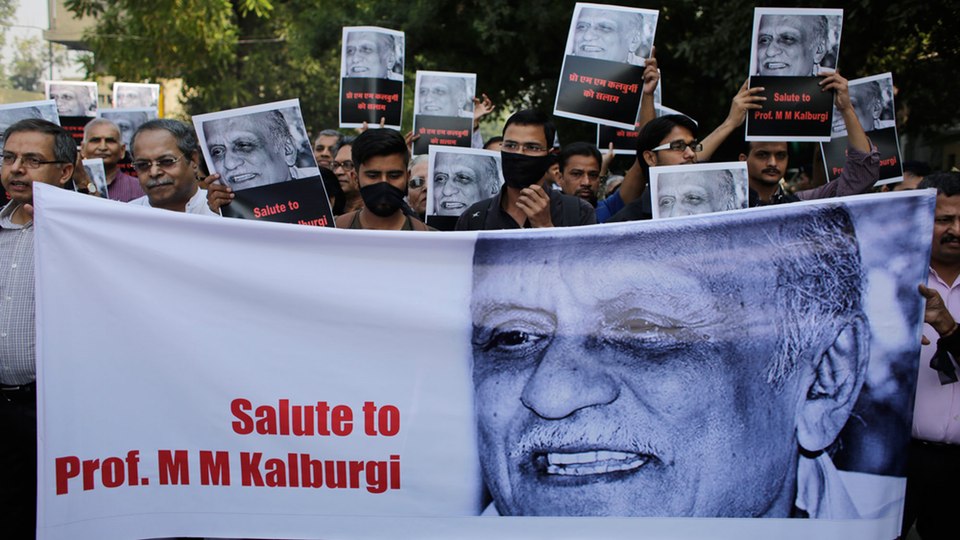
Last few weeks have seen a flood of ‘returning’ honors by writers, scientists and artists. These awardees in way have stood up to make themselves to be counted. There are also various statements from academics, historians, artists and scientists showing their concern about the growing intolerance and erosion of our plural values. Those who returned the honors are amongst the outstanding contributors to literature, arts, film making and science. They in a way have been pouring their heart out at what is going on at social level. The growing intolerance has taken the lives of Dabholkar, Pansare and Kalburgi. There are incidents like where the lynching of one Muslim on the issue of beef eating which has shaken the conscience of the society. In the face of this strong statement from diverse sections of society those related to the ruling party, BJP; its parent organization RSS and many of its affiliates have been strongly criticizing these people on flimsy grounds.

At the same time the President of India disturbed by the happenings in the society; time and again has been reminding the nation about our core civilizational values of pluralism. The vice President has told that it is the duty of the state to protect the ‘right to life’ of citizens. The international rating agencies like Moody have pointed out that unless Modi reins in his colleagues, India stands to lose her credibility. Disturbed by the current growing atmosphere of intolerance the eminent citizens are feeling uncomfortable. So we have the earlier statement of Julio Rebeiro that he is feeling disturbed as a Christian in India. Now Naseerudding Shah said that he is being made to realize his Muslim identity for the first time. The poet, film maker Gulzar stated that the times have come where people ask your religion before they ask your name. Many prominent entrepreneurs like Narayan Murthi and Kiran Majumdar Shaw have shown their concern over growing intolerance. In the same boat of those calling for preserving values of pluralism are people like Raghuram Rajan, the RBI Governor.


The ruling dispensation, the BJP leaders have come out scathingly on these creative people-scientists and labeled the whole process as ‘manufactured rebellion’ as put by Arun Jaitley. It has been alleged that those returning awards are the leftists or those who were recipients of privileges from the state when Congress was the ruling party and now with BJP coming to power from last one year, they are baffled and so the protests. It has been alleged that these people are trying to derail the ‘development story’ being written by the BJP under the leadership of Narendra Modi. Jaitley even goes to say that Narendra Modi is the victim of intolerance by these people returning their awards. Some like Rajnath Singh have pointed out that it is a mere ‘law and order’ problem for which state governments are responsible while these people are targeting Modi government.
                                                                                                      
As such what has happened is neither a law and order problem nor the one related to loss of patronage as it is related to the much broader phenomenon related to intense communalization of society. This time the degree of communalization has crossed the civil limits. The jibe that these people did not return their awards at the time of emergency, anti Sikh violence, migration of Kashmiri Pundits and at the time of Mumbai blasts of 1993 is a very superficial way of dealing with the social response to the phenomenon of growing intolerance and its degree. As the awards which have been returned and the statements put out by different groups do give the reasons for the same and these reasons pertains to the cumulative process and not this or that event. All these incidents mentioned by Jaitley and company have been a tragic part of recent Indian history. Many a writers did protest against most of these incidents, many of them had not even been awarded at that time.

The present times cannot be compared with the tragic incidents of the past for various reasons. Take the case of emergency for example. It was a dark chapter of Indian history, still it was the authoritarianism imposed mostly from the top. What is most disturbing in the current times is the vast network of organizations related to the ruling party whose followers either they themselves create hatred in the society or they mobilize the social sectors through hate speech; the result of which is violence. Currently there is a twin attack on the values of tolerance and liberal space. From the top the ruling dispensation has people like Yogi Adiyanath- Sakshi Maharaj, Giriraj Singh, Sadhvi Niranjan Jyoti who keep spreading sectarian message while basking in the glory of power and at the societal level divisive statements prevail.

At yet another level is the institutional control by communal ideology. Our major institutions and educational places are being mauled by divisive ideology. Our frontline areas of science and technology are being tampered day in and day out. The promotion of blind faith is the byproduct of this very policy. Blind faith and the large section of religious entrepreneurs (Babas, Modern Gurus) have a major say and have a major influence on the present political powers. As such the ideology spread by RSS, the one of Hindu nationalism, is dominating on social and political field. And lastly at the level of social thinking the ‘Hate other’ ideology has been promoted through various conduits using the issues like Ghar Wapasi, love jihad and beef. It is this which is creating the intense social insecurity amongst the religious minorities. It is this which is leading to incidents like Dadri. Such incidents are being projected as law and order problem to deliberately overlook the erosion in democratic space.

Essentially the insane communal violence has its roots in the prejudice leading to hate for the religious minorities. And that’s what flows from the ideology of Hindu nationalism, or any other sectarian nationalism, in the name of any religion or race. In current times the fountainhead of Hindu nationalism which is, the major factor here, is RSS. Not to say that Muslim sectarianism has its own divisive and supplementary influence. Through different conveyer belts this ideology assumes the ‘Hate other’ sentiment and that’s where cow slaughter, beef eating become the ground to kill the people. The practitioners of sectarian nationalism vow that ‘we will kill and get killed’ while defending our Holy mother the cow.

This is just one case in point. The major factor leading to present atmosphere lies in the qualitative transformation of ‘hate for others’. The stereotyping of minorities which began with Hindu nationalism has assumed horrendous proportions where the likes of Gulzar have to say what he said. So while the Jaitleys will keep undermining the steps taken by these people and while the Rajnath Singhs’ will keep dubbing it as a law and order problem, the dissatisfaction amongst those standing for democracy is growing, liberal space and tolerance is shrinking. We will have to keep thinking of more ways to draw the attention of larger sections of society towards the threat looming large on our democratic society, the threat of sectarian propaganda and politics leading to stifling of democratic space. And these are not the ordinary times, the divisive process have assumed menacing proportions and cannot be hidden by the illusory growth story!

Monday, 23 November 2015

Dickens, Shaw and Marx: Contrasting Approaches

Ramkrishna Bhattacharya

No two authors could be more unlike than Charles Dickens and George Bernard Shaw. Dickens was notorious for the saccharine sentimentality that pervades his novels. His rainbow humour - smiling through tears - endeared him to many readers all over the world. But there are others who complain that his appeal is invariably to the heart, never to the head. Shaw, on the other hand, was a sworn enemy of sentimentalism; rationalism was his forte. Yet quite unabashedly Shaw declared in 1906: '... I am a supersaturated Dickensite' (Shaw on Dickens 65). Again, in June 1914 he wrote: 
I am a Dickensian if by a Dickensian you mean a person who read all Dickens eagerly in his nonage. I read a good deal of him in my childhood before I dreamt of asking whom a book was by. I was a good deal influenced by him (Shaw on Dickens 74).
On yet another occasion (July 1919), readily admitting the influence of Dickens upon him, Shaw made a devastating comment: ‘Nothing but the stupendous illiteracy of modern criticism could have missed this fact’ (qtd. in Shaw on Dickens viii).

Shaw’s Foreword to a revised text of Dickens’s Great Expectations, published in 1947, contains some of his penetrating comments not only on Dickens, but also on what made Dickens so significant to him. 

And yet Shaw was not uncritical in his evaluation of Dickens. In a letter to Kate Perugini, daughter of Dickens, Shaw wrote: ‘His (sc. Dickens’s) limitation was the Shakespearean limitation: the current philosophies and religions of his day (Great Portland St – Good God!) were perfectly useless to him; and he never arrived at a philosophy or religion of his own’ (Shaw on Dickens 63). Nevertheless Shaw was charitable enough to admit that even this ignorance ‘had its advantages; for although it prevented him from understanding things that are intelligible enough to a superior person like myself, it also saved him from cooking his books to fit his philosophy, instead of depending on his enormous power of observation’ (Shaw on Dickens  63). 

Shaw finds fault with both Dickens and Shakespeare for the absence of any philosophy in their works. In his Epistle Dedicatory to Man and Superman (1903) Shaw said:
 I read Dickens and Shakespear (sic) without shame or stint; but their pregnant observations and demonstrations of life are not co-ordinated into any philosophy or religion: on the contrary, Dickens’s sentimental assumptions are violently contradicted by his observations; and Shakespear’s pessimism is only his wounded humanity (Shaw on Dickens  108).
Shaw does not deny that
[b]oth have the specific genius of the fictionist and the common sympathies of human feeling and thought in pre-eminent degree. They are oftener saner and shrewder than the philosophers just as Sancho-Panza was often saner and shrewder than Don Quixote. They clear away vast masses of oppressive gravity by their sense of the ridiculous, which is at bottom a combination of sound moral judgment with lighthearted good humor’ (Shaw on Dickens  108).
This absence of philosophy, however, was definitely a hindrance: ‘But they are concerned with the diversities of the world instead of with its unities: they are so irreligious that they exploit popular religion for professional purposes without delicacy or scruple…’ (Shaw on Dickens  108). All this, Shaw says, led to one great fault in their creations: ‘Neither of them could do anything with a serious positive character…’ (Shaw on Dickens 109).

Shaw’s evaluation of Dickens is marked by his antipathy towards the latter’s lack of any well thought-out worldview. Shaw dismisses ‘the compact Tale of Two Cities’ as ‘pure sentimental melodrama from beginning to end, and shockingly wanting in any philosophy of history in its view of the French Revolution’ (Shaw on Dickens  46).
 
In a study of Ruskin vis-à-vis Dickens, Shaw asserts:
Charles Dickens was one of the greatest writers of the 19th century, and one of the greatest writers that England has ever produced. One of the greatest books in the English language is Little Dorrit, and when the English nation realises it is a great book and a true book there will be a revolution in this country. One of the reasons I am a revolutionist is that I read Little Dorrit when I was a very small boy (Shaw on Dickens  111). 
In this essay Shaw points out another shortcoming of Dickens:
Yet a comparison between Charles Dickens and John Ruskin, another great writer, brings home how astonishingly Philistine Dickens was. He really knew nothing about anything except literature, and that was a very serious handicap to him. One gets a far broader wisdom very often from Ruskin than from Dickens… (Shaw on Dickens 111).
Shaw explains that he uses the word Philistine ‘in the popular sense of a man who knows nothing about art.’ Dickens in this respect, however, was not an exception, for in England the authors of the nineteenth century were ‘the most appalling Philistines – even the greatest of them’ (Shaw on Dickens 111).

Shaw is at his paradoxical best when he brings Karl Marx in contrast to Dickens: 
The difference between Marx and Dickens was that Marx knew that he was a revolutionist whilst Dickens had not the faintest suspicion of that part of his calling. Compare the young Dickens looking for a job in a lawyer’s office and teaching himself shorthand to escape from his office stool to the reporters’ gallery, with a young Trotsky, the young Lenin, quite deliberately facing disreputable poverty and adopting revolution as their profession with every alternative of bourgeois security and respectability much more fully open to them than to Dickens (Shaw on Dickens 49).
This, however, is not the only reference to Marx in Shaw’s comments on Dickens. As if to compensate for this harsh   judgment, Shaw declares: ‘Yet Little Dorrit is a more seditious book than Das Kapital. All over Europe men and women are in prison for pamphlets and speeches which are to Little Dorrit as red pepper to dynamite’ (Shaw on Dickens 51).1

 All this comes after a scathing comment on Dickens’s limitations: 

You may read the stories of Dickens from beginning to end without ever learning that he lived through a period of fierce revivals and revolutionary movements in art, in philosophy, in sociology, in religion: in short, in culture. Dean Inge’s remark that “the number of great subjects in which Dickens took no interest whatever is amazing” hits the nail exactly on the head. As to finding such a person as Karl Marx among his characters, one would as soon look for a nautilus in a nursery (Shaw on Dickens 51).

Over and over again Shaw makes a sharp distinction between Dickens the novelist and Dickens the man. It would perhaps be better to say that the distinction is between the man and his works. This no doubt would win the approval of Georg Lukács who insisted on objectivity to the last day of his life (Eörsi 32). Dickens the man was no better than ‘an English gentleman of the professional class, who would not allow his daughter to go on the stage because it was not respectable’ (Shaw and Dickens 52). Shaw again brings in Marx as a typical representative of what Dickens was not. In spite of all his seriousness, Shaw observes,
…Dickens never saw himself as a revolutionist. It never occurred to him to found a Red International, as Marx did, not even to join one out of the dozens of political reform societies that were about him. … He knew so little about revolutionists that when Mazzini called on him and sent in his card, Dickens, much puzzled, concluded that the unknown foreign gentleman wanted money, and very kindly sent him down a sovereign to get rid of him (Shaw on Dickens  52).
Shaw brings in Marx in relation to Dickens again in a different context:

Marx and Dickens were contemporaries living in the same city and pursuing the same profession of literature; yet they seem to us like creatures of a different species living in a different world. Dickens, if he had ever become conscious of Karl Marx, would have been classed with him as a revolutionist. The difference between a revolutionist and what Marx called a bourgeois is that the bourgeois regards the existing social order as the permanent and natural order of human society, needing reforms now and then and here and there, but essentially good and sane and right and respectable and proper and everlasting. To the revolutionist, it is transitory, mistaken, objectionable, and pathological: a social disease to be cured, not to be endured (Shaw on Dickens 48).

#
             
It is quite probable that Dickens did not know anything about Marx. But Marx did know much about Dickens. A correspondent of the Chicago Tribune noticed the works of Dickens and Thackeray in Marx’s private collection (Prawer 395-96). There is, however, only one occasion in Marx’s printed works when Dickens is mentioned by name.3  It appears in an essay written in English and published in the New-York Daily Tribune (August 1, 1854). Dickens is named along with Thackeray, Charlotte Brontë, and Mrs Gaskell who are said to have painted the English middle class as ‘full of presumption, affectation, petty tyranny and ignorance’ (Marx-Engels 339-40). The editors of Marx-Engels Werke have pointed out that parts of the manuscript of this article were radically revised by the editors of that journal (Prawer 237). Hence everything the essay contains should not be blindly accepted as coming from Marx’s pen. Although much has recently been made of a statement in this essay (‘The present splendid brotherhood of fiction-writers in England, whose graphic and eloquent pages have issued to the world more political and social truths than have been uttered by all the professional politicians, publicists and moralists put together…’) and the honour of being such an author attributed to Dickens alone (in Wikipedia and several printed works), the authenticity of the text of this essay, particularly this kind of hyperbole, is not beyond question.  

However, there are several allusions to Dickens’s characters in Marx’s works which exhibit his close acquaintance with the works of the English novelist. They are not to be found so much in the works meant for publication but in his letters. Dickens was indeed one of Marx’s favourite authors. As S. S. Prawer observes:

There are also constant additions to Marx’s canon of literary excellence: Homer, Aeschylus, Ovid, Lucretius, Shakespeare, Cervantes, Goethe, and Heine are joined, successively, by Dante, Diderot, Cobbett, Balzac, Dickens, and many others (401). 

Marx does not go into the merit of Dickens’s works, nor does he pay much attention to the contents of the novels and the message they convey. Dickens to him was basically a fashioner of typical characters, so typical as to represent any individual who belongs to the type. Dickens was memorable to him as the creator of a variety of odd and curious characters who can be recalled in relation to other people of Marx’s own times. In a letter, for example, Marx speaks of ‘the modern bourgeois Pecksniff- style…’ (qtd. in  Prawer 174), alluding to the notorious self-server in Dickens’s Martin Chuzzlewit.  Pecksniff comes handy in reference to Napoleon III of France who is called ‘the imperial Pecksniff’ (Prawer 262).4  Similarly in his Ethnological Notebooks (posthumously published) both Jeremy Bentham and Henry Maine are called ‘Pecksniff’ and ‘Pecksniffian’ respectively(Prawer 361-62), apparently as  terms of disapproval. There are references to Tupman, a character in Pickwick Papers (Prawer 186). Marx also speaks of the ‘Pickwickian sense’ in which politicians employ their words (Prawer 252). Richard Cobden is called ‘umble’ like Uriah Heep, a hypocrite in David Copperfield (Prawer 203). Two other characters from Dickens, Wackford Squeers (the cruel headmaster in Nicholas Nickleby ) and Artful Dodger (the nickname of a pickpocket in Oliver Twist ), are mentioned as specimens of cruelty and unscrupulousness (Prawer 252). Marx again mentions Wackford Squeers (Prawer 392) in connection with the editor of the National-Zeitung, Berlin.

Literary allusions are galore in Marx’s less known work, Herr Vogt : English authors, such as Shakespeare, Samuel Butler of Hudibras  fame, Alexander Pope, Lawrence Sterne, Byron, and last but not least, Dickens. Both in Capital , vol. I and Herr Vogt, Bill Sikes, a vicious thief in Oliver Twist, is made to appear as a ‘voluble cut-throat’ (Prawer 340). Marx calls Gladstone’s style of oratory ‘Circumlocution-Office style’ (Prawer 358) and explains the term for the benefit of his German readers who had not read Little Dorrit : it is employed to describe the style of function of Government bureaucracy.

Marx once said, ‘Individuality and specificity are an integral aspect of typicality’ (qtd. in Prawer 410).5 Referring to this formulation, Prawer observes:

 In this way a novel by Balzac or Dickens may become a ‘concrete universal’ – it may reveal more of the dynamic of nineteenth-century life in France and England, and of the workings of human nature in its general as well as its temporally and sociologically particular aspect, than the writings of most historians, economists, and sociologists (Prawer 410).

 Marx used to collect literary nicknames from a wide number of sources; they do not show any inclination to choose only such authors who had a philosophy of their own (as Shaw demanded). Marx’s admiration for Dickens is purely literary: he never bothers to reflect on Dickens’s personal views regarding the burning issues of his times. On the contrary, Marx hugely enjoyed the peculiarity of the characters that Dickens created.  
      
To sum up then: Shaw’s evaluation of Dickens is coloured by his own propensity towards philosophizing in his plays and the sense of purpose that must, he felt, permeate every work of art. He discovered in Dickens’s works the full potential of a ‘revolutionist’, although in his personal life and thought Dickens himself was far from being so. Marx, on the other hand, found in Dickens’s novels a delightful gallery of characters who could be picked up and projected as typical representatives of human follies, foibles and vices.

Notes and References

1 Shaw considers Little Dorrit to be ‘Dickens’s masterpiece among many masterpieces’ and Great Expectation ’his most compactly perfect book’ (46).
2 Dan H. Laurence and Martin Quinn, editors of Shaw on Dickens, inform us that Mazzini and Dickens later became friends (52 n6).
3 Engels too is known to have mentioned Dickens once by his pen name, Boz (Marx-Engels 297). He makes a distinction between the older kind of romance and the modern novel dealing with the fates and fortunes of the poor, the despised class, replacing those of kings and princes. As examples of the ‘new class of novel writers’, Engels mentions George Sand, Eugène Sue, and Boz (i.e., Dickens). This distinction between romance and the novel was later explored in more details by Arnold Kettle, a twentieth-century Marxist critic (33-37).
4 On another occasion Napoleon III is called ‘the Quasimodo of the French Revolution’ (Prawer 252), alluding to the poor hunchback in Victor Hugo’s novel, Notre-Dame de Paris (translated into English as The Hunchback of Notre-Dame), not, however, in the sense of a pathetic grotesque figure, but, as Marx himself explains, as a terrifying Quasimodo.
5 Engels too appreciated this quality in characterization. In a letter (November 26, 1885) he told Minna Kautsky, a German novelist, that her ‘characters exhibit the sharp individualization so customary in your work. Each of them is a type but at the same time also a definite individual, a “Dieser” [This one], as old Hegel would say, and that is how it should be’ (Marx-Engels 87). In another letter (beginning of April 1888), to Margaret Harkness, an English socialist-feminist author,  Engels defined realism as ‘besides truth of detail, the truthful reproduction of typical characters under typical circumstances’ (Marx-Engels 90).


Works Cited

Eörsi, István. György Lukács, Fanatic of Reality, The New Hungarian Quarterly, Vol.12.  No.44, Winter 1971, pp.26-34.
Kettle, Arnold. An Introduction to the English Novel, vol.1. London: Arrow Books, 1962 (first published 1951).
Laurence, Dan H. and Martin Quinn (eds.). Shaw on Dickens. New York: Frederick Ungar Publishing Company, 1985.
Marx, Karl and Frederick Engels. On Literature and Art. Moscow: Progress Publishers,1976.
Prawer, S.S. Karl Marx and World Literature. Oxford: Oxford University Press, 1978.

Acknowledgements: Amitava Bhattacharyya, Siddhartha Datta and Sunish Kumar Deb. The usual disclaimers apply.


Prof Ramkrishna Bhattacharya taught English at Unversity of Calcutta, Kolkota and was an Emeritus Fellow of University Grants Commission. He isnow a Fellow of Pavlov Institute, Kolkota


Sunday, 15 November 2015

Three Murders and a Lynching

Ram Puniyani

Laws of nature cannot be applied to human society so directly. Still sometimes these have been used to explain-justify social catastrophes, “When a big tree falls. Earth shakes (in the aftermath of anti Sikh massacre 1984), ‘every action has equal and opposite reaction’ (during Gujarat carnage of 2002) are too well known. I have been very puzzled from last month or so since the scholars-writers, who have returned their honors and are being questioned as to why they did not do so when emergency happened or anti Sikh violence took place or when the mass migration of Kashmiri pundits took place or when the Mumbai train blasts killed hundreds of innocent lives.  I am tempted to think of the laws of physics of ‘qualitative transformation’ during heating or cooling of water, the temperature remains the same but water becomes either steam or ice.

Govind Pansare, Narendra Dabholkar, MM Kalburgi

When Dr. Dabholkar, Com Pansare and then Prof Kalburgi were killed over a period of months, the danger signals started being perceived but still it took the beef lynching of Mohammad Akhlaq to give a message that something has drastically changed in the society, and the spate of returning  of Sahiya Academy, National and state, awards followed in quick succession. Their protest was against the rising intolerance in the society. The incidents that followed and ran parallel to these ‘award-returns’ were equally horrific. The killing of a trucker on the assumption that he is carrying cows for slaughter; beating of a MLA in Kashmir Assembly by BJP legislatures and the scattered incidents of attacks on Muslims on the ground of beef consumption are too striking. We are currently facing a situation where anybody can incite the violence by just uttering the word beef, while seeing mutton or some such thing. We are living in an atmosphere where cow cannot be shooed away even if she is blocking the traffic.

The viciousness of atmosphere is not lost on the social perceptions. The insecurity of minorities has gone up by leaps and bounds. One knows that since the present NDA regime came to power all those ‘spewing hate’ are working overtime. For one Akbaruddudin Owaisi there is an army of Sakshi Mahraj, Sadhvis, Yogis and what have you. This army of mostly saffron robed or the one’s with the association with Hindu Nationalist politics has high position within their political combine, what is known as Sangh Parivar. The prime Minister himself had exerted the Hindu youth to emulate Maharana Pratap to save the honor of Mother cow during the election speeches. During this last over one year, words like Haramjades  (illegitimate) have been used with gay abandon. On the mere suspicion; a Pune techie Mohsin Shaikh was done to death. Serial attacks on Churches were passed off as thefts, the love jihad bogey was kept alive and the likes of Yogi Adityanath, the top BJP leader from UP, stated that for every one Hindu girl marrying a Muslim, Hindus should bring 100 Muslim girls. Muslim youth have been barred from participating in festivals like Navaratri. Mukhtar Abbas Naqvi, the BJP’s Muslim face advised those wanting to eat beef to go to Pakistan. The glorification of Mahatma’s killer Godse has been stepped up and temples are being planned in his memory, while a BJP MP from Kerala stated that Godse was right but he chose a wrong target. Atmosphere of communal violence has gone up in a big way during the preceding year.


Even after the awards started being returned the BJP leadership looked down upon the writers/scholars and overlooked the phenomenon which has lead to returning of awards. To mock these writers Buddhi Shuddhi puja path (purification of intellect ritual) has been organized and BJP spokespersons are humiliating them in talk shows with all their ferocity. To cap it all the Haryana Chief Minister, an old RSS pracharak, said that Muslims can live here but only if they will give up beef eating. No doubt the BJP Chief Amit Shah has talked to some of these leaders behind the close doors, but that does seem to be a mock drill as the leaders concerned did say that they went to meet their chief for some other reasons and none of them gave any serious apology.

Disturbed by what is going on, the President Pranab Mukherjee on three occasions urged the nation to uphold, pluralism, the core civilizational value of the country and to uphold tolerance. The Vice President Hamid Ansari reminded the Government that it is the duty of the state to uphold the ‘right to life’ of citizens. The index of the changing social atmosphere is reflected by the statements of two outstanding citizens of the country. Julio Reibero, the top cop, expressed his pain and anguish by saying that “as a Christian suddenly I feel stranger in my own country.” And the renowned actor Naseeruddin Shah had to point out that “Have never been aware of my identity as a Muslim until now.”

These are not ordinary times. The values of pluralism and tolerance have been pushed to the margins. With this Government in power all the wings of communal politics, the RSS affiliates, have unleashed themselves in full blast. Communalism is not just the number of deaths due to violence, it is much more. The foundation of this violence begins with the manufacture of perceptions about the religious minorities. These perceptions based on history and some selective aspects of present society are given an anti human tilt and interpretation. This is used to create hatred for the minorities and that’s where the communal elements can unleash violence either as a massive violence like Gujarat or Mumbai or Bhagalpur or Muzzafarnagar or the one in Dadri. This creates the divides in society which over a period of time is converted into polarization. And polarization is the foundation of electoral strength of party wanting a nation in the name of religion. As per Yale study, the communal violence is the vehicle which strengthens BJP at electoral level.

Communalism has been planted in India over a century and a half ago. The British policy of ‘divide and rule’ used communal historiography as a major weapon. This type of interpretation of history was picked up by communal organizations and given an anti Hindu or anti Muslim tilt and gradually this has been strengthened after every act of violence which has been the outcome of their politics. The present phase is the one where the cup of communalism is spilling out from its earlier levels or boundaries. The intensity of ‘Hate’ constructed around temple destructions, love jihad has been supplemented by the oft used tool of beef. In the present situation where the divisive elements, who are in center stage of politics also know that they are safe and secure as the present Government precisely wants what they are doing, their contrary posturing notwithstanding.

The present combination of the Government guided by the ideology of Hindu nationalism and the ‘fringe elements’ having same ideology, has a vast network and with a wide reach. This party has the advantage that mostly it does not have to dirty its hands in the local agenda of sectarian nationalism, and so there are many elements which can do the local work for dividing the society. The so called fringe elements now are occupying the center stage, and so the ‘qualitative change’ in the situation.  The flood of awards being returned is due to the situation created by deeper communalization of society. This is manifested in growing intolerance, attack on plurality and is leading to the insecurity of minorities, which has qualitatively transcended the earlier limits. The question is how to uphold the values of Indian Constitution in the current times?

Monday, 26 October 2015

The Cārvākas against Caste and Gender Discrimination

Ramkrishna Bhattacharya

[This is Part II of "Facets of Materialism in India: A Historical Outline". Part I is here]


The Carvakas against Caste Discrimination

Let us now see what these two arch-opponents of materialism say regarding the materialists’ (or, to be more specific, of the new materialists,’ i.e., the Cārvākas’) views on caste and women. 

In Kṛṣṇamiśra’s (eleventh century) allegorical play, Rise of Moon-like Intellect (Prabodhacandrodaya), Mahāmoha (Great Delusion), an avowed materialist, declares:   
tulyatve vapuṣāṃ mukhādyavayavair varṇakramaḥ kīdṛśo…| 2.18ab
If the bodies are alike in their different parts, the mouth, etc., how can there be a hierarchy of castes? (Trans. by S.K. Nambiar)
A heretic in Śrīharṣa’s (twelfth century) Naiṣadhacarita (Life of Naiṣadha) throws a challenge to the forces of status quo ante:
śuddhir vaṃśa dvayī śuddhau pitroryadekaśaḥ | 
tadanantakulādopādadoṣā jātirasti kā || 17.40

īrṣyayā rakṣato nārīrdhikulasthitidāmbhikān | 
smarāndhatvāviśeṣe’pi tathā naramarakṣataḥ || 17.42

tṛṇānīva ghṛṇāvādān vidhūnaya vadhūranu | 
tavāpi tādṛśasyaiva kā ciraṃ janavañcanā ||  17.58 

Since purity of caste is possible only in the case of purity on each side of both families of the grandparents, what caste is pure by the purity of limitless generations?

Fie on those who boast of family dignity! They hold women in check out of jealousy; but do not likewise restrain men, though the blindness of passion is common to both!

Spurn all censorious statements about women as not worth a straw. Why dost thou constantly cheat people when thou, too, art as bad as women?(Trans. by K.K. Handiqui) 
Both the authors intended to depict the Cārvākas as heretics and non-believers. Defiance of the caste system was considered a heretical idea and hence deserved censure.

Is there any truth in labelling the Cārvākas as opposed to the caste system? I think there is. Two oft-quoted genuine aphorisms attributed to the Cārvākas say that the human body is a combination of four natural elements, namely, earth, air, fire and water (I.2-3).[1] Apparently the Cārvākas gave no credence to the late Vedic idea that the Brahmaṇas, Rājanyas (warriors), Vaiśyas (agriculturists and traders), and Śūdras (manual workers) were different parts of the supreme person called puruṣa (Ṛgveda 10.90.11-12): 
yat puruṣaṃ viadadhuḥ, katidhā vi akalpayan? 
mukhaṃ kim asya? kau bāhu? kā ῡrῡ pādā ucyete?

brāhmaṇo ‘sya mukham āsīd, bāhu rājaniaḥ kṛtaḥ; 
ῡrῡ tad asya yad vaiśyaḥ padbhyāṃ śῡdro ajāyata. 

When they divided Puruṣa, into how many parts did they dispose him? What (did) his mouth (become)? What are his two arms, his too thighs, his two feet called? 

His mouth was the Brāhaman [Brāhamaṇa], his two arms were made the warrior, his two thighs the Vaiśya; from his two feet the Śῡdra was born. (transA.A. Macdonell, pp.200-01) 
This was a convenient way of explaining why acceptance and observance of the hierarchy of castes was obligatory. The law books insist on the preservation and continuation of the caste system. The Cārvākas cared nothing for these sacred texts. Hence it is quite probable that the Cārvākas had no faith in the so-called divine origin of castes and did not observe caste rules in social life. A verse attributed to the Cārvākas runs as follows:  
na svarga nāpavargo vā naivātmā pāralaukikaḥ | 
naiva varṇāśramādīnāṃ kriyāśca phaladāyikāḥ ||  

There is no heaven, no final liberation, nor any soul inthe other-world. 
Nor do the actions of the four castes, orders, etc. produce any real effect.[2] 


The Carvakas against Gender Discrimination

As to the defence of women and treating them as equal to men, the Cārvākas apparently were very much anti-sexist. They did not believe, as Manu did, that women in general were basically untrustworthy, were not entitled to study the Vedas, and were never to earn freedom but should always be under their fathers’, husbands’ and sons’ protection and surveillance (Manusmṛti, 9.10-20). The Cārvākas’ claim of the equality of the sexes quite logically follows from their basic anti-śāstric stance. Being freethinkers, they could also very well be free from all prejudices against women that are rampant in the law books of ancient India. They did not admit word (śabda), that is, verbal testimony, as a valid instrument of cognition (pramāṇa). So they were not under any compulsion to accept what the Brahmaṇcal law books declared as something sacrosanct. This is why Sāyaṇa-Mādhava could make them say: ”[T]here is no more reason for believing on another’s word that smoke and fire are connected, than for our receiving the ipse dixit of Manu, &c.” dhῡmadhῡma-dhvajayor avinābhāvo ’stīti vacanamātre manvādivad viśvāsābhāvāc ca. [3] 

To sum up then: materialism in India, particularly the Cārvāka/Lokāyata,  appeared heretical to the powers that be, not only in respect of its ontology but also because of its social outlook. This is why two Vedantin poets considered it necessary to present it in poor light, as an enemy of the established order which is founded on the varṇa system and patriarchy. 

One word more. Eli Franco once suggested perceptively: “[A]ll the Lokayātikas were fighting for… was ultimately to found social and political institutions independently of religious dogma…”.[4] He might have had in his mind Frauwallner’s view that materialism in India was created for the Realpolitikers. I do not think so, as I have shown elsewhere.[5] I would, however, heartily agree with Franco’s suggestion. The Cārvākas did have a vision of an ideal society in which organised religion would have no room, and there would be no varṇa and gender discriminations. Their approach was thoroughly rational and they denounced such discriminations as impediments to founding a society based on equality of rights and opportunities. In this sense the social outlook of the Cārvākas was essentially democratic.


Appendix A 


Ajita Kesakambal's 'worldview'

O King, there is no (consequence to) alms-giving, sacrifice or oblation. A good or bad action produces no result. This world does not exist, nor does the other world.  There is no mother, no father. There is no rebirth of beings after death. In this world, there are no samanas [Śramaṇas] or brāhmaṇas established in the Noble Path and accomplished in good practice, who, through direct knowledge (i.e., magga insight) acquired by their own efforts, can expound on this world and the other world. This being is but a compound of the four great primary elements; after death, the earth-element (or element of extension) returns and goes back to the body of the earth, the water-element (or element of cohesion) returns and goes back to the body of water, the fire-element (or element of thermal energy) returns and goes back to the body of fire, and the air-element (or element of motion) returns and goes back to the body of air, while the mental faculties pass on into space. The four pall-bearers and the bier (constituting the fifth) carry the corpse. The remains of the dead can be seen up to the cemetery where bare bones lie graying like the colour of the pigeons. All alms-giving ends in ashes. Fools prescribe alms-giving; and some assert that there is such a thing as merit in alms-giving; but their words are empty, false and nonsensical. Both the fool and the wise are annihilated and destroyed after death and dissolution of their bodies. Nothing exists after death.’ (Ten Suttas, p.83, translation slightly modified.) 

Acknowledgements: Amitava Bhattacharyya, Sourav Basak, Sunish Kumar Deb, and Krishna Del Toso. The usual disclaimers apply.

Works Cited

Ācāraṅgasūtram and Sūtrakṛtāṅgasūtram  with Niryukti of Ācārya Bhadravāhu Svāmī and the Commentary of Śīlāṅkācārya. (1978). Ed. Ācārya Sarvanandājī Mahārāja. Re-ed. with Appendix by Muni Jambuvijayaji. Delhi: Motilal Banarsidass Indological Trust.
Bhattacharya, Ramkrishna. Studies on the Cārvāka/Lokāyata. Firenze: Società Editrice Fiorentina, 2009.
Bhattacharya, Ramkrishna. Development of Materialism in India: the Pre-Carvakas and the Carvakas, Esercizi Filosofici 8, 2013, pp. 1-12. (2013a). ISSN 1970-0164
Chattopadhyaya, Debiprasad. Knowledge and Intervention. Calcutta:  Firma KLM, 1985.
Cārvāka/Lokāyata. Edited by D. Chattopadhyaya and M. K. Gangopadhyaya. New Delhi: Indian Council of Philosophical Research, 1990.
Cowell, E. B. The Chārvāka System of Philosophy, Journal of the Asiatic Society (Bengal), 31(4), 1862, pp.371-90.
Dasgupta, S. N. A History of Indian Philosophy. Vols. 1-5. Delhi: Motilal Banarsidass,1975 ( Reprint).
Del Toso, K., "tebhyaś caitanyaṃ : il 'sé' secondo il Materialismo indiano", in A. Cislaghi and K. Del Toso (ed. by), Intrecci filosofici. Pensare il Sé a Oriente e a Occidente, Milano-Udine: Mimesis, 2012, pp. 135-153.
Franco, Eli.“Paurandarasūtra” in M.A.Dhaky (ed.), Aspects of Jainology, Vol. III. Varanasi: Sagarmal Jain P.V. Research Institute,1991.
Feanco, Eli. Lokayata, in Brill Encyclopedia of Hinduism, vol.XI. Leiden; Brill, 2011.
Franco, Eli. Perception, Knowledge, Disbeilief / A Study on Jayarāśi’s Scepticism. Delhi: Motilal Banarsidass, 1994.
Franco,Eli and Karin Preisendanz. Materilism, Indian School of, in Edward Craig (General Editor). Routledge Enclopedia of Philosophy. Vol.6. London: Routledge, 1998.
Frawallner, Erich. History of Indian Philosophy. Vols. 1-2. Delhi: Motilal Banarsidass, 1971.
Gerschhiemer, Gerdi. Les ‘Six doctrines de spéculation’ (ṣaṭtarkī) – Sur la categorization variable des systems philosophiques dans l’Inde classique, in Expanding and Merging Horizons  (Wilhelm Halbfass Memorial Volume). Ed. Karin Preisendanz. Vienna: Austrian Academy of Sciences Press, 2007, pp.239-58.
Haribhadra. Samarāicca kahā. Ed. H.Jacobi, The Asiatic Society, Calcutta 1926.
Jayarāśibhaṭṭa.Tattvopaplavasiṃha of Jayarāśibhaṭṭa. Eds. Sukhlalji Sanghvi and Rasiklal Parikh. Baroda: Oriental Institute, 1940.
Jayarāśibhaṭṭa. Tattvopaplavasiṃha of Jayarāśibhaṭṭa. Trans. V. N. Jha. Ernakulam: Chinmaya International Foundation Shodha Sansthans, 2013.
Joshi, K. L. (ed.). Sāyaṇa-Mādhava. Sarvadarśanasaṃgraha. Trans. E. B. Cowell and A. E. Gough. Delhi: Parimal Publication, 1981.
Kṛṣṇa Miśra. Prabodha Candrodaya. Ed. and trans. Sita Krishna Nambiar. Delhi: Motilal Banarsidass, 1971.
Macdonell, A. A. A Vedic Reader for Students. Madras: Oxford University Press (reprint), 1978.
Maninekalai. Trans. Prema Nandakumar. Thanjavur:Tamil University, 1989.
Manusmṛti with nine commentaries. Vols.1-6. Ed. J. H. Dave. Bombay: Bharatiya Vidya Bhavan, 1972-84.
Padmapurāṇa. Sṛṣṭikhaṇḍa. Ed. and trans. into Bangla by Tarakanta Devsarmma and others. Kalikata: Vangavasi, 1310 Bangla Sal [1903-04].
Radhakrishnan, S. and C. A. Moore. A Source Book in Indian Philosophy. Princeton: Princeton University Press, 1957.
Ruben, Walter. Uddālaka and Yājñavalkya. Materialism and Idealism, Indian Studies Past and Present, Vol. 3 No. 3, April-June 1962, pp.345-54, reprinted in his Studies in Ancient Indian History, Calcutta: Indian Studies Past and Present, 1966.
Sarup, Lakshman (ed.). The Nighaṇṭu and the Nirukta. Delhi: Motilal Banarsidass, 1984 reprint.
Sāyaṇa-Mādhava. Sarvadarśanasaṃgraha. See Joshi, K.L. (ed.).
Shastri, D. R. A Short History of Indian Materialism, Sensationalism and Hedonism (1930). Calcutta: Bookland, 1957.
Śrīharṣa. Naiṣadhacarita. Eds. Sivadatta and V. L. Panshikar. Mumbai: Nirnay Sagar Press, 1928. Trans. K. K. Handiqui. Poona: Deccan College Postgraduate Research Institute, 1956.
Sūtrakṛtāṅgasūtram. See Ācāraṅgasūtram, etc.
Ten Suttas from Dīgha Nikāya. Varanasi: Central Institute of Higher Tibetan Studies, 1987.
Vanamamalai, N. Materialist Thought in Early Tamil Literature, in: Social Scientist, 2:4, November 1973, pp.25-41 (available in JSTOR archive).
Varāhamihira. Bṛhatsaṃhitā with [Saṃhitā-]Vivṛti by Utpalabhaṭṭa. Ed. Avadha Vihari Tripathi. Varanasi: Sampurnanand Sanskrit Vishvavidyalaya, 1968.


[1] R. Bhattacharya 2009, pp.78-79, 86. 
[2] Qtd. Sāyaṇa-Mādhava in Joshi 1981, p.12. Emphasis added. The verse occurs in the Padmapurāṇa, Sṛṣṭikhaṇḍa 13.323. For other sources see R. Bhattacharya 2009, pp.84, 91.  
[3] Sāyaṇa-Mādhava in Joshi 1981, p.9. 
[4] Franco 1991, p.160. 
[5] Bhattacharya 2009, pp.21-32.


Prof Ramkrishna Bhattacharya taught English at Unversity of Calcutta, Kolkota and was an Emeritus Fellow of University Grants Commission. He isnow a Fellow of Pavlov Institute, Kolkota


Worshipping Cow: Killing Humanity

Ram Puniyani

Just over a decade ago (2002) in Dulina village of Jhajjar in Haryana a mob of over a thousand people lynched five dalits who were skinning a dead cow to sell the hide. A few months ago in Malegaon Mahahrashtra police arrested three Muslims on the charge of storing beef. On the back of this come the news from Bisara that a Muslim was killed and his son injured seriously on the charges of storing-eating beef.
In the context of Dulina lynching VHP’s Acharya Giriraj Kishore in a press conference stated that "the life of a cow is more precious than that of a human being." The recent incidents, the above quoted may be a sampler of what is happening, this is becoming a ‘new normal’ after the new Government at Center has taken charge. States with BJP ruled Governments beginning with Maharashtra have been bringing in legislations banning storage of beef.

For Hindu nationalist politics identity issues have been the hallmark and they pursue it to divide the society and polarize the communities along religious lines. Today the insecurity amongst minority is going through the roof, making their life very difficult. For implementing the polarizing agenda, so far Ram Temple issue was the core one. Over a period of time as it has played its role; now lately Holy cow, ‘cow as mother’ is the major tool. As such ‘Cow as mother’ was the ploy used by Hindu communalism all through from late nineteenth century. At that time, there was a matching slogan of ‘pig as an object of hate’ from Muslim communalism on the battleground. As classic serial Tamas (Bhism Sanhi) showed the use of pig being thrown in a mosque to instigate the riots was running parallel to beef in the temple, such incidents leading to communal violence and boosting communal politics in turn.

After independence the ‘pig in the mosque’ is heard of less often. Occasionally one did hear of beef in the temple being put in by Bajrang Dal elements. But not too many casualties were heard on this ground. On subconscious level the issue of beef has been kept very much alive and now this issue has become more important one as far as communal polarization keeping in mind electoral arithmetic is concerned. It has added to the worsening scenario as far as communal harmony is concerned.

It is remarkable that in our country to begin with cow could be presented as ‘mother’ and then used as a tool of communal propaganda and action. Talking at economic level cow has been an important part of the agricultural economy. The old bullocks and cows being used for food by large sections of society has been the norm. Apart from Adivasis, large sections of dalits, Muslims, Christians and even upper caste Hindus consumed beef, as a cheap and rich source of protein. Being a large country with big cattle strength, India is also the major exporter of beef.

Historically; it is interesting to note that beef was part of food habits from Vedic times. Cow got transformed in to mother hood and a major tool of identity politics later. Bhimrao Ambedkar in his celebrated essay “Did Hindus never eat beef?” demonstrates this very well. At popular level Swami Vivekananda confirms the findings of historians like Prof D.N.Jha, who traces the history of beef consumption in Vedic times. Swamiji points out, “You will be astonished if I tell you that, according to old ceremonials, he is not a good Hindu who does not eat beef. On certain occasions he must sacrifice a bull and eat it.” [Vivekananda speaking at the Shakespeare Club, Pasadena, California, USA (2 February 1900) on the theme of ‘Buddhistic India’, cited in Swami Vivekananda, The Complete Works of Swami Vivekananda, Vol 3 (Calcutta: Advaita Ashram, 1997), p. 536.]

This is corroborated by other research works sponsored by the Ramakrishna Mission established by Swami Vivekananda himself. One of these reads: The Vedic Aryans, including the Brahmans, ate fish, meat and even beef. A distinguished guest was honoured with beef served at a meal. Although the Vedic Aryans ate beef, milch cows were not killed. One of the words that designated cow was aghnya (what shall not be killed). But a guest was a goghna (one for whom a cow is killed). It is only bulls, barren cows and calves that were killed.” [C. Kunhan Raja, ‘Vedic Culture’, cited in the series, Suniti Kumar Chatterji and others (eds.), The Cultural Heritage of India, Vol 1 (Calcutta: The Ramakrishna Mission, 1993), 217.]

It is not that society cannot resolve the issue of contrasting food habits and faith in an amicable way. Gandhi shows the way and one wishes that we he has to say on the issue of beef eating, “…beef is not their (Muslims, added) ordinary food. Their ordinary food is the same as that of the millions. What is true is that there are very few Muslims who are vegetarians from religious motive. Therefore, they will take meat, including beef, when they can get it. But during the greater part of the years, millions of Muslims, owing to poverty, go without meat of any kind. These are facts. But the theoretical question demands a clear answer. As a Hindu, a confirmed vegetarian, and a worshipper of the cow whom I regard with the same veneration as I regard my mother (alas, no more on this earth!) I maintain that Muslims should have full freedom to slaughter cows, if they wish, subject of course to hygienic restrictions and in a manner not to wound the susceptibilities of their Hindu neighbours. Fullest recognition of freedom to the Muslims to slaughter cows is indispensable of communal harmony, and is the only way of saving cow. (http://www.mkgandhi.org/g_communal/chap14.htm)

Share

Twitter Delicious Facebook Digg Stumbleupon Favorites More